The title of this exhibition summarizes a large part of its intentions and content. A team made up of the Colombian architect Gonzalo Cano Durán, the Australian sculptor Lisa Andrews, and the North American designer Paul Lashment, along with a large group of collaborators, have been working for three years on a curious and interesting project concerning the urban space of the Caracas Avenue, a trunk road in the city of Bogota. They have taken from this linear space, which crosses the city from south to north, conceptual and formal elements to make projects for transforming the avenue into a special event, into urban art.
The idea goes back to a project titled Art for Bogota, organized by the District Institute of Culture and Tourism in 1995, with a view to bringing together different kinds of projects that would create urban points of reference in a city characterized by its heterogeneity and complex internal structure. The original idea of the group, the characterization of Caracas Avenue, was selected as one of the ten prize-winning entries at the event and formed the first phase of a process that is still continuing. The content of the exhibition presented in New York reflected a more developed stage in the projects. The show was sponsored by the Colombian Center and by the (now dying) Museum of Urban Development of Bogota, coordinated by the architect Liliana Andrade.
Caracas Avenue emerged in Bogota in the mid-1930s, as part of a series of works planned by the Austrian urbanist Karl Brunner, a pioneer of urban planning. Its initial route followed the corridor of the North Railway and provided an urban space of exceptional quality, lined with trees and high-quality residences. Over time, the avenue developed towards the south and the north to become the longest road in the city. It now crosses various sectors with different economic, social, and cultural features, constituting a kind of cross-section of the structure of the city and life in Bogota. Its recent conversion into a trunk road resulted in a number of major changes in its profile and urban treatment, which have now made it one of the least attractive spaces in the city. This is the subject of study and transformation reflected in the content of this exhibition.
It is difficult to describe this project merely in terms of urban art. Its conceptual scope and the scale of the proposed interventions, as well as its refined aesthetic sense, place it at the interesting frontier of art, architecture, urban design, and communication. The premises established by the authors were as follows:
Art-architecture: the creation of elements that transcend their object status and become the basis for different levels of use and meaning.
Memory: the generation of active mechanisms for the stimulation of a “storehouse of representations", at both the individual and collective levels.
Public space: the generation of events that contribute to the recuperation of a civic and public sense that transcends private interests.
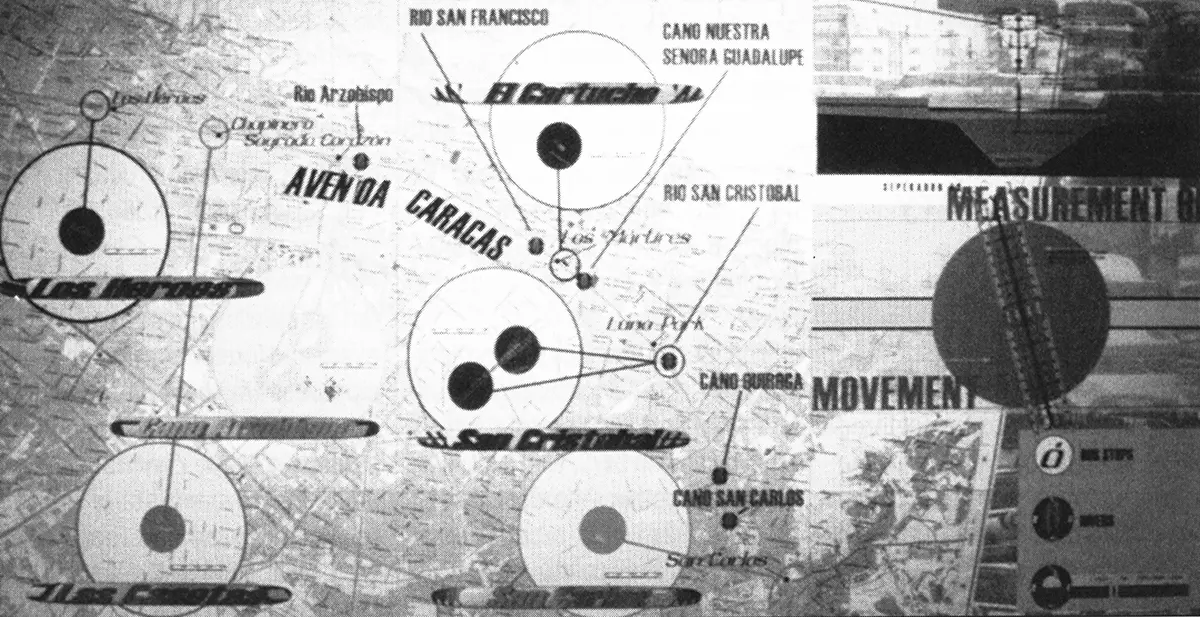
The observation and recording process was guided by the theme of memory and took account of the juxtaposition and collision between the natural landscape and the constructed landscape, the collective ritual and individual rites, as well as collective vs. individual rhetoric. This recording process, the results of which appeared in the exhibition in the form of graphic posters, offered a multidimensional reading of space, with its events and people, and in particular, those elements of popular urban culture which are present along the avenue, subsequently translated into various proposals concerning the status of the road as a corridor line, its significant segments and the residual places which can still be found in each of these segments.
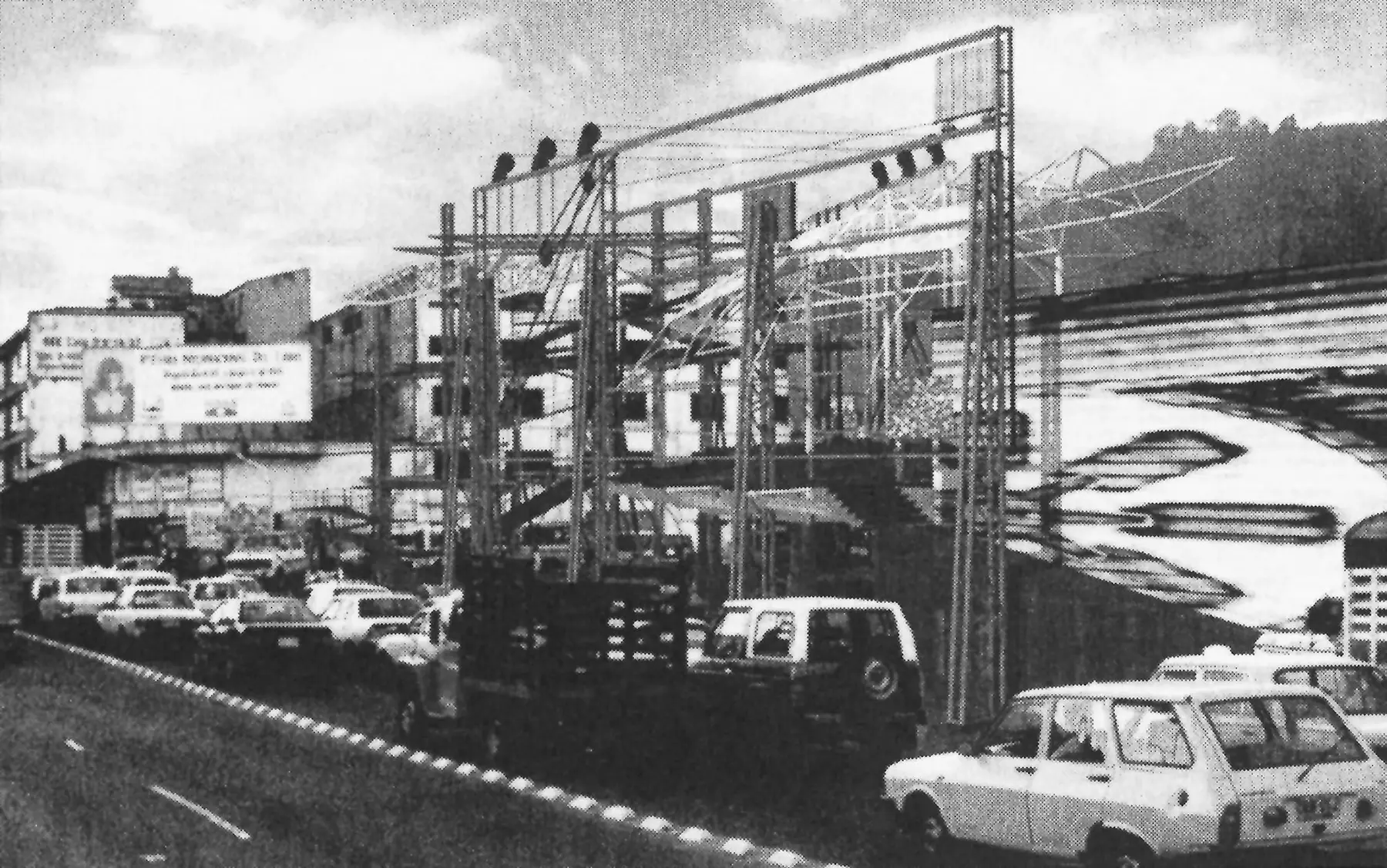
The focal point of the project lay in the specific projects located in eight strategic places along the avenue. These projects, called factories, are large-scale interventions in which the architectural structures are fused with various kinds of elements: natural, graphic, and luminous, to create the desired points of reference and emphasize the memory of the place. The metallic structures rework the theme of urban posters in various interpretations of scale, form, and content. The meanings are related to the memory of each place as well as its urban geography. The names are eloquent and suggest something of this content: Factory of heroes, Factory of knowledge, Factory of the body and mind, Factory of recycling, Factory of water, and Factory of entertainment.
The presentation of an urban project is not always an artistic event. In most cases, the reference concerns merely the presentation of plans and descriptive records. This was not the case with the Caracas Avenue project. On the one hand, the projects were of an aesthetic kind, in particular those placed at the eight points along the road. The large metallic structures have in each case a different function and their spatial expression acquires in more than one case the size of an urban sculpture. The computer-based graphic work provided an unusual account of each proposal and the composition of visually attractive elements. The show also included a series of objects referring to the public transport operating along the avenue, in particular the elaborate radio equipment which is a feature of the buses in Bogota.
The city as an art theme has been interpreted and often misinterpreted in various attempts at embellishment, to say nothing of the disasters caused by the pragmatic view that things that are cheap are good for the city. This project transcended the barriers of the purely utilitarian and raised a larger problem concerning the reinterpretation of urban memory, the construction of meaningful places, and above all, the creation of elements that renew the meaning of art, and place it within a contemporary context of experiences and multiple meanings, as befits a city made up of many different cultural personalities.
The preparatory process of this project continues. Part of this was included in the show titled Fragility: Art and the Environment which was recently presented in Bogota at the Museum of Art of the National University of Colombia. Let us hope that City Hall in Bogota will become interested in it and promote its development. This would undoubtedly change the face of the city and would provide an unusual and interesting example of aesthetic reflection on a Latin American city.
ALBERTO SALDARRIAGA ROA