Although this exhibition features paintings, sculptures, and installations from the past ten years of María Brito’s highly respected career, the themes and materials that are now so distinctive to her work have emerged after an even longer period of development that actually encompasses her entire life. Born in Cuba, María Brito came to Miami at the age of thirteen and was raised in a bicultural world. A member of "The Miami Generation" of artists who were educated entirely in the United States, and often express the struggle to reconcile the memories of the past with the realities of the present in their work, she developed her own visual language to deal with the sensitive issues of acculturation and identity. Brito’s imagery is based on a personal system of meaning and symbols that manifests itself in paintings and objects, often in combination and in installations.
The exhibition’s title, Rites of Passage, is a key to not only this selection of works but to all of her works. While she may now have matured beyond what one associate with the adolescent rites of passage, as a woman she identifies life’s experiences with a never-ending sequence of journeys. This sequence is at once personal and universal, and one does not have to be a woman or of any particular age to appreciate the rites that she is describing, or the hopes, joys, and fears that dwell within such hallowed concepts. Rites of passage imply deep references to the soul that inhabits each of us and is a determining force in our existence and relationships.
It is not difficult to identify the artist in all of Brito's works. Whether realistically described in a self-portrait, or surrealistically implied by her very absence, she is present. The viewer is invited to travel with her either physically or metaphorically as she embarks on life’s journeys. We recognize her as The Juggler (1989), an artist/virgin/saint fulfilling maternal duties while attempting to find her own place and just reward. She is The Traveler (1993), displaying her own version of the stigmata in a medieval cell, as paint seeps like blood out of its construction into a metal bucket below. Although she is absent in Self Portrait (1989), the fiery contraption that is as much of a wheelchair as a trap, the allusions to self are obvious. At the same time, she uses art historical references as subtle devices of martyrdom and pain. Appropriating iconography and imagery from art history’s past enables her to recontextualize personal issues in startling new formats that emphasize over and over her strict Catholic upbringing and its effect on every aspect of her life. These references are also a means to experiment with new media and techniques that lend their own richness to her extraordinary combinations and constructions.
The large sculptural constructions and installations that are perhaps her most distinctive works have allowed María Brito to explore beyond her immediate self and create entire environments for her life's journeys. In Merely a Player (1993), the largest of her installations, she evokes the pain of isolation, the shedding of masks with their pretense of false roles and identities, and the quest for eternal peace. In a small house that is as much a laboratory of self-introspection as a trap that warns of the errors of the past, torn photos and documents vie with the pristine equipment of scientific experimentation for attention, as a film of a child knocking repeats through a tiny peephole. As one wanders through the house's claustrophobic corridors, fraught with anxiety, trap doors lead to nowhere and the ladder of escape has rungs covered with spikes. Life’s journey is clearly fraught with danger. The same theme of entrapment and fear appears in other contraptions and installations. Their messages may be understood within the realm of the artist's personal experiences, but they should also be read as commentaries on life’s injustices and false expectations.
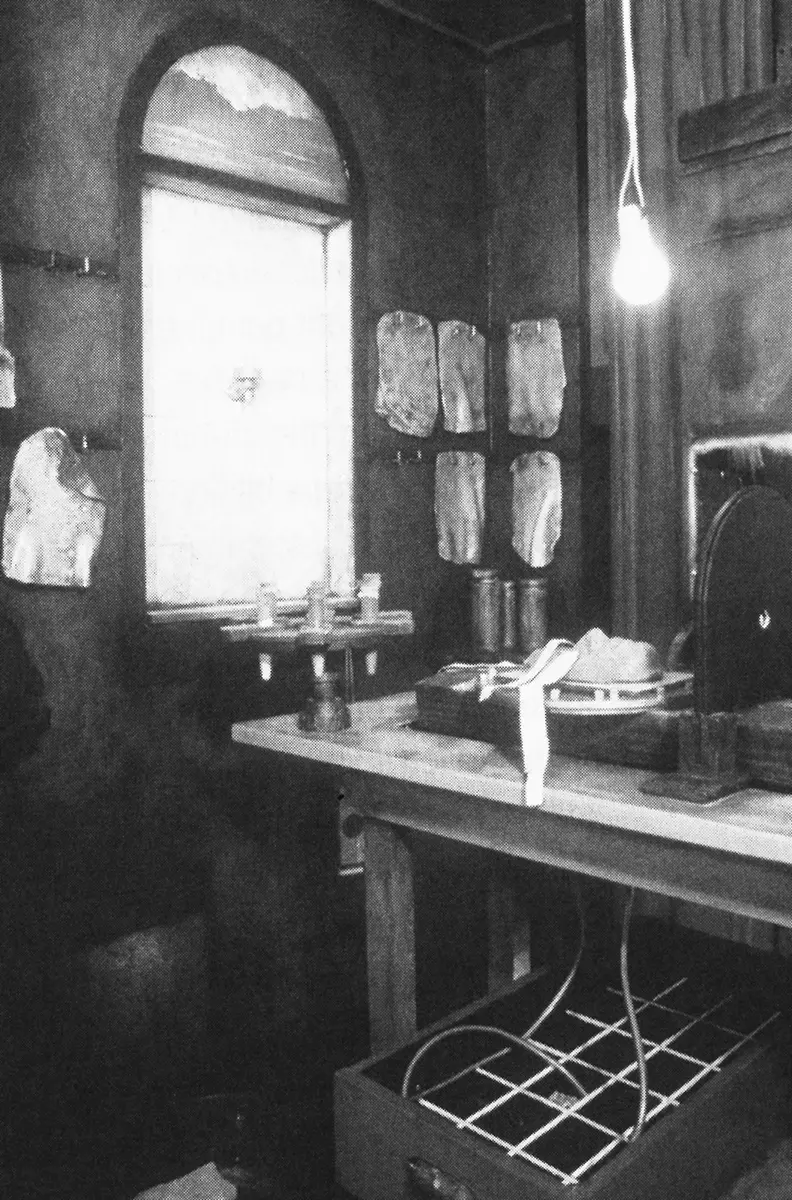
The large self-contained installation titled Trappings (1995) is another view into Brito's personal laboratory of time and place. Complete with a plaster cast of the artist’s face set upon a plank of wood and surrounded by the strange apparatus that is being used to prepare the “flesh” for its final makeover into a new person, the “operation" is cleansed by holy water that flows from a spigot. Painted in a Renaissance palette, the room is veiled in plastic curtains and layers of cloth, but the effect is decidedly bizarre. The “flesh" hangs on the wall and a peephole allows a glimpse into an even stranger image, that of the Virgin and Child set within a birdcage. Was it the Virgin that set the standard by which one must live? Can anyone hope to live up to such expectations?
The most recent paintings in the exhibition present a new direction for the artist, away from the clutter of such bizarre Baroque sensibilities into a more minimal and direct statement. Still somber in theme, these paintings include sculptural elements mounted within the surroundings of a dark panel that plays upon surface textures for its effects. The image of a baby floats against an earthly void and dusky sky in Becoming (1996). Strings float above, ready to attach a lifeline, and lifetime of dependency. For María Brito, the rites of passage appear to have come full circle, born of a new hope that the message she delivers with such serious commitment will finally be heard.
CAROL DAMIAN