
Priscilla Monge has a special and highly personal view of cliché and taboos, and denounces the givens of "the feminine and masculine" with a very subtle and biting refinement, preferring insinuation and humor over cutting or radical postures. She can represent the cliché of masculinity by turning to sports, and that of femininity by making reference to domestic and artistic chores.
Monge observed that women, from the beginning of time, instead of inventing, creating, or playing the lead role in events, have been systematically pushed to one side of the action and of creation, reduced to the passive role of spectators and perhaps witnesses in writing. In response, rather than painting on canvas, she began using it as a sheet of paper and taking up the brush to write texts. Later, she would exchange the brush for the needle to fully touch upon the theme of sewing, traditionally the reserve of women and one of the most celebrated traits of femininity.
"Upon leaving the School of Fine Arts in San Jose, I began by painting a bit. Right away I preferred writing texts on fabric because I had read a book by a British feminist who commented that the inveterate habit women have of writing down what happens to them is due to the fact that they have traditionally been forbidden from the action. So I began by imitating recipes that indicated what ingredients were needed and what to do with them. I set about writing on the canvas, not a recipe but rather some sort of superstitious advice that explained, for example, how to catch a man, how to turn him into your slave, or how to kill the pet of the woman next door using a recipe for poisoned meat. I colored the texts with Indian ink, coffee, or tea and then ironed them to fix the colors."
But for Monge, the incorporation of embroidery represented the integration into her work of an activity attributed to the women in her culture from ancestral times and at the same time, was a sort of homage to crafts—neither of which prevents her from questioning the current validity of that very thing nor of denouncing the element of seclusion and the silent, homebound work it has represented over time for women, separating them from the tasks and decisions of active society.
"I made many pieces using embroidery. The first thing I made was my signature, embroidered on small squares of canvas because, for me, my signature embroidered on cloth seemed a kind of self-portrait. The embroidery was done by a computer on sackcloth, linen, or canvas."
The first pieces of embroidery were substitutes for the painted text. But one day a book fell into her hands that would give her work an even greater sense of commitment and incisiveness for the book was the confirmation of how aggressive, hypocritical, and cruel the Costa Rican society of the nineteenth century could be. The book described a series of death sentences in which witchcraft was mixed with some ritual.
"I happened upon a book that described death sentences of the period in great detail. What most caught my attention was the account of a married man who, after having murdered the lover of his wife, was condemned to death. They first hanged him and then stuffed him in a sack together with various live animals (a monkey, a snake, a rooster, and a dog). After having made the traditional request for permission from Guatemala, they threw the sack into the lake at the Royal Hospital of San Juan de Dios. I made a series of these death sentences embroidered delicately on linen. The sole alteration made to the original document was the replacement of certain words with small pictures embroidered in the style of scholarly books that seek to facilitate the reading. In this way, if one doesn't read the text, the embroidery gives the impression of something very sweet and pretty."
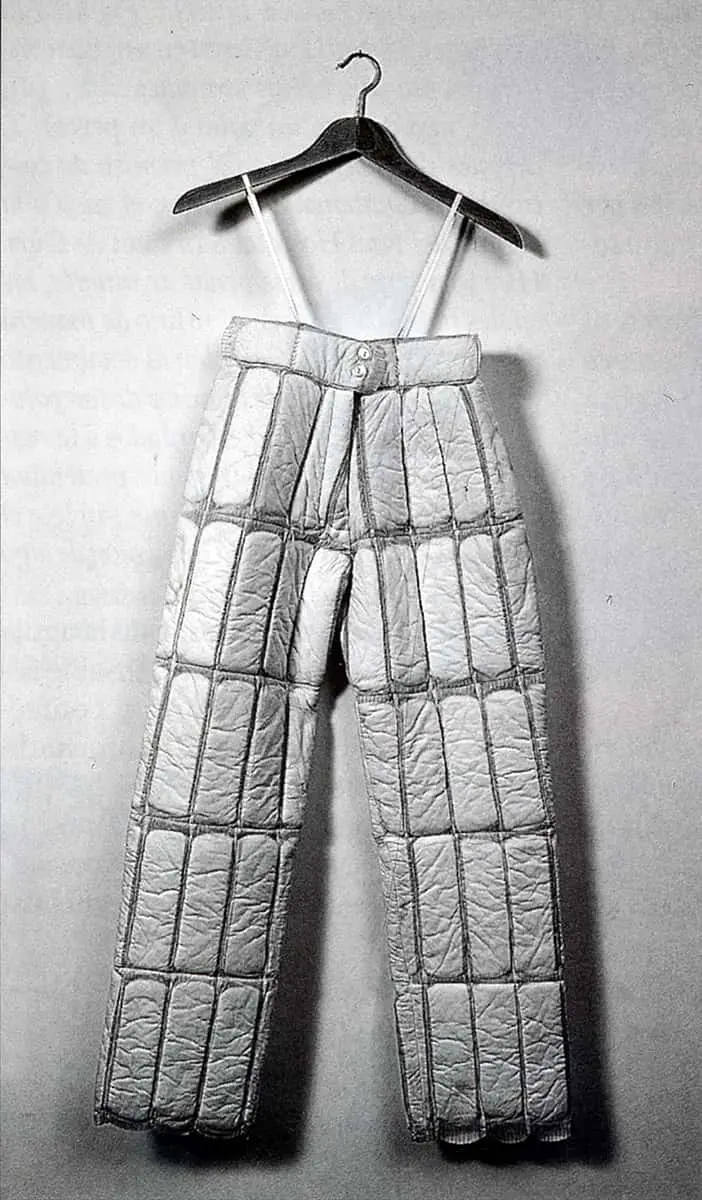
She soon took another step forward and from the needle and embroidery advancing to that indispensable activity called "dressmaking". The first step was to make articles of clothing (pairs of pants) not from cloth but rather with panels made up of those familiar sanitary napkins which she assembled as if in strange boards, passing imperceptibly from humor to sarcasm.

"The choice of sanitary napkins as the 'material' for making the pants was inspired not only by their obsessive promotion on television but also by the fact that throughout history blood has always carried the connotation of taboo, has been associated with dirtiness, sickness, and finally, with death. In some religions the woman herself becomes taboo during her menstrual period: she is unable to approach men and is not allowed to perform impure domestic tasks. Nevertheless, no value whatsoever is given to the vital, positive connotations of the menstrual process. I presented this work in 1996 in my exhibit at the Thomas Cohn Gallery in Río de Janeiro. This year I have taken up the theme once again and created a series of street performances: I put on one of these pairs of pants, smeared them with blood, and then went to the center of San José to set about my daily activities—talking on public telephones, waiting for red lights, etc. All of this was documented photographically and on video. I was seduced by the idea of going to a public space and making visible something that is generally hidden and very private."1
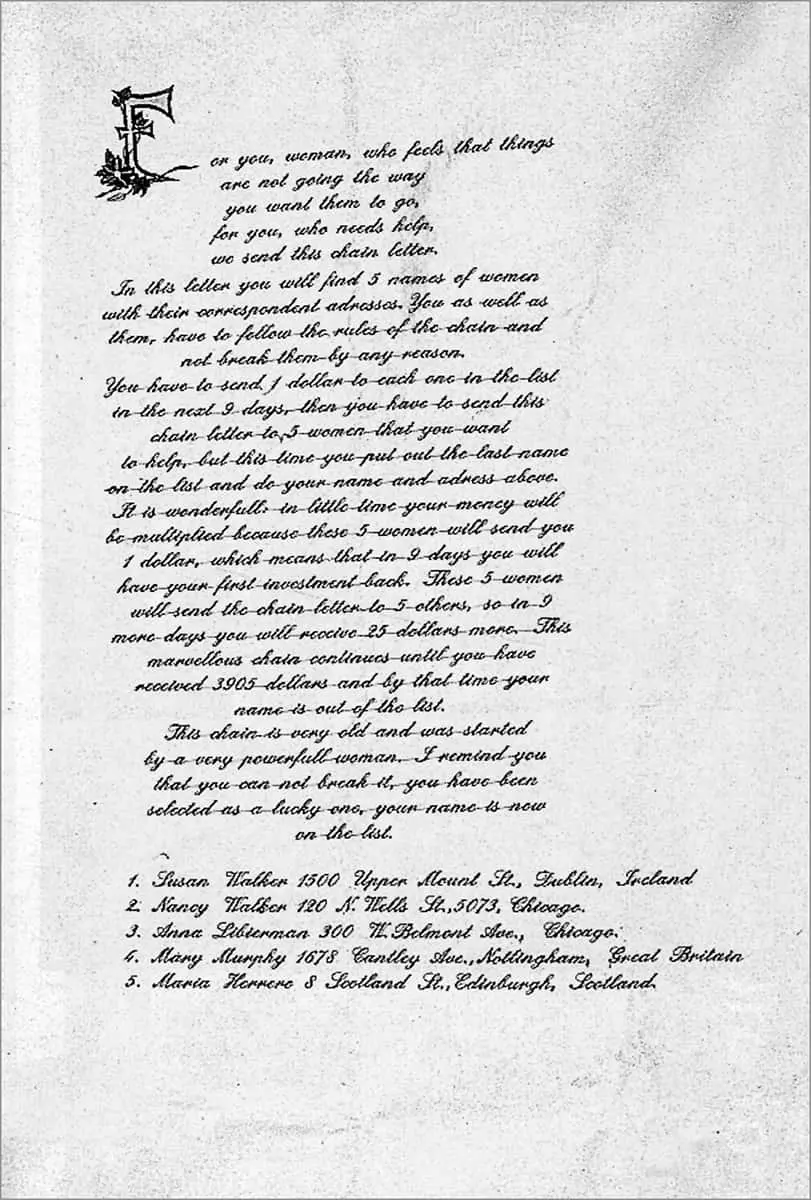
Without resorting to outright or aggressive denunciation, Monge prefers to speak in the second person and to appeal to that which is implicit. Thus she is inspired by the very widespread superstition of the chain letter, emphasizing its inconsistency and its pretension to dominate the individual by means of the timeworn recourse to fear and lies—both common tools used to dominate not only women but individuals in general.
"My work based on texts continues to hold great interest for me so that after the executions I proceeded with a series of chain letters. As a teenager, I received a chain letter. Frightened and not knowing what to do with it, I photocopied it and went to a parking lot where I placed it on car windshields. The second time I got one I decided to make use of it. I embroidered the letter as I had the death sentences, without changing a single word, remaining faithful to the original document".
"This chain letter claimed to have been started by a priest in California and had to continue on its way within ten days should one wish to avoid grave danger. It described how one man had broken the chain and was run over by a car, and how a woman broke it and had a miscarriage. I am very interested in how terror is used as a mechanism that makes it difficult and on occasions, impossible, to act or react in the face of certain situations. The chain element is also important: the sequence that must not be broken and which causes an individual to continue something she ought not. I worked on and off with chain letters from 1992 to 1997".
Her method highlights the long-inherited indirect route by which women have always found, as they have learned by having it beaten into them, that to assert reason through direct confrontation inevitably leads to disqualification and failure. That is why Monge goes back to the old wisdom that attempts to please and gratify to the point of achieving a trust that leads to dialogue which, in the long run, allows her to convey her ideas, to introduce and even to impose them.
She might allude to the silent work of the home in thousands of ways. In the last season of ARCO, the Jacobo Karpio Gallery in Costa Rica showed one of her works, apparently innocent but in fact, charged with purpose. The slow, silent, domestic activity of ironing was represented by a burn mark on a cloth made by iron in a moment of distraction. No woman, despite the routine and monotony of her work, can allow herself the possibility of having to correct the unwanted and unintentional 'accident' through additional work.
"In fact, it is the trace left by a burning iron on a piece of fabric entirely covered with silver, shiny glitter indicative of festivity. I felt the desire to assault that glamorous, ephemeral, and frivolous brilliance, to demystify this tinsel-for-a-day with the stamp of what is, in reality, a common object."
And just as Monge doesn't conceive of the world as inhabited by only one sex, she takes a look at men. If women are attracted most of all by domestic work that ensures their absence from the action, she personifies men's masculinity and machismo in one of their most universally popular pastimes: sports. And within the realm of sports, she begins with the one considered the king that sways the masses—that is, soccer.
"I am very interested in the phenomenon of soccer and in the passion, it awakens not only in Costa Rican society but throughout Latin America; I am interested in the camouflaged violence that takes place at all levels, by which many soccer games end in veritable catastrophes, events that are widely used by sectors of power to hide behind the 'passion' unleashed by these games."
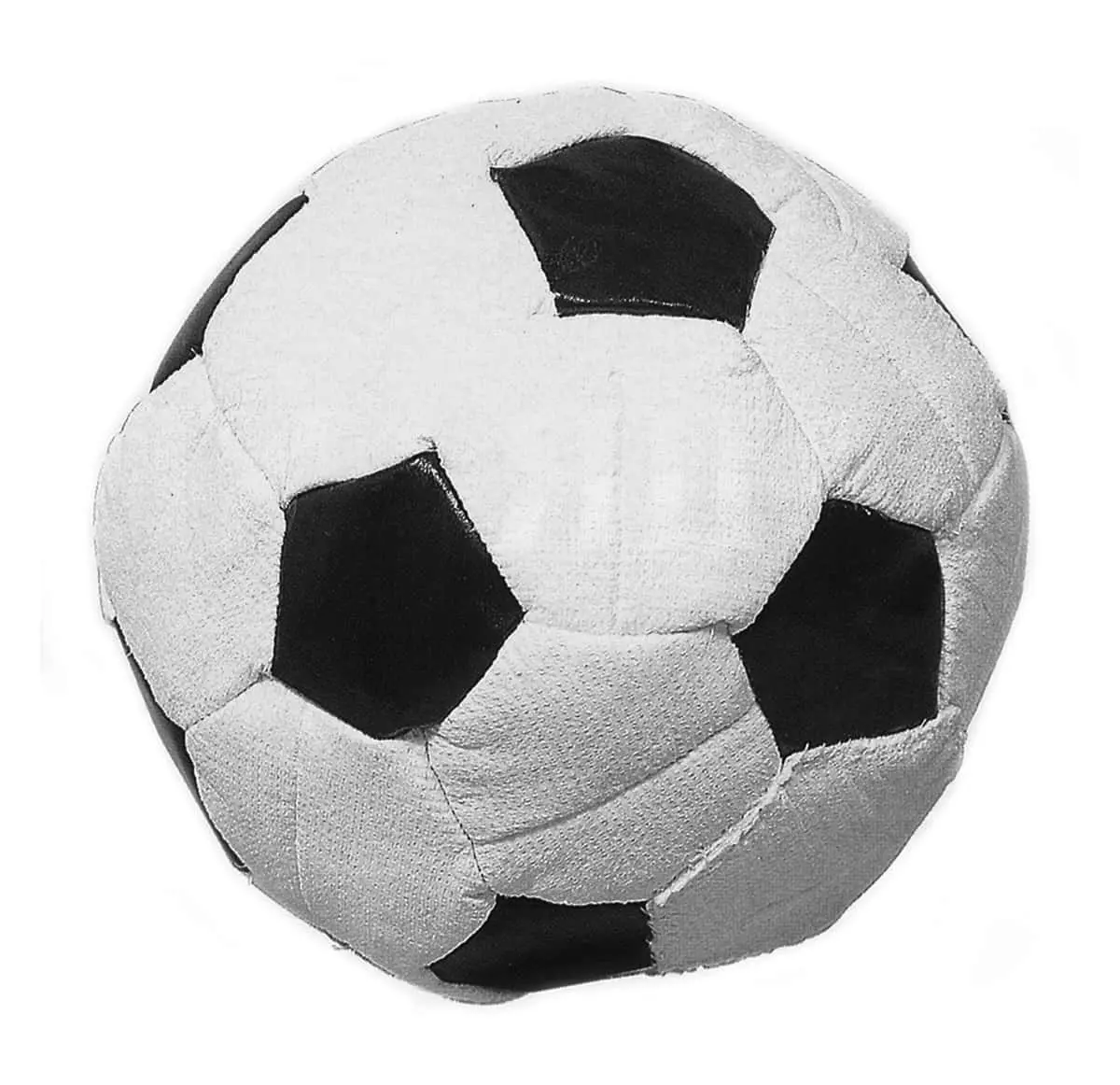
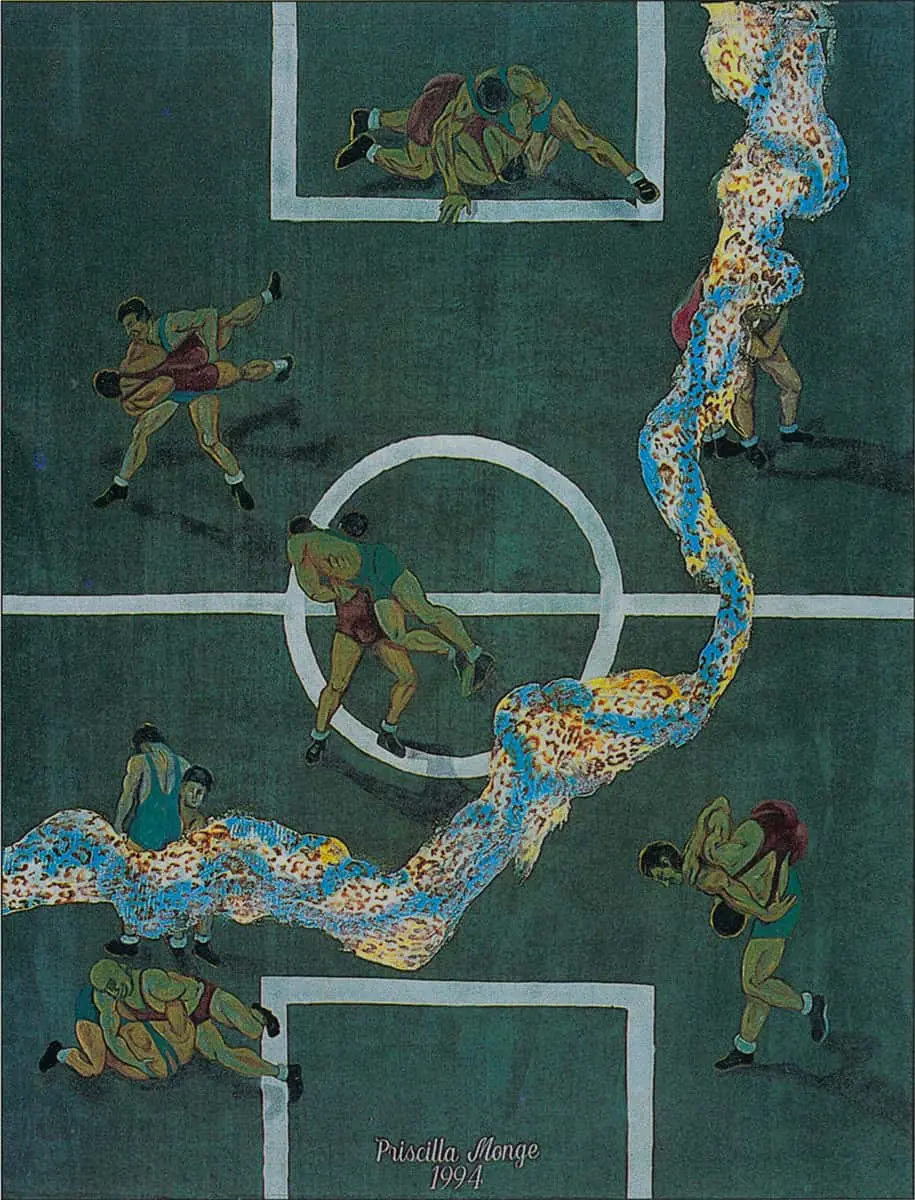
"I tackled this theme while I was still in school when I was laying out fabric in the style of soccer fields, the painted players engaged, rather than running after the ball, in a sort of Greco-Roman wrestling that conveyed both very violent and very sensual qualities, producing intimate contact between the players, almost sadomasochistic. I worked on this series of soccer fields for some time, one of which was acquired by the MEIAC in Badajoz. I took up the theme again recently, making soccer balls out of white sanitary napkins and black leather."
Monge does not limit herself to highlighting the identification of supposed manliness with violence but rather touches on the irrepressible appeal that sports with mass audiences exert on their fans who are drawn like flies to honey; she seeks the resemblance they have with the flies and the sweet liquid.
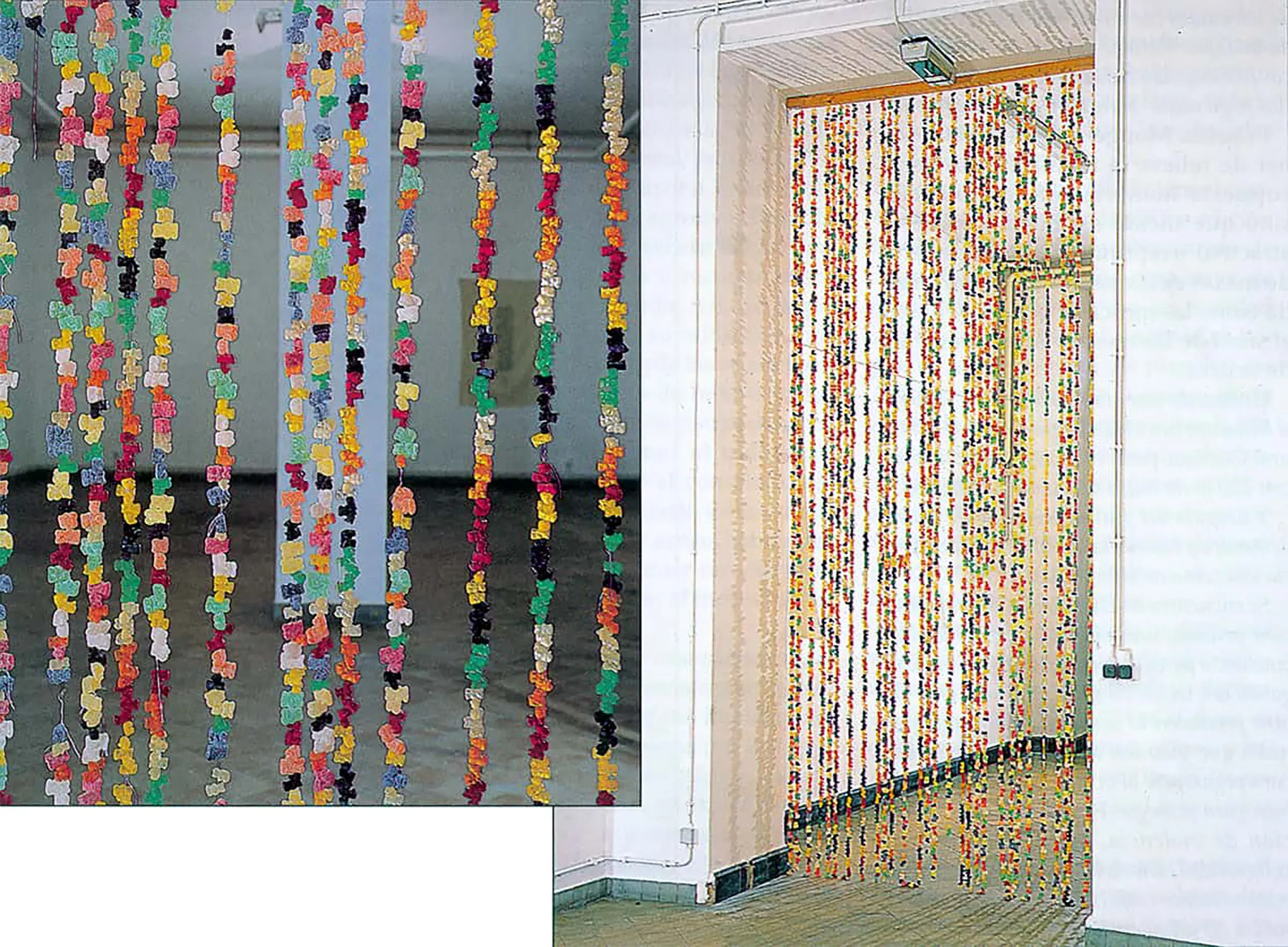
"Taking up this resemblance, I exhibited in the Museum of Van Hededaagse Kunst in Ghent in 1996 Cortina para moscas (Fly Curtain), made from 120 meters of threaded sugar bears."
"Following the great popular spectacle of Latin America, the denunciation of violence takes boxing as its metaphor."
"In Dusseldorf, in a private collection, an installation I made with fifty pairs of boxing gloves that hung from the ceiling. Their proximity to one another created the impression of numerous nests that were concealing something. The glove is used for hitting but at the same time, it serves as protection. To accentuate the sensation of violence, uncertainty, and danger, one of the gloves concealed a clockwork mechanism whose tick-tock was amplified by means of a miniature microphone and a speaker, giving the sensation that this sort of mechanical heart could very well be a time bomb".
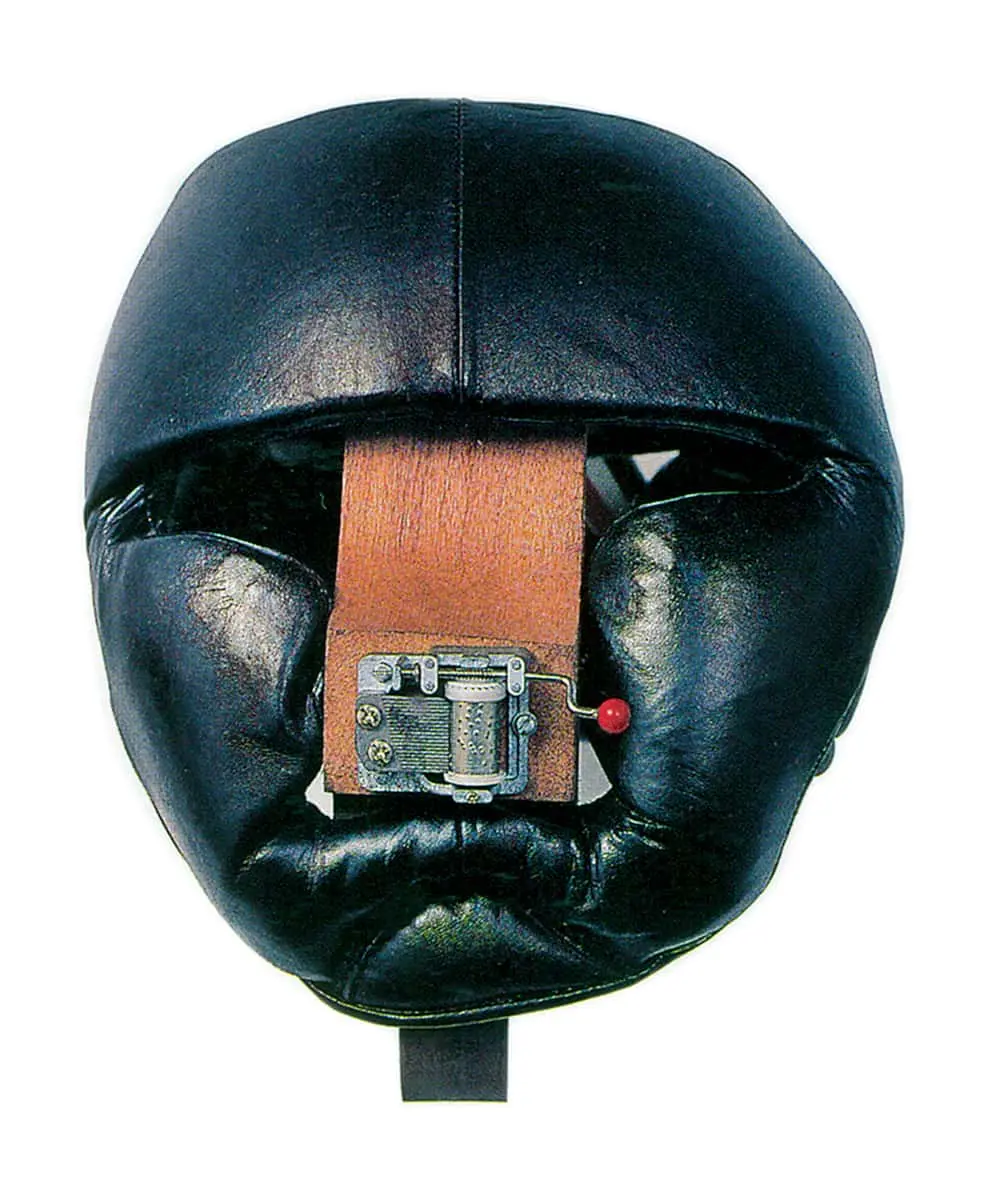
In the last Havana Biennial, Monge presented an installation titled Callése y cante (Shut Up and Sing) which proposed, by reductio ad absurdum, a reflection on violence and freedom of expression. This time it was not a matter of an implied time bomb but rather of contrasting aggressiveness and art, boxing, and music.
"In the Sixth Havana Biennial, I presented an installation made of eight boxing masks made of black leather mounted on metal and wood, giving them a form similar to that which the head might have inside the masks, thereby managing to 'steal' the identity of he who uses or might use the mask, seeking its ability to conceal. I took the part corresponding to the mouth and replaced it with music boxes of the kind one finds in jewelry boxes or stuffed dolls. The tiny boxes were stripped of all ornaments and reduced to their most basic form. They had cranks which, when turned by the spectator, produced a variety of tunes, like Ravel's Bolero, Beethoven's Fifth Symphony, the Wedding March, or Chaplin's Limelight. The music alludes to the title of the piece, Cállese y cante. I was drawn to the fact that in Latin America when someone is interrogated by the police, one says that the person 'sings' when actually they mean that he says what he knows. Another thing that interested me was the fact that there are therapies for people who stutter in which the act of speaking is replaced with singing. In this work, the act of singing becomes a vehicle like a means of communication and catharsis, becomes a vehicle of physical violence and psychological abuse."
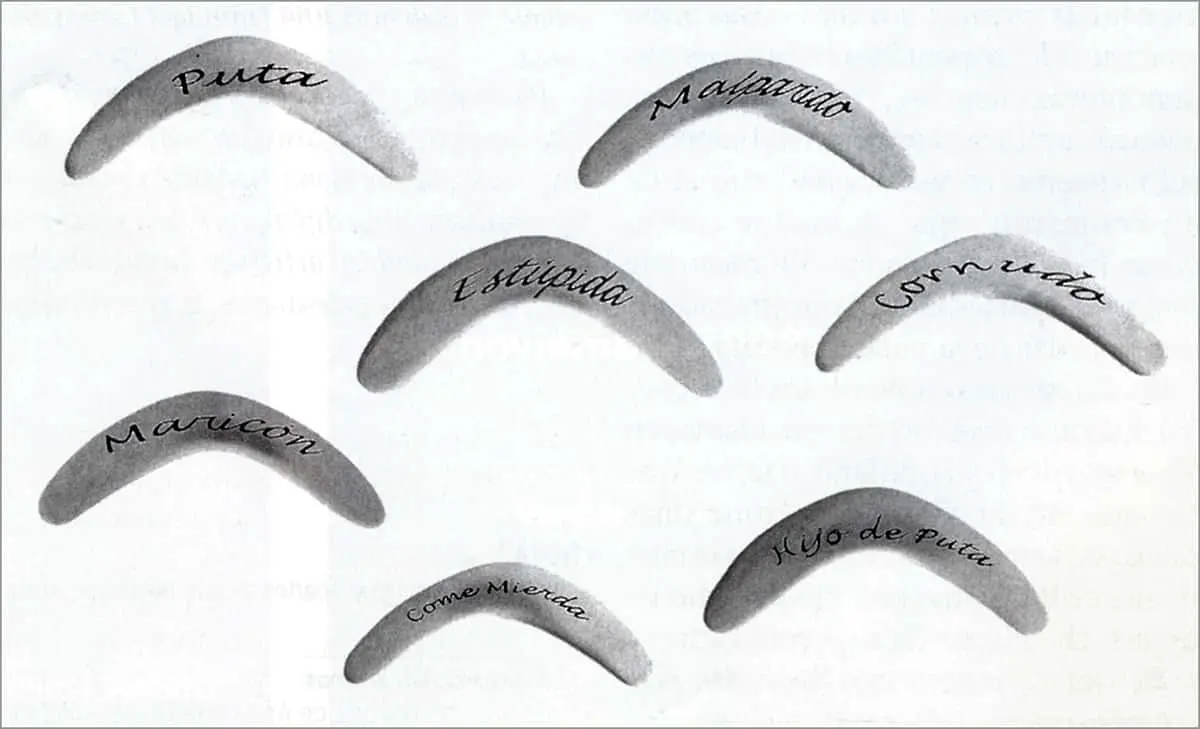
The theme of the supposed identification of masculinity with aggressiveness, and of femininity with passivity has led her to make a highly ironic work where sanitary napkins become the white segments of a regulation soccer ball which previously displayed a symmetrical alternation of white pentagons and black pentagons. Going one step further, she illustrates the impact of violent spectacles on society by way of a boomerang that flies back toward the person who throws it, making use once again of another craftsperson's technique, pyrography, and once more the written word.
She is furthermore able to turn the Huevos de oro (Golden Eggs/Balls), the supreme attribute of male chauvinism, into something so trivial and commonplace and at once so fragile and irrelevant as a bunch of empty eggshells that seem to shine like gold, displayed in a simple and common supermarket carton.
"I have left my country often but have never lived abroad. Shortly after meeting my boyfriend, I went to live in Belgium where I find in artists of my generation a tremendous fragility toward us Latin Americans. Not because they are highly committed on a political level but rather, because of their twisted temperament. And speaking more specifically of my country and Belgium, I find that they share the same passivity and apathy. In both 'whatever' is a quite common phrase."
"To move from one country to another always takes a lot of energy. In my particular case, as a rather timid person, it has been quite difficult, not only on a personal level but also on an artistic one. I tend to work in the style of an artisan and finding myself in a totally industrialized country like Belgium has affected several changes in me. In order to realize some of my pieces, I find it necessary to return to Costa Rica. Everything changes—the galleries I work with are in Latin America, many of the projects I have are outside of Belgium or my country, and so my work has undergone a considerable shift so that these projects must inevitably become magicians of a sort who pull everything out of a hat, or in this case, a suitcase."
"So, in reality, I always return to Costa Rica to work, like the criminal who always returns to the crime scene."
NOTE
1. This text contains fragments of the interview that Maria Lluïsa Borràs did with Priscilla Monge in Spain in March 1998.
MARÍA LLUÏSA BORRÀS