Rosana Fuertes (Mar del Plata, b. 1962) occupied the large room in the Benzacar Gallery in August and September with imagery that promised one thing and delivered another. At first sight, her painting, full of popular icons, commercial firms, political symbols, and everyday objects—some beautiful, but never complacent, despite the placid, almost sugary-sweet colors-appears pleasant and even innocent, but it proposes a discourse that attempts to bring into the open what need and ignorance hide. Fuertes does not attach value to the signs that she uses —everyday, sacred, banal, sinister, pleasant— preferring to allow the spectator to establish their own categories.
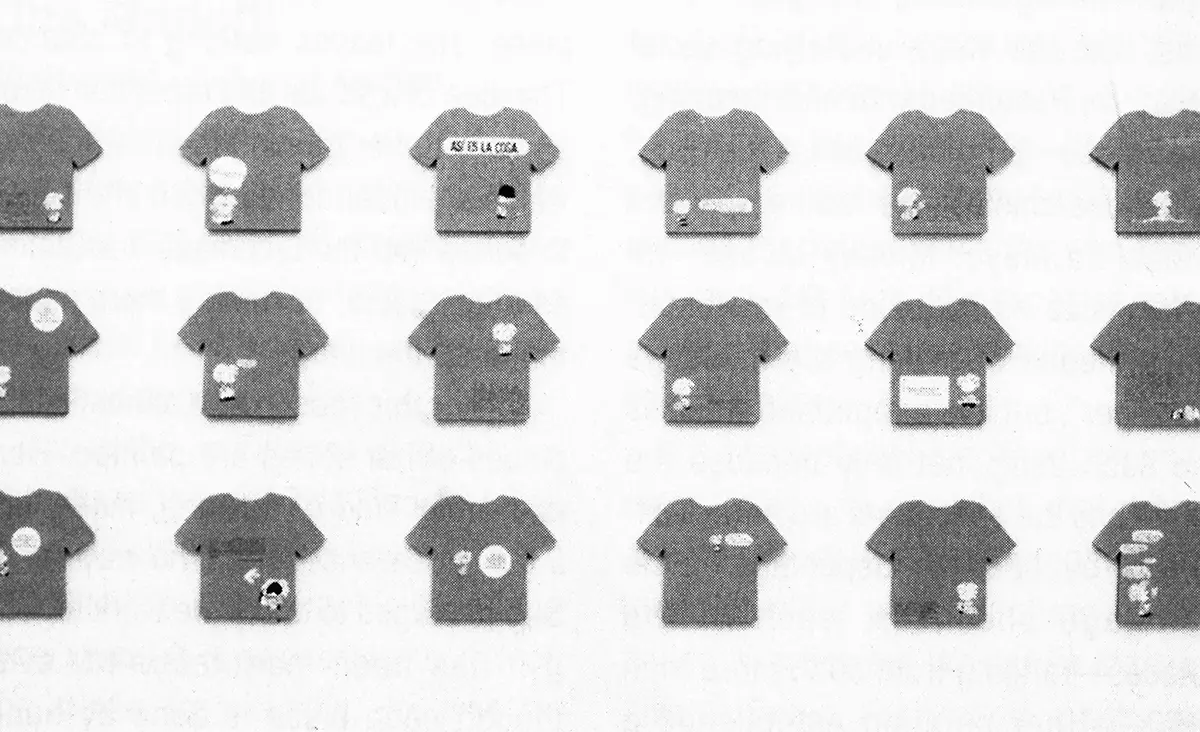
The artist divided the Benzacar walls between two "Migueles" with local and international history, engaging in a serious game of contrasts. On one side, with striking colors and fragments of figures and onomatopoeic elements, she painted a mural on which she placed more than 30 pictures (36 x 36 cm.) of Disney’s Mickey Mouse, who springs out from between abstract backgrounds, figurative motifs, political elements, maps of Argentina, the image of Che Guevara and of President Carlos Menem, ordinary-looking images, hearts, and fruits. Opposite, there were 250 T-shirts with the figure of Miguelito, the philosophical friend of Mafalda— the comic strip figure by Quino— as the protagonist. Miguelito appears in all the T-shirts (measuring 18 x 22 cm.) which are in the same rather neutral green color. Miguelito, in black and white, appears alongside phrases by writers, politicians, artists, journalists, Argentineans, or fragments of texts by Quino, uttered by the little protagonist.
David against Goliath? It is the eye of the beholder who must decide whether the magnificent mise en scène by Fuertes is more battle than a dialogue. These seductive images, simple in their complication, seem to question two societies, with their different values and aesthetics. The North American hegemonic culture is expanding without limits and Disney has become a passport to history.
At 36 years of age, the artist has had a career distinguished by its coherence. She is a woman full of ideas who still reminds one of a provincial school teacher, with an open smile and strong convictions.
Her work—painted on a square board, in the form of a T-shirt— looks like a picture book for children, where there are no stereotypes and where the message is clearly against authoritarianism. Indeed, in a country like Argentina, where education is constantly losing ground because of a lack of funds and where teachers constitute one of the few pockets of organized trade union protest, her artistic work, so close to the school environment, gains strength from its elements of resistance.
With her almost childlike drawing, Fuertes manages to make the appearance of her painting contradict its essence. The candor of her colors, the insignificant objects, the flat silhouettes—all ingredients of pop art—contrast with the sharp underlying social criticism. Reworked with new meaning, the figures—a T-shirt, a ball, a fried egg, a handkerchief of the Mothers of the Plaza de Mayo, Mickey Mouse—all emphasize a silent kind of repetition" as a means of making the message stronger”, but it is a repetition which is no such thing, not only because the artist and the spectators are always different, but because, depending on the montage she uses, each of the pieces—ranging from 50 to more than 250—of her painting establishes a changing dialogue, that is different from the meaning given by the previous context.
The T-shirt series, which she presented for the first time in 1992, began as a game that is still continuing. There are more than 400 scattered throughout the world. The T-shirt —in this case, the 250 Miguelito's—is like her favorite son, a trademark of sorts. Fuertes began by using the T-shirts of the 27 or 28 football clubs in Argentina and ended up appropriating the article— which by its colors and inscriptions reveals almost automatically where an individual has come from and which is, furthermore, an almost perfect advertising medium —to develop a quintessentially local work which has paradoxically, become better known outside the country than in Buenos Aires.
Fuertes’ works are of rare perfection. The enormous patience with which she cuts, paints, and glues reveal that she is a woman who uses her manual skills as a means of fighting against oblivion. But the almost industrial precision of her brushwork seems to establish a distance from any sense of facile irresponsibility. She endeavors to make the lines as flat as possible so that we hardly notice them or think that they have been printed. The technical excellence of this kind is a hallmark.
Fuertes, who works in large series of small works, where there is a strong conceptual element, says that her painting is much more mental than that of other artists since she knows in advance what color she will give to each element, rather than deciding in the course of her work. Before beginning a piece, she leaves nothing to chance. The idea of a series and repetition takes us back to her training in print-making, which she abandoned when she began to sense that the technique was acting as an obstacle, becoming more important than the image.
It is for this reason that almost all the pieces of her series are painted. Hers is a prolix kind of painting, ingenuous in its appearance, but in no way naive. She manages to make the work look as if it has been manufactured, even though each piece is done by hand.
Drawing is fundamental here because she first works each element on tracing paper and then moves on to the cardboard image, which she repeats and stores in school notebooks which she carries around like a portable archive. In her very personal register, she incorporates motifs of objects which she has used in other works: abstract, geometrical, and political elements, letters of the alphabet, comics, photographs, letters, oriental print, numbers, and T-shirts dedicated to other persons. The daily newspapers, the smudged corrections of her pupils, the figures she draws, and the random ideas which she writes, patterns, and modules, all these are part of her library of images.
VICTORIA VERLICHAK