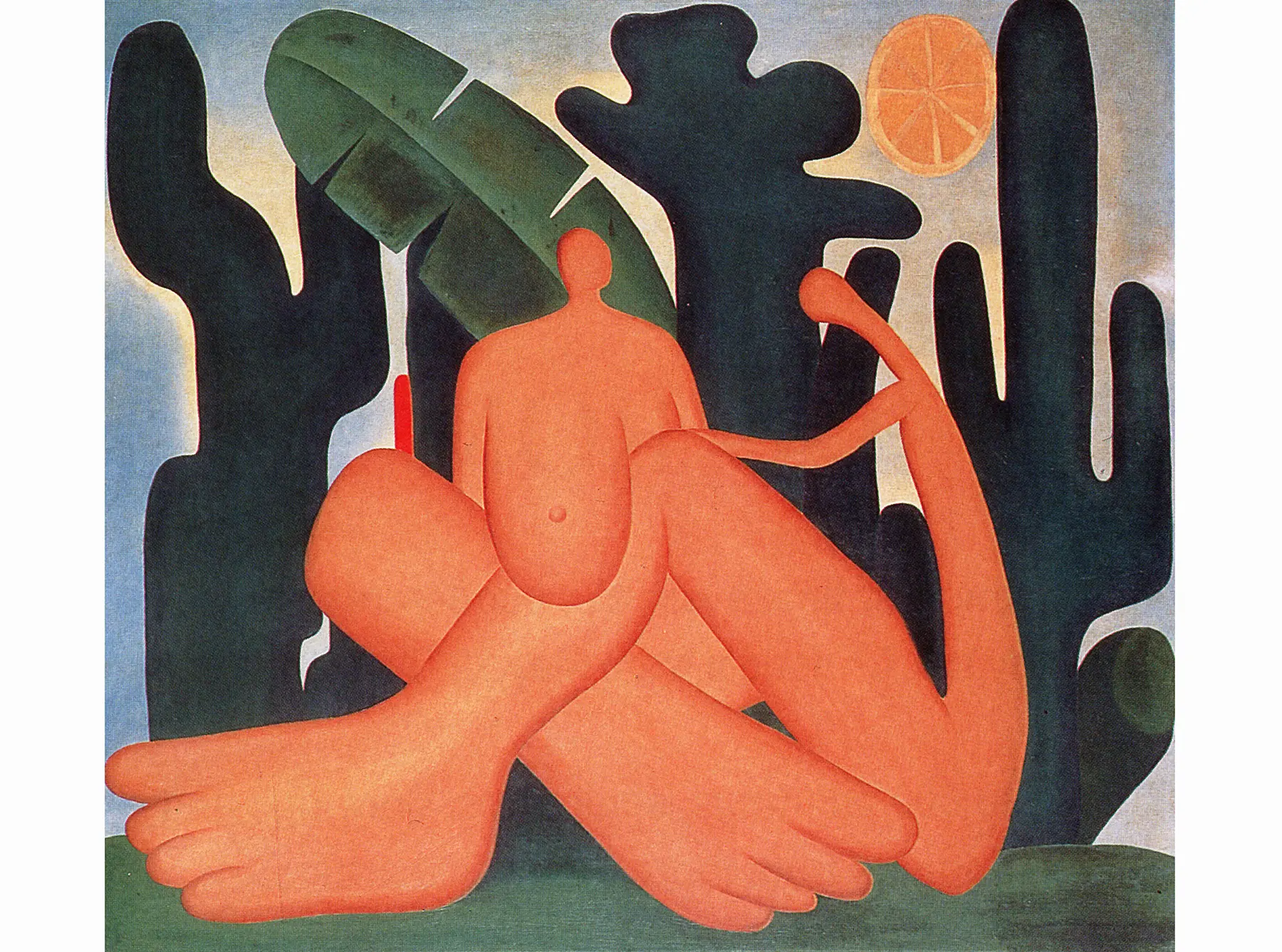
When the painting Abaporu by Tarsila do Amaral was auctioned off at Sotheby's, the impact on the Brazilian cultural world, as well as its repercussions throughout the Americas, confirmed once more that this artist is one of the essential figures in the history of artistic production in twentieth-century Brazil and Latin America.
Her work is occupying a prominent place in international exhibits of Latin American art, including those held recently in Spain, Madrid, and Barcelona, at the La Caixa Foundation in 1997,1 and another that took place in Brazil, in September of the same year at the S.E.S.I. Gallery,2 a retrospective that highlighted her production from the twenties. It is worth remembering that in 1993, Abaporu had been featured on the front cover of the exhibition book catalogue of Latin American Artists of the Twentieth Century at MoMA in New York. Now, in 1998, the São Paulo Biennial, taking cannibalism as its theme, finds in Tarsila a central framework.
Tarsila do Amaral was born in the state of São Paulo in 1886 in the San Bernardo hacienda in the small city of Capivari during the golden era of the coffee economy.
Coming from a traditional family in São Paulo, French culture was a fundamental reference point in her education and taste. So it was that Tarsila learned French and was able, from an early age, to spend periods of time in Europe and in Paris. She took her first trip to Europe in 1902 to study at the Sacre-Coeur School in Barcelona and, in 1904, visited the capital of France.
She made her first drawings while still a girl. They were small vignettes of the Catholic saints and drawings of animals taken from life on the hacienda.
She first studied art in Brazil from academic artists, and prestigious professors in the São Paulo society. She took classes in 1917 with the Swedish sculptor, Zadig, and with the Brazilian painter, Pedro Alexandrino. Shortly afterward, before traveling to Paris in 1920 to study at the Julien Academy, she studied briefly with the German impressionist painter, Elpons.3
In Paris, although she devoted herself to the academic study of the live model, she had the opportunity to observe new directions in art, particularly cubism and futurism, as she revealed in letters she sent to her friend, Anita Malfatti, another important Brazilian painter. From Malfatti, she received word in Paris of what was happening in São Paulo, a series of events that culminated in 1922 in the Week of Modern Art.
In Brazil, the Week of Modern Art represented a collective gesture that rejected the artistic status quo with the intent of creating a new spirit. It was an event that sought the most advanced artistic creation. The "Week" included exhibits of fine arts and architecture, panels on literature and music, concerts, song, poetry readings, readings of prose fragments, and dance performances—all preaching the abandonment of values bound to the old structures of society, expressing the longing to set in place a new, intellectual, modern mentality. There was an idealization of Brazil integrated with the European centers that were most developed and most active in the world of the arts.
Tarsila do Amaral did not participate in this event of ruptures, but returned to her country in 1922, a year of intense cultural effervescence to join the modernists.
In the group of modernists that included the poet-writers Oswald de Andrade, Mário de Andrade, and Menotti del Picchia, the musician Heitor Villa-Lobos, and the painters Anita Malfatti and Di Cavalcanti, she was one of the driving forces in the dissemination of modernism in the country. It can be said that in the visual arts of the twenties, Tarsila do Amaral was the artist who most successfully brought together the fundamentals of that aesthetic project in pictorial form.
In 1923, she returned to Europe, now with an eye turned to the new artistic proposals of the avant-garde. In this year she joined Oswald de Andrade, the most iconoclastic of all the modernists, an intellectual possessing a bold and persuasive voice, author of the Pau-Brasil and Antropófago (Cannibal) manifestos. Throughout their marriage in the twenties, the work of each had to be studied and discussed, taking into consideration the interaction that characterized their shared life.
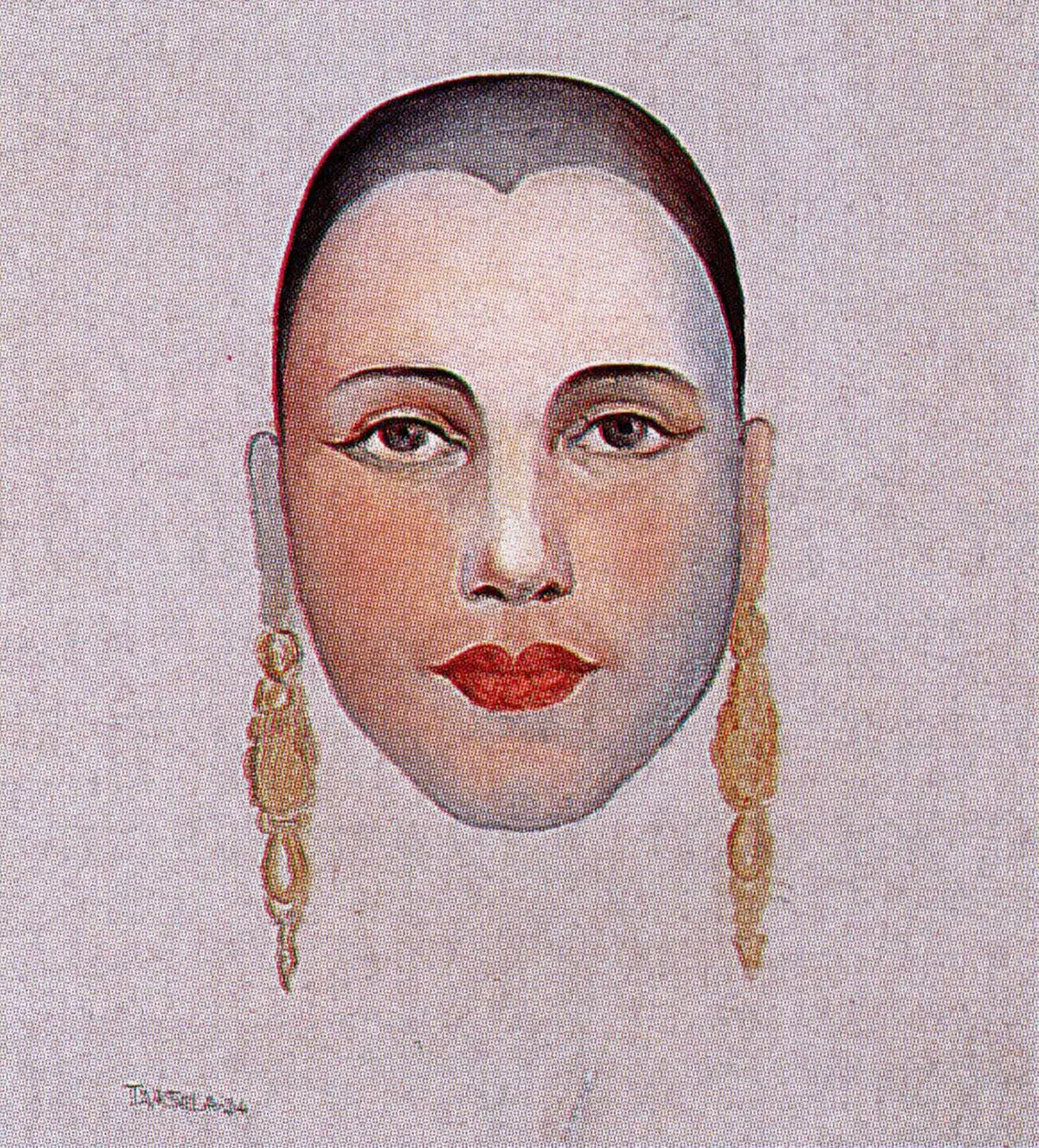
With Andrade, Amaral traveled through Spain and Portugal. In Paris, they rented a study at 9 Hégésipe Moreau Street, near the Place Clichy. She studied with Lhote and was in contact with Gleizes and Léger. It was during this time that she produced several of the canvases that would later become famous. She painted her Manteau Rouge Self-Portrait wearing the same long jacket she had worn at the dinner which she offered in homage to the Brazilian aviation pioneer, Santos Dumont. She also painted Blue Portrait of Sérgio Milliet, one of the Brazilian critics who most trenchantly commented on her work. It was Milliet who commented: "With Lhote, Tarsila learns the need to react against impressionism and crosses over the bridge of the academics of life to something new, synthesis, rhythm, movement; with Gleizes, the importance of geometry: geometry, the abstraction of the object, creation."4
Amaral's time in Paris, from 1923 to 1924, with Andrade, was marked by intense cultural life. She met Blaise Cendrars, the French poet of Swiss origin, who visited Brazil and became close with the modernist group, as well as Jules Romains, Jules Supervielle, and Valery Larbaud. "Paris became my world of wonders!" the artist would later say.
Amaral and Andrade were present at the major cultural events of the time: they attended Diaghilev's ballet with set designs by Picasso, and the Swedish ballet with set designs by Leger; they frequented bookstores and cafes where intellectuals like Max Jacob went. They received visits from Brazilian artists and intellectuals who were also in Paris. To their studio came Brancusi and Ambroise Vollard. Then, the couple also were in contact with the critics Leonce Rosemberg and Maurice Raynal.
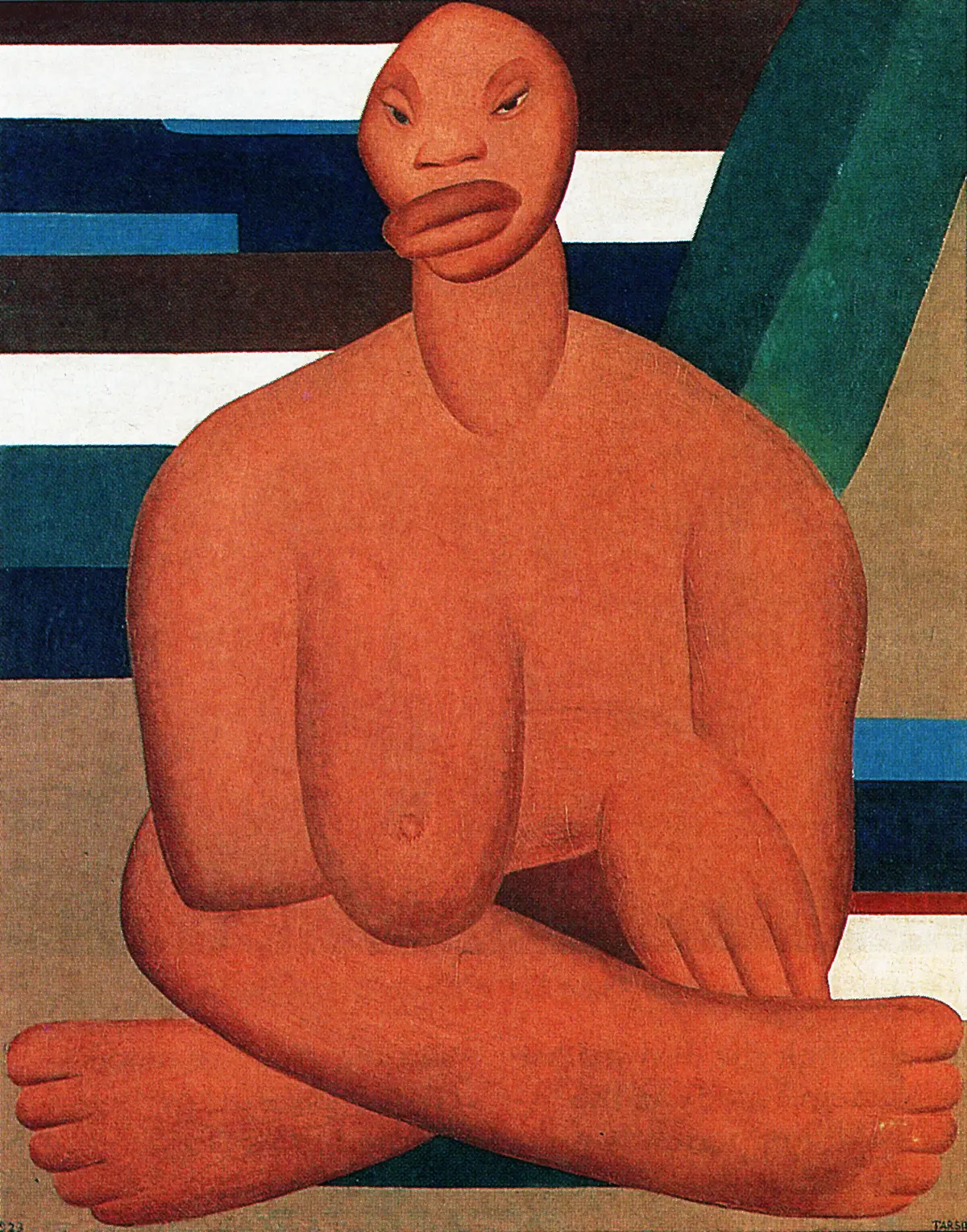
It was in Paris, in 1923, that Amaral painted the masterful The Black Woman, an emblematic canvas in the understanding of the paradigms that guided the new visual quality of Brazilian art in the modernist movement.
In The Black Woman, Amaral used an expressive deformation in her gigantic treatment of the female figure which practically stretches across the whole vertical space of the canvas. She placed the image of the black woman against a constructively worked plane, giving the composition a synthetic organization. The abstract, geometric plane is in stylistic contrast with the distortion of the human figure, constructed using almost surrealist forms of expression. The image of the black woman symbolizes the earth. Behind the figure can be seen a stylized banana leaf—a fruit found in abundance in her country. The black woman's large breasts, one of which hangs over her arm, denote fertility; the piece conveys the idea of a "fertile earth,”. an important part of the idealization of Brazilian-ness.
Tire composition is organized with devices from language extracted from the experiments of the European avant-garde of the day. In the context of Europe, the fantastic dimension of the figure was an anticipatory one when we recall that surrealism did not come together as a movement until 1924. On the other hand, in The Black Woman, a local grounding was fully developed, with identity being structured in the image.
In Brazil, as in the other countries of Latin America during the era of the artistic avant-garde, the search for an expression of identity served to realize the reconstitution of a historical sense of reality, and its basic essentials. Tire staging of updated artistic languages, the act of getting in synch with the contemporary world during the period from the twenties to the fifties was evident in light of the need to measure what we are, how we are, what is our specific nature in relation to the hegemonic cultural models that have been part of our lives since the colonization.
In The Black Woman, the local and the universal are configured with complete fullness of form. Its composition constructed a stylistically heterogeneous structure in which identity is presented as a lever with which one can reach universality.
This strategy can also clearly be seen in the artistic proclamations of the era. In Brazil, in 1923, the aesthetic proposal of modernism, as stated in Klaxon—the first magazine to disseminate this set of ideas—sought out the up-to-date international world without finding "obstacles to the integrity of the country," to tire definition of the national character, in this objective.
Without renouncing the fundamental roots of history, Klaxon proposed the advancement, of the experiment. It "knew that the laboratory exists" and called for freedom ruled by observation in the interests of constructing the new.
In his Pau-Brazil Manifesto from 1924, Andrade claimed that it was "necessary to substitute the visual and naturalistic perspective with another sort of perspective— sentimental, intellectual, ironic, ingenuous—to reach another level." He observed that our era announced the return to the "pure senses" and that "no formula for the contemporary expression of the world" would be legitimate if it didn't consider it "necessary to see with free eyes", "to be original and pure in one's age." He observed that "the counterweight of native originality" would render useless "academic adhesion", and "that the best of our lyric tradition, the best of our modem expression" would be motors for the "reaction against the indigestion of wisdom." (Wisdom would lead to stagnation!) Later, in the Cannibal Manifesto of 1928, written after Tarsila had already painted Abaporu ("cannibal" in Guarani), Oswald de Andrade proclaimed: "Tupy or not Tupy, that is the question" or "cannibalism as the sole factor of union, socially, economically, philosophically; as the only law of the world," cannibalism as the logic from which individual and collective expression are derived; a "dynamic force", "a knowledge in communication with the earth." He stated that "we already possessed the surrealist language" in the "golden age", and that it was necessary to transform "taboo into totem." The practice of cannibalism in certain indigenous communities symbolizes conceptually the act of swallowing in order to transform, dominate, and strengthen oneself.5
We could say that between 1923 and 1929, Amaral's work projected, through the painted visual image, a thorough elaboration of the construction of identity in which a cannibalistic logic was shaped.
From 1924 on, the so-called Pau-Brazil phase was present in her work. Amaral was once again in her country and felt motivated by the identity of Brazilian culture.
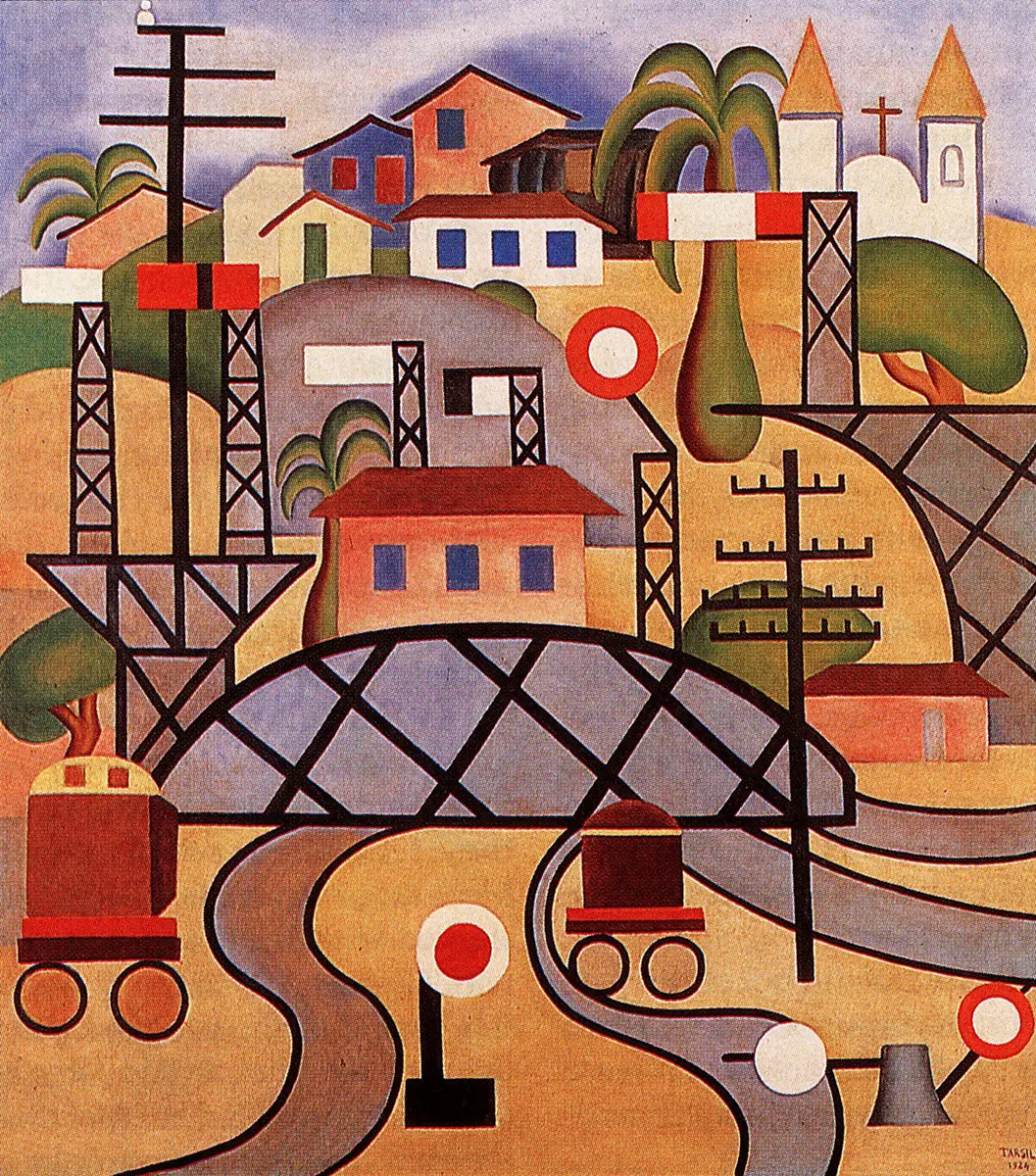
An example of the Pau-Brazil phase is the canvas Central Brazilian Railway, from 1924, in which the artist expressed the dense relationship between the colonial world, present in the architecture of houses and churches, and modernization, by which, with the construction of bridges, the railway crisscrossed the city and electricity arrived. In the compositional stage, one can see palm trees which constitute another symbol for the earth. Formally, the composition is organized on the basis of the simplification of planes, defined by the superimposition of visual information displayed vertically, one on top of another in the space of the canvas. In the structure of the composition, the artist breaks with the classical Renaissance construction of depth in painting, using, as it were, a "pre-classical" method of organizing space.
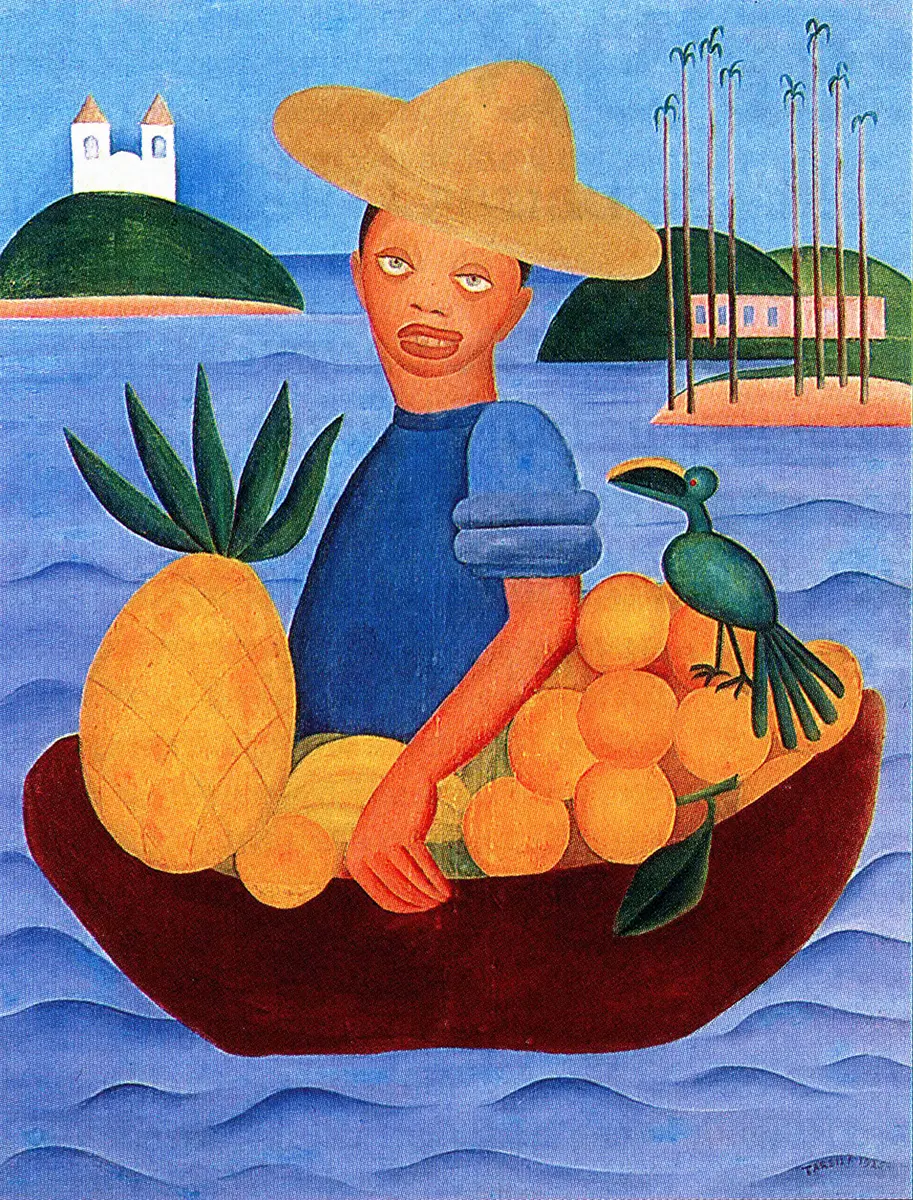
The artist also took advantage of a "post-cubist" way of seeing in her use of simplification, the sensual roundness of certain forms done in the style of Léger. Blues, pinks, yellows, and ochres are all present, recalling the colonial reality of the country, particularly the rise of the baroque cities of the eighteenth century. It can be said that in her work lyricism is rooted in memory,6 the realm of the imagination has no precise borders dividing the real from the unreal, both regions are explored with equal liberty.
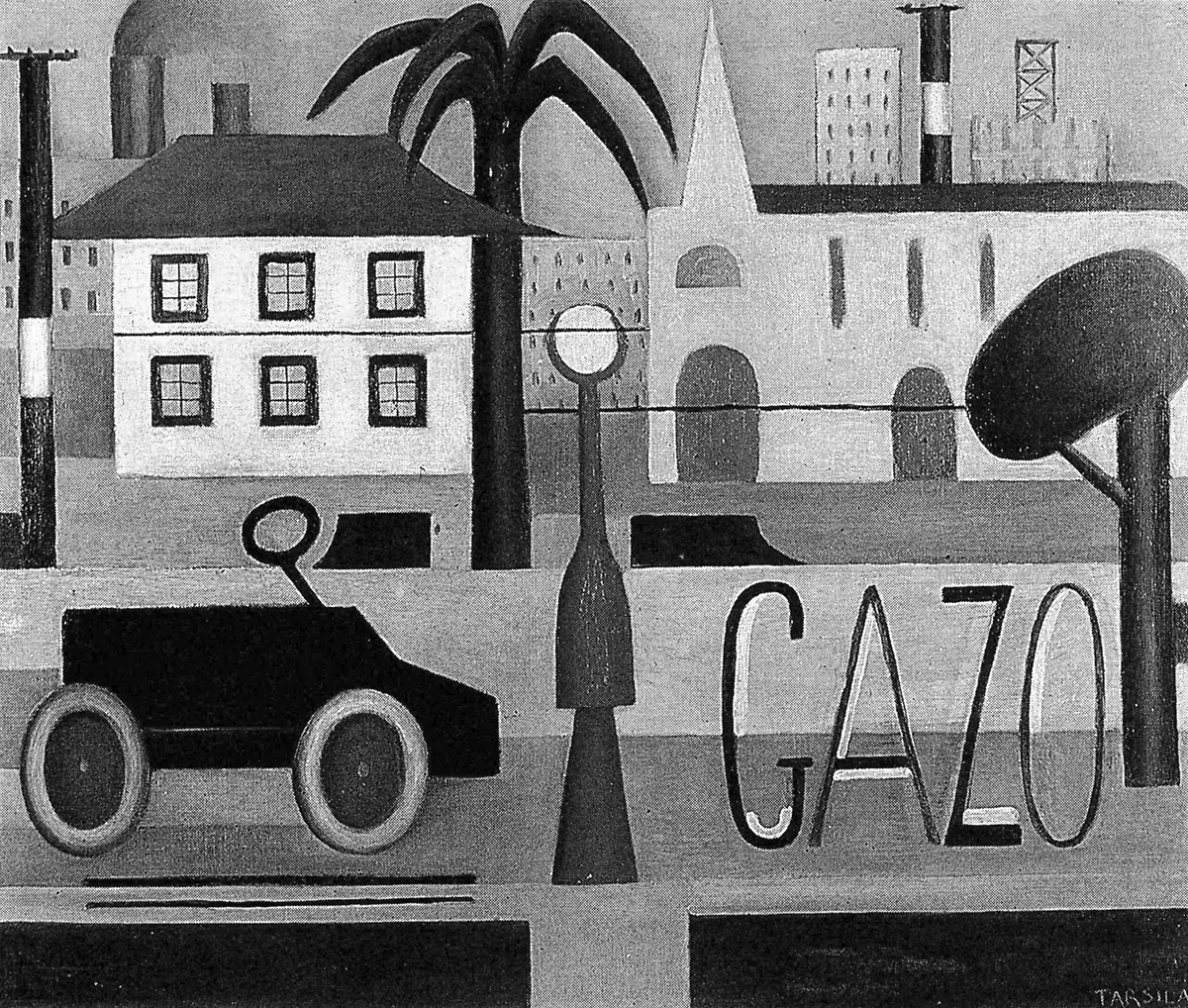
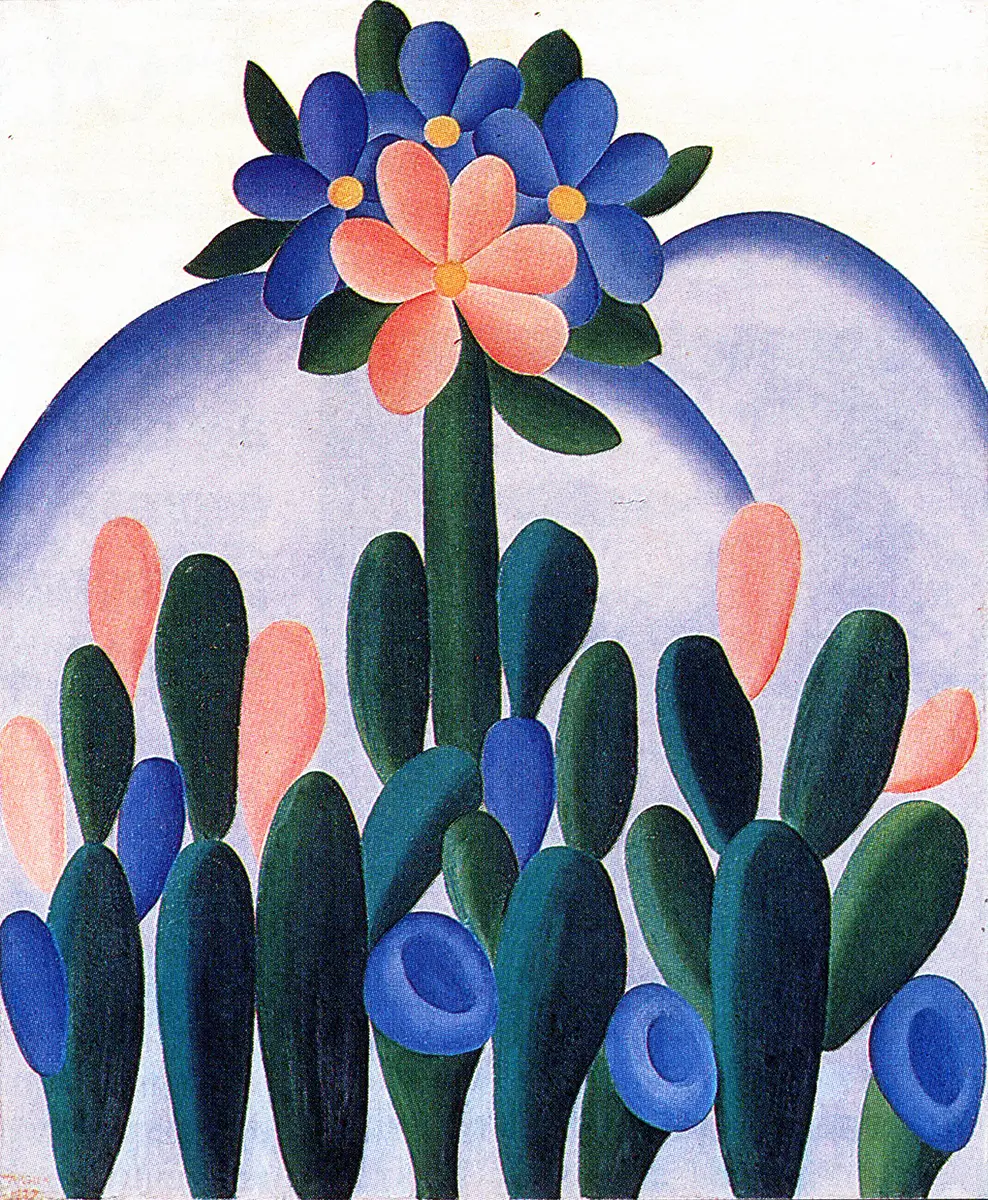
Amaral produced a large number of works starting in 1924 within the context of Pau-Brazil, among them Carnival in Maduereira, São Paulo, The Witch, and São Paulo (Gazo) from 1924; Fruit Seller and Festival Boats from 1925; and Manacá (a type of ornamental bush) from 1927.
While in Brazil in 1924, Amaral traveled to Minas Gerais, the state in which the principal historic, colonial cities are located. She took the trip accompanied by a Group of Five (Anita Malfatti, Oswald and Mário de Andrade, Menotti del Picchia, and Amaral herself) and Blaise Cendrars, the poet who was in the country for a visit. Previously, the modernists had taken Cendrars to Rio de Janeiro to see the carnival.
These experiences of contact with Brazilian reality had a great impact on Amaral. She was dazzled by the colors, by the handmade decorations on the houses in the colonial cities of Minas Gerais (Ouro Preto, Sabará, Mariana, Tiradentes, Congonhas, São João del Rey). She would rediscover her country's culture, would revisit the hues to which her eyes had grown accustomed during her childhood and youth in the daily life of the coffee plantations where her family lived. At that moment, to a large extent, her Pau-Brazil painting was born.
From 1924 to 1928, Tarsila do Amaral's production was fruitful, just as her life was hectic with frequent trips to Paris and other trips within Brazil and outside the country. In 1926 and 1928 she had individual exhibits in the Galerie Perrier on the Rue de la Boétie, near the Champs Elysées in Paris. These were her first solo exhibitions, and the artist succeeded in catching the attention of the French cultural milieu. In 1929 alone she showed her work in Brazil in Rio de Janeiro and in São Paulo.
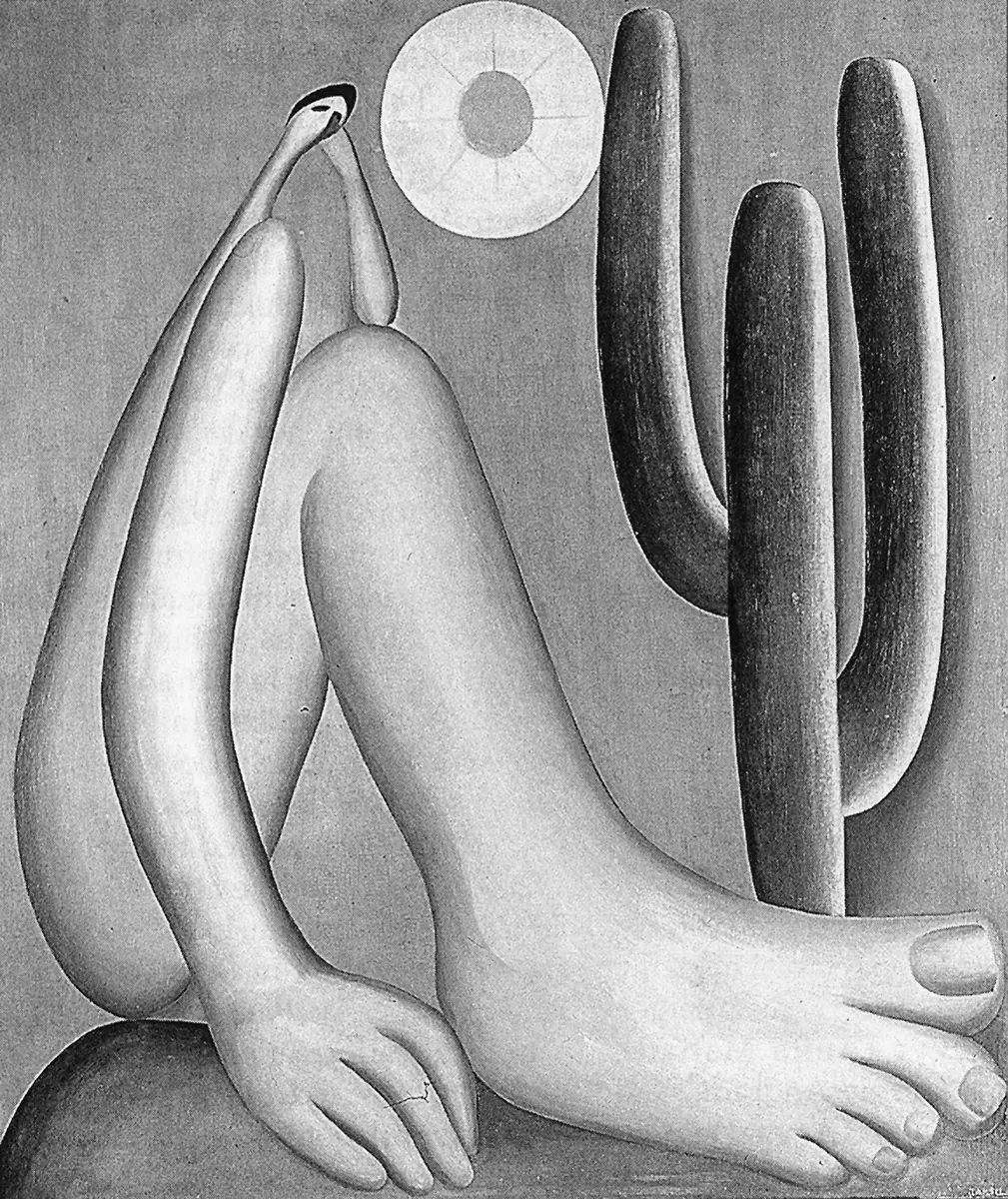
In 1928, the formation of a cannibalistic image came to fruition in her painting. It is worth noting the creation of the canvas Abaporu, a work slightly connected to The Black Woman, a relationship which the artist herself noted in another of her pieces, Cannibalism (1929) in which she articulated the figures from both compositions. Abaporu attained the conceptual level that La Negra had already announced. In its composition, there is an expressive deformation. The enormous figure that expands in the vertical dimension of the canvas has a leg and one foot, one of its arms and one hand, all voluminous and disproportionate. The form of the body is merged with that of the gigantic leg while the figure's head and one of its arms are minuscule in relation to those parts of the body, establishing a strong contrast. An intense tension is generated by the minimization and exaggeration of forms within the same figure.
From an iconographic perspective, this tension of contrasts can lead to the question of the diversity of values present in the individual, in the being. Regarding the interpretation of the symbols, the leg is related to the foot, and from a biological point of view, both profoundly distinguish the human form. The leg signifies the qualities of steadiness and splendor. The foot and the hand, symbolically support the body, support the person, and the being. The feet are also symbols of "the soul, which gives life to Man".7
In the composition of the painting Abaporu, the image of the Sun appears beside the head of the figure. Symbolically, because of its rays, in the mythology of many peoples, the Sun is strongly likened to the "feet." On the other hand, also in counterpoint to the figure, another iconographically powerful sign appears, completing the composition: the cactus, a familiar plant in Brazilian territory, its thick barrel due to its reserve of water.
The painting's background is totally blue, a blue as from the palette of the Pau-Brazil phase, scarcely broken by the space symbolized by the surface: the earth, the green of the vegetation that covers the surface of the earth, the same shade as the green cactus. The composition as a whole produces an image that is fantastic, magical, oneiric, and surrealist, and because of this final quality, the sense it communicates is direct and strong: something like a "cosmovision" of reality, the consciousness of place. In that image the idea of "savage" is configured, the drive for a new order of meanings, a drive for identity, a state that emerges from the unconscious for consciousness, as if in chaos. The image of the cannibal symbolizes resistance to the tensions that the "civilizing" system imposed on the conquered country. Abaporu expresses the power of the identity of origins, turned into the inner power of the being.
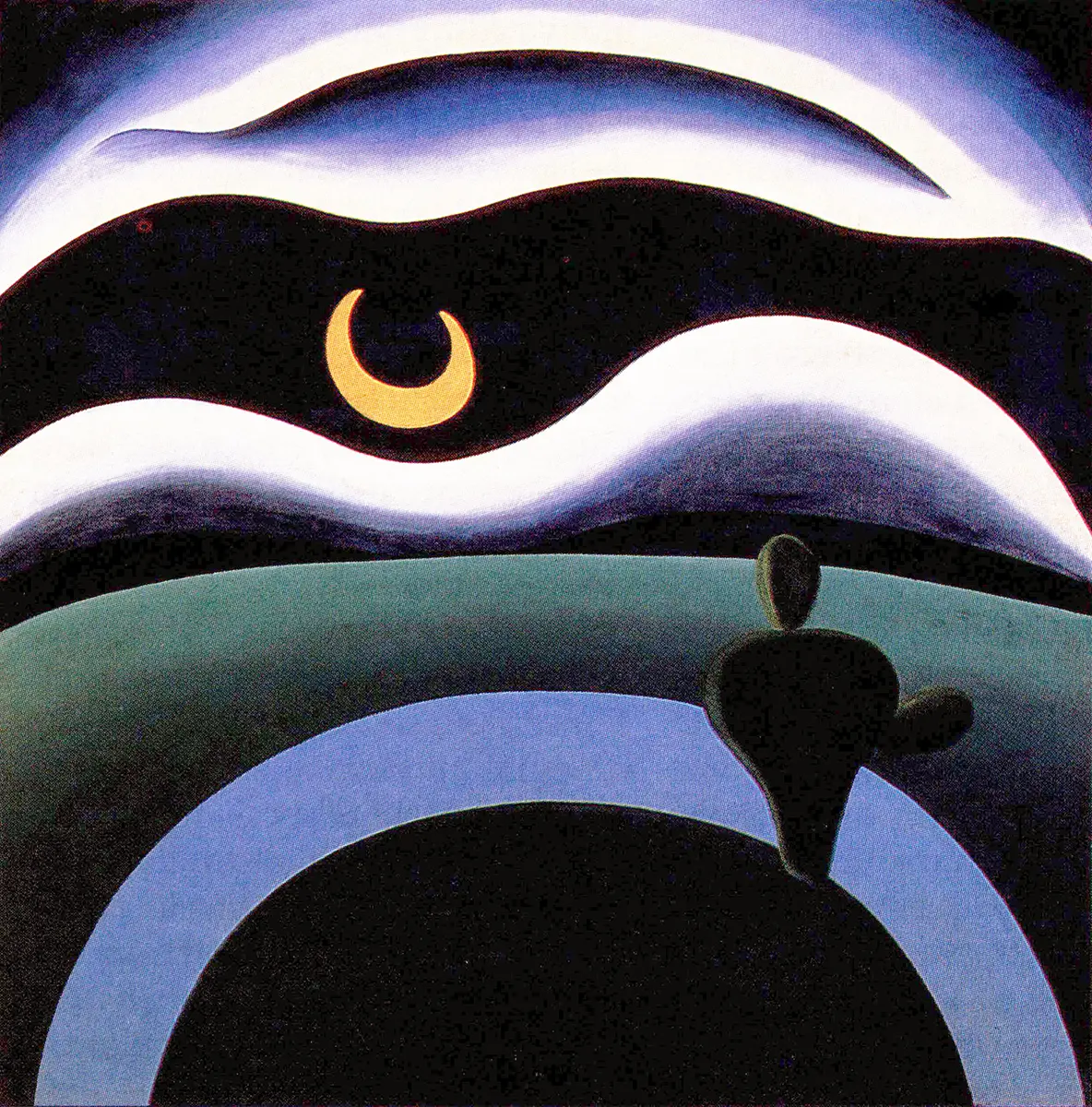
Others of Amaral's works would be located in the environment of those profound, identifying contents in which the local and the universal, references to place, and the adoption of a formal, contemporaneous language are in perfect symbiosis. Note the compositions in which Nature is the theme, as in Manacá: The Lake (1928), The Egg/Urutu [a type of poisonous cobra] (1928), The Moon (1928), Setting Sun (1929), Jungle (1929).
In the twenties, Tarsila also paints many works in which a formal reflection predominates, such as Estudio (Academy No. 1 or The Cup from 1923), Cubist Composition (1923), and Meekness (Calmaria) from 1928. In certain works, she reaches for the theme of popular culture, focusing on religiosity, as in Angels and Adoration (1925), and Brazilian Religion (1927), a theme which she worked on as well in the forties and fifties. Nevertheless, it is in their twenties that the artist carries her innovative creation in painting to its apex.
At the beginning of the 1930s, she initiates a social phase and later (starting in the fifties), heads toward the phase which has been termed neopau-Brazil.8
During her life, two retrospective shows of her work were organized: in 1950, in the Museum of Modem Art of São Paulo, and in 1969, in the Museum of Modern Art of Rio de Janeiro and the Museum of Contemporary Art of the University of São Paulo. In 1963, the Seventh Biennial of São Paulo also had a special gallery dedicated to the work of the artist. In the sixties, despite her problems physical ailments that affected her mobility, the artist continued to paint. Tarsila do Amaral died in December of 1973, at the age of eighty-seven.
Today the aesthetic legacy of her work has been reassessed as being a fundamental guide for the analysis of the artistic expression of Brazil and Latin America.
NOTES
1. The show presented, in addition to the works of Tarsila do Amaral, works by Frida Kahlo (Mexico) and Amelia Peláez (Cuba).
2. This is a cultural space maintained by the Social Service of Industries and by the Federation of Industries in the city of São Paulo that promotes the diffusion of the visual arts and theater.
3. All of these painters lived in the city of São Paulo.
4. Nádia B.Apual Gotlib, Tarsila. (São Paulo: Brasiliense, 1983) 34.
5. In some cases, in the indigenous social organization, the consumption of human flesh responded to the belief that certain qualities of the individual eaten were assimilated by the person ingesting him. In this case, cannibalism appears to be linked to magical or totemic rites. In Brazil, the cannibalism practiced by certain indigenous groups was cloaked in an exclusively ritual character, its importance lying in nomination and initiation as a process of acquiring status in the community.
6. The impact of the baroque cities of Minas Gerais awoke in Tarsila do Amaral the memory of her childhood and youth at the haciendas of her family. The colors that were considered "peasant’ (caipira in Portuguese) came to be seen through new eyes by the artist. In a text, she wrote for the catalog of the May Salon II, in 1938—an important modem art salon that took place in São Paulo in 1937,1938, and 1939—the artist recounted, "In Minas, I found the colors I adored as a little girl. Later they had taught me that these colors were ugly and caipiras... but I took my revenge on this oppression, bringing them to my canvases: blue as blue can be, violet red. glowing green, all in more or less strong degrees depending on the proportion of white."
7. According to J. E. Ciriot, Diccionario de símbolos (Barcelona: La Labor, 1991).
8. Nomenclature used by Aracy Amaral in her book Tarsila, sua oba, seu tempo (São Paulo: Editorial Perspective, 1975) V.l.
** Publication of the illustrations was made possible thanks to Mr. Guillerme Augusto do Amaral and the Museum of Contemporary Art of the University of São Paulo who authorized the reproduction of the works.
LISBETH REBOLLO GONÇÁLVES
Professor and Doctor at the School of Communications and Arts at the University of São Paulo and Director of the Museum of Contemporary Art at the University of São Paulo.