
Emerging as a product of contrasts, Teresa Serrano's works are located within a disturbing realm reflecting the hardness and fragility of existence. Perhaps the sensation of uncomfortableness produced by her sculptural objects comes from the coldness of the stainless steel combined with the delicate nature of the lace, gauze, hair, and mirrors she uses. But its greatest quality, in my opinion, lies in the creation of an indeterminate atmosphere oscillating between the idea, the object, and perception. This is certainly due in part to the result of the most ethereal elements used: translucent acrylics, lace, and transparent veils that partially cover the rigid metal constructions, which are aggressively raised up to penetrate into space. Contained within themselves, these post-minimalist sculptures emerge from the industrial sphere as useless artifacts of a practical life where rhythms, thoughts, and objects have been suspended in a woman's gaze.
In her more recent objects, the lace has given way to an exploration of the intangible image of the mirror and woven fabrics with embroidered hair. The presence of the mirror, a traditional symbolic element of vanity and, here, of the empty appearances of the technological world, also evokes the other being depicted and therefore the idea of access to an enigmatic and ciphered world. The gaze at oneself through the reflection emphasizes one's ambiguity in One, two, and three. Make a wish (1997): from each of the three rectangular full-length mirrors resting against the wall, there emerges a long mane of hair, unattached to any person. To the disturbing image that is reflected —the impassive exhibition room, the arrival of the spectator who is also a participant in the work— there is added the sensation of the strangeness of the materials, something as incorporeal and volatile as hair which belongs to no one and which is the reflection of everyone.
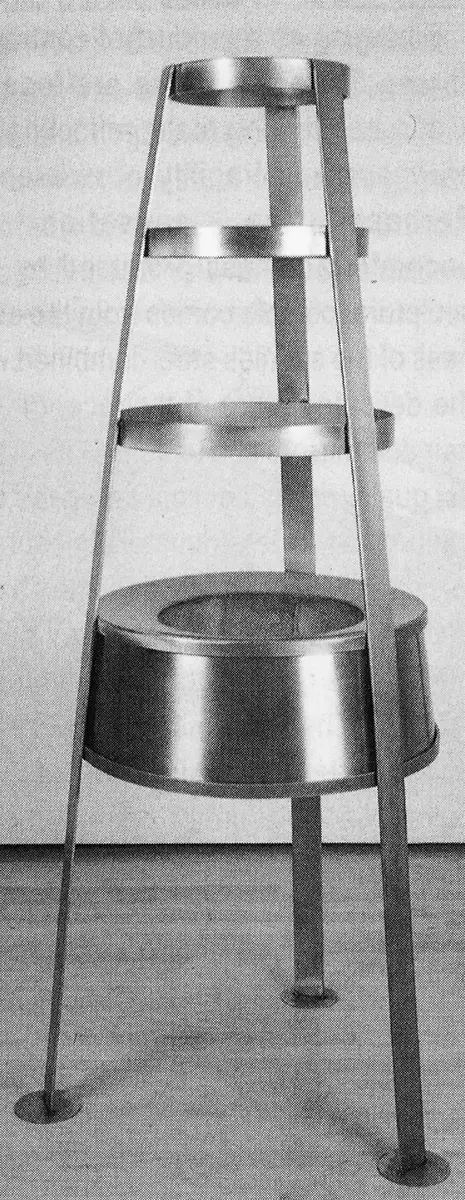
In the same way, Intacta (1995) plays with a closed form of circular descending strips which end in a recipient with a steel mesh. The hermeticism and the defensive protection suggested by this work retain only the air and these same ideas. There is a perfect harmony between the use of materials and the artist's conceptual language, acquired through her contact with New York art. Her presence on the international and Mexican scene has become more and more evident over the last ten years. As Osvaldo Sanchez has pointed out, she belongs to the current sculptural avant-garde, a member of a generation of post-minimalist female artists— at least within the United States and European avant-garde— who "deconstructed the paradigms of modernity and minimal sculpture's reductive principles, undermining all its systemic ideology, its triumphant technologism, its hard morphology, its emotional hermeticism, and its lasting attitude..."
A few months ago, Serrano participated in the exhibition The Edge of Awareness, organized by the Art for the World association, which will be seen in New York, Sao Paulo, and New Delhi. She was also included this year in the Sense of Place exhibition at the Queen Sofia Museum, while in 1997 she participated in the Havana and Johannesburg biennials. At present, she is preparing a video for the Caracas Clay Biennial on the fatal vanities of modern men and women, based on the handling of transnational marketing and featuring music by Frank Sinatra.
The exhibition at the Nina Menocal Gallery was an important retrospective that gathered together work from 1995 to 1998. It provided an opportunity for appreciating the maturity she has acquired since her last one-woman show in Mexico in 1993.
ANA ISABEL PÉREZ GAVILÁN A.