
In light of the fact that the media have succeeded in immunizing (ideologizing) us by means of the cryptic smuggling of manipulated images (taken out of context), the illusion is what governs our bombarded eyes today. We consume the photographic torrent undigested, as passive agents, mere containers for dry-docked virtual realities and real fiction. These worlds of imagination and mythic narratives, these cultures that have carried to their outer limits the persistence of concepts that navigate their ever-collapsing contradiction, construct new networks of incomprehension of the world in order to conspire against human emancipation, against Nature. They serve as an alibi for the market in order to rule the destinies and senses with which we appreciate our lives, as vulnerable as they are ephemeral, and now disposed as well to the new designs of future methods to protect and assist the System in the service of death. Reality is certainly being concealed; reality is abject and violent; reality is concealment. If this were not the case, reality would be different or would be, at least, an absolute based on romantic chimeras, "when desiring was still useful" (Peter Handke).
Language, denomination, and words are all there is. Rarely is an image worth more than a thousand words, as the millenary and canonical Chinese tradition holds, and it is true that artists are generally better paid than those who devote themselves to the work of words. Words habitually enclose images in addition to abstractions, which lead, like symbols, back to themselves and to death as dadaism understood. But one needn’t go back to Freud or even to Deleuze and Foucault to adopt the immorality of working with one's back turned to life, on one's knees before the silence, forever looking the other way which may signal nothing other than betrayal and squalor, slavery, and propaganda.
On the other hand, perhaps wherever one goes, honesty does not dress according to tailor-made patterns and it lacks sizes for the image possessed like an idol of the sort that makes us privileged beings with consciences. Nor can one ignore that conscience, in a world ever more ultra-liberal and stupid in its complexity, lacking defenders in power. Nevertheless, conscience, about which only now do we have available relevant information, contains deliberately concealed dimensions and capacities that many Asian cultures and religions have explored masterfully.
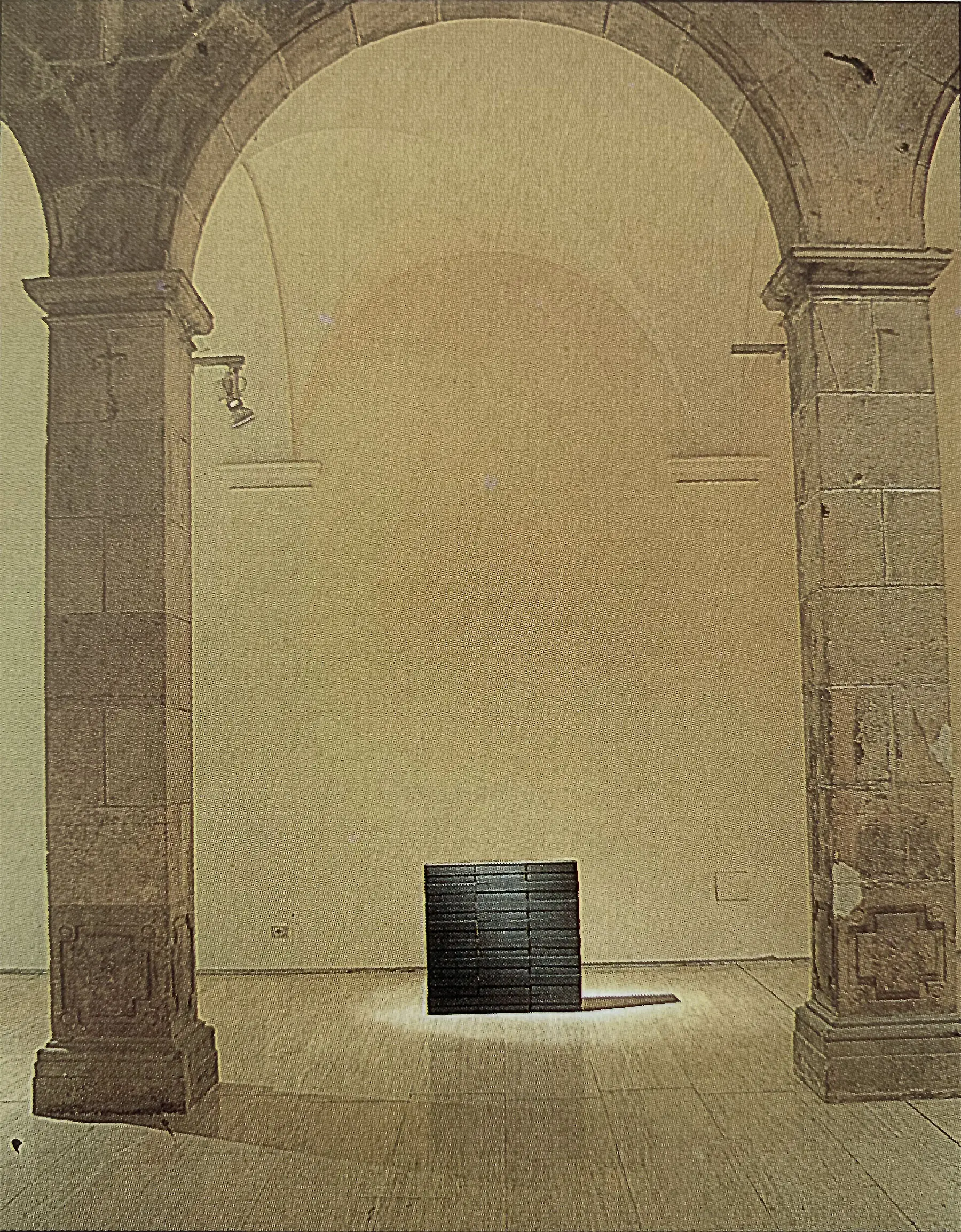
And what does all of this have to do with Jaar? What does he think? To begin with, it was his pieces, made of language and conscience, of histories and realities —rather than aristocracies—, that suggested these notes to me. But if it is true that these works —which can currently be viewed in the Santa Mónica Center on Barcelona's La Rambla and which will then travel to the Koldo Mitxelena in San Sebastián— about the genocide in Rwanda illuminate even the conscience of he who lacks one, it is no less true that they demand introspection and tenderness. These works implicate us as accomplices and co-authors by omission and abdication when we see what his eyes saw and beyond, seeing our own cannibalistic immolation, what is taking place every hour and every day beyond lunch, between soup and desert, always dressed with a healthy portion of commercials. On the other hand, Jaar would have let us see the photographs containing the striking black funereal boxes of this holocaust, so many times repeated. This cryptogrammatic concealment, in order to reveal, and conceals, obeys the very status of the photographic image today—which circulates like an automated, servile, devoted vehicle, its direction previously established, predetermined by the contexts of informational infamy which renounced their intention to public service so that they too might appear in the photo, holding hands with criminals and the lie, though the suit does not make the man and the monkey dressed in silk is still a monkey still prevail. Today the protagonists of the news are those who have the power to manufacture it with the proper container for its immediate consumption, all of which feed successive substitutions and the kingdom of Great Babylon in which we all so comfortably swim.
But, perhaps in being obvious, these commentaries are as commonplace as our daily blood prepared for take-out and consumption on the rubbish heap of domestic histories where terrorism, of course! is an accepted mode of behavior. I, along with those few who are legion, continue to think that the silence of life is death. Without language, there is no life. Jaar does not use words as dogma precisely because he uses them as an artist of images, of that which occurs outside the facade. He calls our attention to the tragedy beyond expression that occurs within, where we refuse to see what is evident. That we should not see those thousands of photos, that daily hell is, more than a gesture, a territory, a context from which the discourse emerges. Is it not enough to see the dried blood, timeless, in the memory of other, so many other, previous atrocities?
Conscience is resistance to dogma, to the blurb on the cover which all gossip refers to, to the shell. Dogma and permanence are concepts foreign to art, creation, to vitality; they are sickly and metastatic, but also artificial, prosthetic, and dead weight.
In his celebrated book, Aesthetic Theory, T. W. Adorno writes that: "It would be more than could be desired that one fine day art as such should disappear, that it might forget the suffering that is its expression and whose substance is an art form. What art could be in terms of a form of writing history should the memory of accumulated suffering be erased!" Nevertheless, if, as Adorno indicates, the art of our age only expresses pain, contradiction, and wretchedness, its existence is guaranteed a long life. Our society is full of models to be followed, distinct from the Apollonian Aristotelian model.
But let us not deceive ourselves: suffering, misfortune, and wretchedness have no value in our society. Only professional success, comfort, and immediate benefits are taken into account so that the artist acts according to his own convictions. These things have falsified his art, weakening its efficacy, so that it can be used as an empty product. So it is not true that the art of our age lacks ethical imperatives. And it isn’t true that nearly all artists pursue the attainment of economic and social security as an absolute priority although the market absorbs and falsifies their truth. There are some artists who have not yielded. For them, economic success, security, and comfort are not part of their artistic preoccupations nor are they interesting as destinations per se.
Modernity on the other hand has been constructed in large part by formulas of cultural resistance, like catharsis and it substitutes for a life bureaucratized and rationalized to the extreme, tedious, and soulless. In my opinion, our society has lost too much time over superfluous matters. Art reflects the imbalance, castration, uncertainty, frustration, impotence, and commotion involved in the activity of our species on this planet. In this sense, if art, taken as a whole, has had any leading role in this century it has been, that of helping to create a critical, radical consciousness despite having been frequently assimilated by the dominant culture which has turned it into an article of consumption with immediate expiration and substitution dates. It is hard to value something that has no price. Inversely, we devalue that which is for sale.
The subversive impulse of modernity is, in my opinion, the greatest merit of our culture. The vanguard acted as the conscience that told us we were trapped in an artificial, cultural, trans-incestuous world of problems and desires without transcendence that removes us from the satisfactory answers to the questions we ask ourselves every day and refuse to answer for diverse and complex reasons. Some believe that artistic rebellion originates in the contradiction between society and an attitude that grows out of faith.
But has art perhaps succumbed to professionalism, mercantilism, and bureaucracy and lost its truth and its conscience? The conformity that artistic activity experienced during the eighties and for a good part of the nineties has ended though artists may still be as interested in eating as the next person, and in having a studio and even a gallery to represent them. It is possible that dissidence has lost its ascendancy in the current scheme of things but the artist has had to maintain his independence at a cost of great sacrifices, even material ones. It is not true, in my opinion, that there is not enough money to buy the individual. It is as if the man of our age lacks sufficient self-esteem to resist prostitution from the moment at which the reward to the ego is great enough and reaches the necessary dollar amount. Art of the twentieth century, as a whole, has not been the production of unnecessary luxury items. Modernity was always committed to an attitude that implied the negation of the society in which we live and which, consequently, is supposed an ethical basis. If creativity arises from talent and from the life experiences of each person, the primordial characteristic of artistic activity is the personality of the artist himself in constant renewal. The work of art testifies to this self-transformation; these artists are noteworthy for what they do but also for what they are. But perhaps we have made a mistake and have in some cases called those artists who are not so.
To pretend, on the other hand, that people might be interested in what you do when few people truly are interested is not bravado—guapería as a Cuban would say—it is a joke, as it is logical to offer praise that public centers in the Basque Country and Catalonia might include in their programming exhibitions like these which, without a doubt, show the commitment the art of our age has to society and life, to history and the present and which, furthermore, question the leadership that omits the realities inconvenient to the powers complicit in these terrible massacres.
To be sure, Jaar’s is not just another of many exhibitions. Startling and terrible, it expresses the melancholy of another failure from having made man a being in and of Nature. One more failure on the part of our societies and our civilized, cultured age. In short, one feels shame and a stifling atmosphere when viewing these pieces being offered from the heart to others. And in its desire to mingle with the damned, it suffers the same wounds, the indifference toward a life without love in which slavery and corruption—on all levels— are the coin of the realm.
ANTONIO ZAYA
Writer, Editor-in-chief of Atlántica, and an independent curator of international exhibitions.