Four spectacular billboards were distributed in Mexico City.
The latest project by Diego Toledo is being presented outside the protected and restricted environment of the gallery and has invaded the public space. It consists of four spectacular announcements placed strategically at four key points in what was a few years ago the artistic center of Mexico City: the Colonia Condesa. The four announcements are comprised of various visual and linguistic elements that not only evoke the idea of advertising but inexorably become part of their actual surroundings. What at all events distinguishes them from the other advertisements competing for public attention is the decontextualization of the messages. These are direct and imperative phrases that intrigue the casual spectator, even though he does not know who is uttering them, irrespective of whether he recognizes their artistic purpose.
Although it is not clear that they have to be read in a specific order, we shall begin by commenting on the piece which acts as the title of the project: We have you surrounded. The announcement shows the fragment of a great map of Mexico City, over which several pairs of anonymous legs are walking, most of which are directly in the semicircle circumscribed by the title phrase. In this case, the text functions simultaneously as discourse and graphic description: the walking of the faceless beings over the city map (i.e., the city synthesized in an almost geometrical structure) condemns them to remain within this twofold limit of the announcement and the text. The vital space of the city has been reduced to the point of trapping them (trapping us).
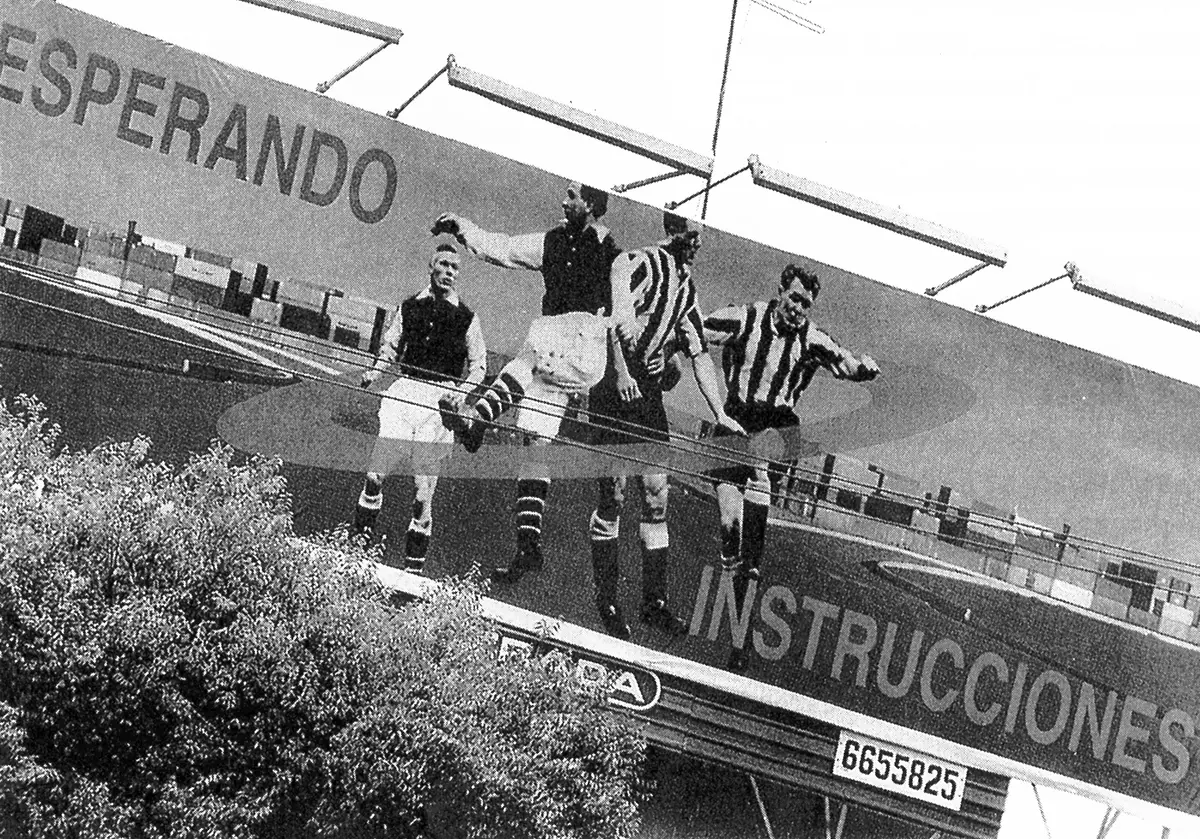
This restrictive situation is repeated in Awaiting instructions, where the four figures in the center of the composition are concentrated within a hoop which limits and render difficult any movement: in this case, they are four footballers, three of whom are jumping up to reach a ball which supposedly lies outside the frame of view. The central concentration of the image contrasts with the surrounding landscape, not only because it seems to have nothing to do with a football pitch, but because it makes the piling up of the figures seem completely pointless —and therefore deliberate. The text here emphasizes the tension and sense of expectation of the frozen instant depicted in the scene.
In Keep your distance, the central composition has been broken to extend all along the horizontal field of the support. This time we can see the football pitch which was missing in the previous advertisement. There are two players walking along, while a third is stretched out on the ground. The coherence of the scene is abruptly cut by the presence of another figure. Within a sepia-colored central fringe, there appears, facing us, a player who is playing another game. The two scenes are irreversibly fragmented despite the continuity of the white lines of the pitch which link them. The text is spread throughout the composition, with the syllable en (in Spanish) coinciding exactly with the sepia section. Here the text-image interplay is more complex. The central figure is clearly far from the rest of the scene. He is playing another game, probably at another time, wearing other colors and following other rules. But there is no clear unity in the case of the other three players either, and in fact, the indifference we can sense in the players who are standing is more evident when we see that they are wearing the same colors as the injured player.
We only received orders is the last work in the series. In the foreground, we can see the lower part of a face of a man with his mouth open, which may signal a cry of pain or a dental checkup (especially since the face is being held by a hand that seems to be forcing it open, similar to the procedure used on prisoners or with drug traffickers, for example). At the back, we can pick out fragments of a city, over which a series of bubbles seems to be emerging from the composition. The typographical size is not very big and it is the central scene that catches our eye. This is probably the most literal announcement since the man in the center is being forced —ordered— to open his mouth (to speak? or even to issue the orders himself?)
The project is interesting above all because of the thoughts which it provokes in the passerby. It, therefore, functions as an authentic urban intervention —we recall here the work of Jenny Holzer— in which the effect on the recipient is much more important than the intention of the sender, who in the final analysis is unknown to the average viewer of the announcements. Of course, the effects of this kind of work cannot be determined with all the desired rigor and go beyond quantifiable limits —especially in a place like Mexico City— but the four announcements reflect the intention of one person to use words and return them to us within a field which remains open to our own interpretation.
ISSA MA. BENÍTEZ DUEÑAS