
Next November, the Colombian sculptor Eduardo Ramírez Villamizar will present a group of works produced in recent years at the Denise René Gallery in Paris, a gallery that has been one of the most prestigious sites of geometrical abstract art since its inauguration in 1944. The show, in a rather larger incarnation, had already been seen at the Diners Gallery in Bogota during May and June. On the cover of the Bogota catalogue there appeared the excellent portrait of the artist taken in 1997 by the Mexican photographer Flor Garduño, in which Ramírez Villamizar appears to be covering his face with a recent work, a small iron multiple, supported by a wooden base. Through the base, we can see the artist’s face looking upwards. The photograph emphasizes the sculptor's hand and his intensely observant eyes. Behind the narrow metallic surfaces, the artist appears to be shackled, as if he were a mystic performing penance, or was a man possessed. Yes, a man possessed by a sense of order and the rigor of geometry, which have been indissolubly linked with his creativity since the time he lived in Paris at the beginning of the 1950s, when he frequented the Denise René Gallery.
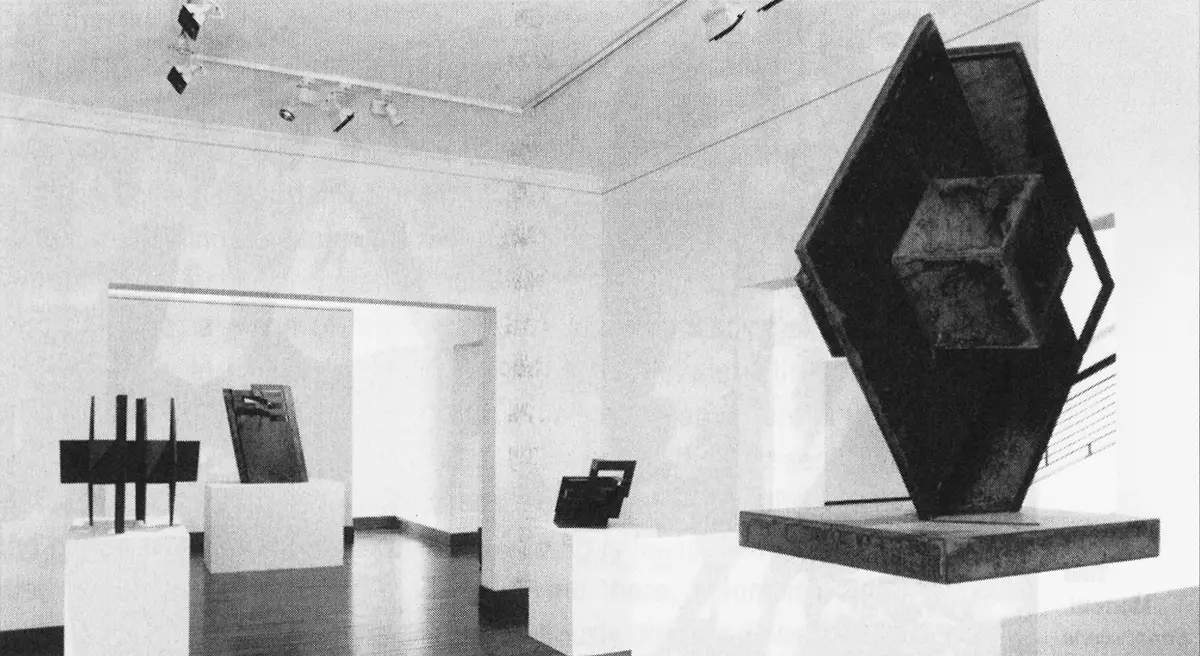
Ramírez Villamizar is renowned for his work and periodically exhibits his production. For these exhibitions in Bogota and Paris, he has gathered together pieces from the present decade. In the Diners Gallery, there were 23 works of various formats, including two very large works, and one multiple. Most of these were from 1997 and 1998. From the time of his earliest three dimensional —work like the plaster Bird from 1950—to the time when he finally committed himself to sculpture around 1960, Ramírez Villamizar had felt admiration for pre-Columbian art, an admiration which has undoubtedly increased over the years. This can be clearly seen from the list of such recent titles in the catalogue as Double Idol I, Ceremonial Raft in Guatavita, Circular Ruins, etc. His admiration for pre-Hispanic culture has determined a large part of the abstract art of Ramírez Villamizar who, although working with pure and essential forms devoid of the details of ordinary reality, does not fail to remind us on many occasions that his creation is rooted in nature. However, his abstraction also reveals another permanent source of attraction: architecture, an art which "composes’’ —like music— by organizing spaces and volumes, without attempting to establish any similarities with the natural world. Architecture has in its essence to do with geometry (though there may be exceptions), planning, and with construction. The sculptor, who also studied architecture, is imbued with its spirit. For that reason, some of his best pieces are those which openly refer back to architecture— Terraces, Temples, and Inclined Vertical Architecture, to mention only some of the sculptures included in this show—and in the same way, his most “figurative” constructions are also at the same time works involving planes, volumes, and spaces. Cóndor, from 1997, is a stupendous interweaving of surfaces and slender, lengthened semi-volumes, set on two large boxes of a minimalist kind; Ceremonial Raft in Guatavita, from 1998, is an enormous circular surface, in the center of which there is a much smaller square surface and several others which are inclined and oriented in various directions. The small lozenges superimposed on the large metal circle are only that: little parallelograms which have equal and parallel sides, with two of the angles being greater than the other two. Other works that can be related directly to architecture include the Facades from 1998. These sculptures are variations on the different projects which the artist carried out for a large door to be placed at the main entrance to the Universidad del Valle in Cali. For reasons unknown to the artist, the handsome maquette which had been approved by the University authorities was never used. The recent constructions of the great Colombian sculptor fully confirm once again his talent and the validity of his modern style, related as it is to cubism and profoundly influenced by the concept of architecture and the spirit of the pre-Columbian creators.
GERMÁN RUBIANO CABALLERO