
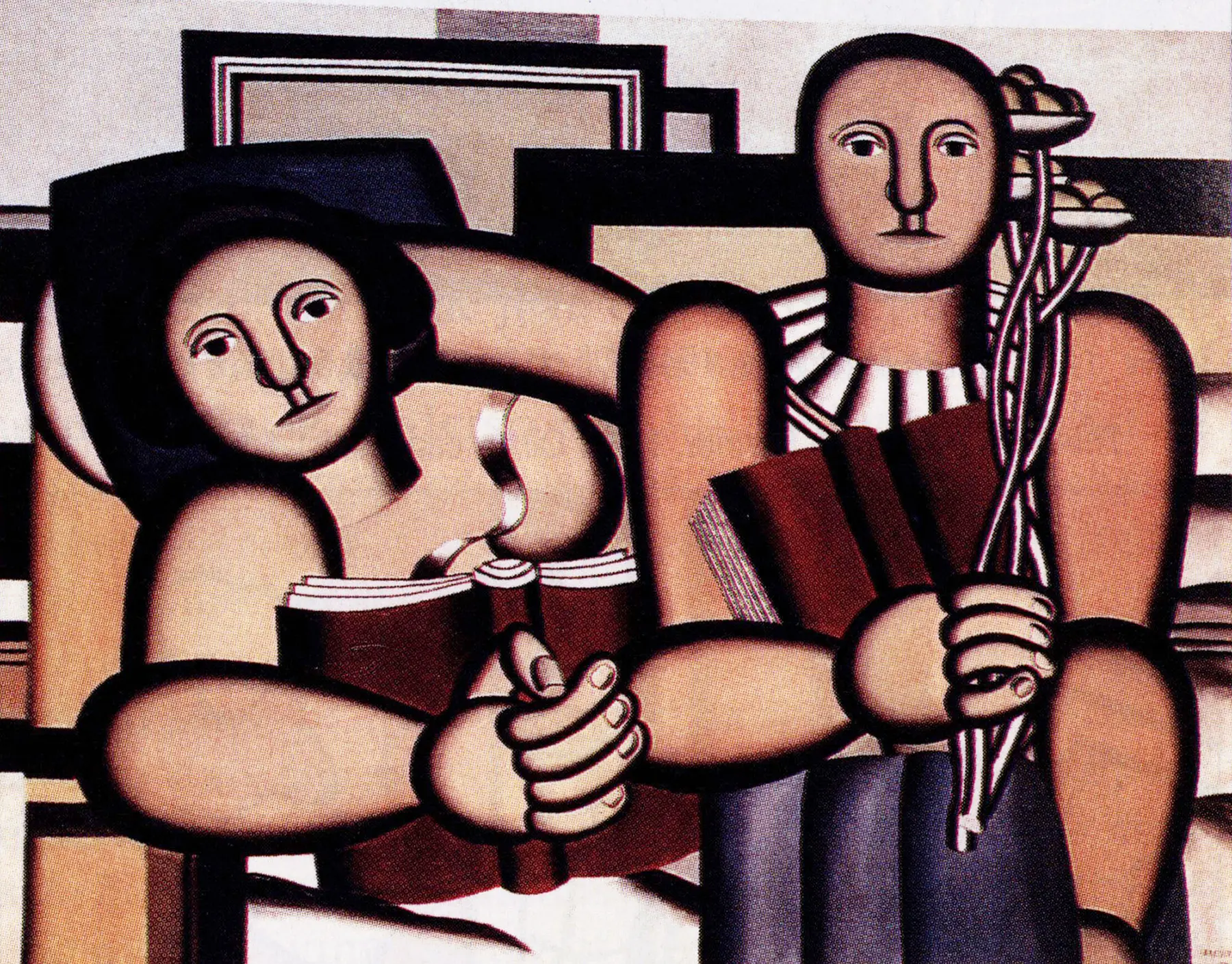
When I made my first linoleum print in 1957, I completed it convinced that I had copied one of Fernand Léger's faces and that everyone would brand me a plagiarist. Due to my clumsiness, this paranoia turned out to be groundless, but the solution of joining the line that described the nose with that of the eyebrows seemed to be an easy approach to follow and one which guaranteed the maintenance of the graphic plane. In essence, what I had done was to establish a relationship with the work of Léger the way a student generally does with respect to drawings of comic strips: He looks at the model in terms of a formula that produces effects. They are visual tricks that, when one develops them by oneself, demand too great a power of the imagination. The problem with Léger is that with a superficial reading—as was my own at that moment and as it continued to be for quite a while—his work seems to have elements of a refined comic strip. It can be interpreted as a packaged stereotype for the museum. It is this quality that allowed his work to be presented as a precedent of Pop art. His formal solution in that sense had far more influence than his preoccupation with representing the everyday life of the industrial world. Given this connection with the artistic movement that probably produced the most commonplace art in the history of the United States, it is surprising that Léger did not have a stronger reception in this country and more frequent retrospectives. This detail is emphasized by local critics and the catalog essay that underscore the absence of significant exhibitions since 1953 when the Museum of Modern Art itself gave the artist a solo show (a featuring show had already been organized in 1935).
The current exhibit is small given the occasion (seventy paintings and graphic works) and constitutes an abbreviated version of an exhibition from the Pompidou Center (117 paintings and graphic works). It offers, nevertheless, a rich and complex vision of the painter—quite distinct from the outline I have just sketched out—and with sufficient detail to encompass his oeuvre. We skip over his first post-impressionist works to identify as quickly as possible those paintings in which Léger's style appears in latent form: two paintings in gray hues and with a cubist structure from 1909-1910 (The Seamstress and Nudes in the Forest). For quite a while, Léger worked on his own version of cubism (someone called it "rubism") in which he integrated a vision of mechanics that served as the mainstay for all his work to come, even when his paintings entered the realm of abstraction. It is this vision that distinguishes him profoundly from North American Pop art. The possible confluence of the two presents itself only in reproductions of his works, not in the works themselves.
If one only glances at Léger's work in magazines and books, the iconic nature of his work predominates in such a way that its quality tends to disappear. The graphic quality of his characters, the roundness of forms, the tubular structure, and, in his postwar works, a certain absorption of the devices of the comic strip are all evident. These elements confirm the enormous sense of design Léger had. They are all qualities that stand out in mechanical reproduction to the detriment of his quality as a painter. It is only through this experience that he can be attributed the craftsman's distance—an interest in an "industrial look" typical of pop artists. But standing in front of his paintings, one's impression is the opposite. Léger is primarily a painter who not only doubts his craft but who uses it to measure out and control the atmosphere in a form that is antithetical to that required by an industrialist approach.
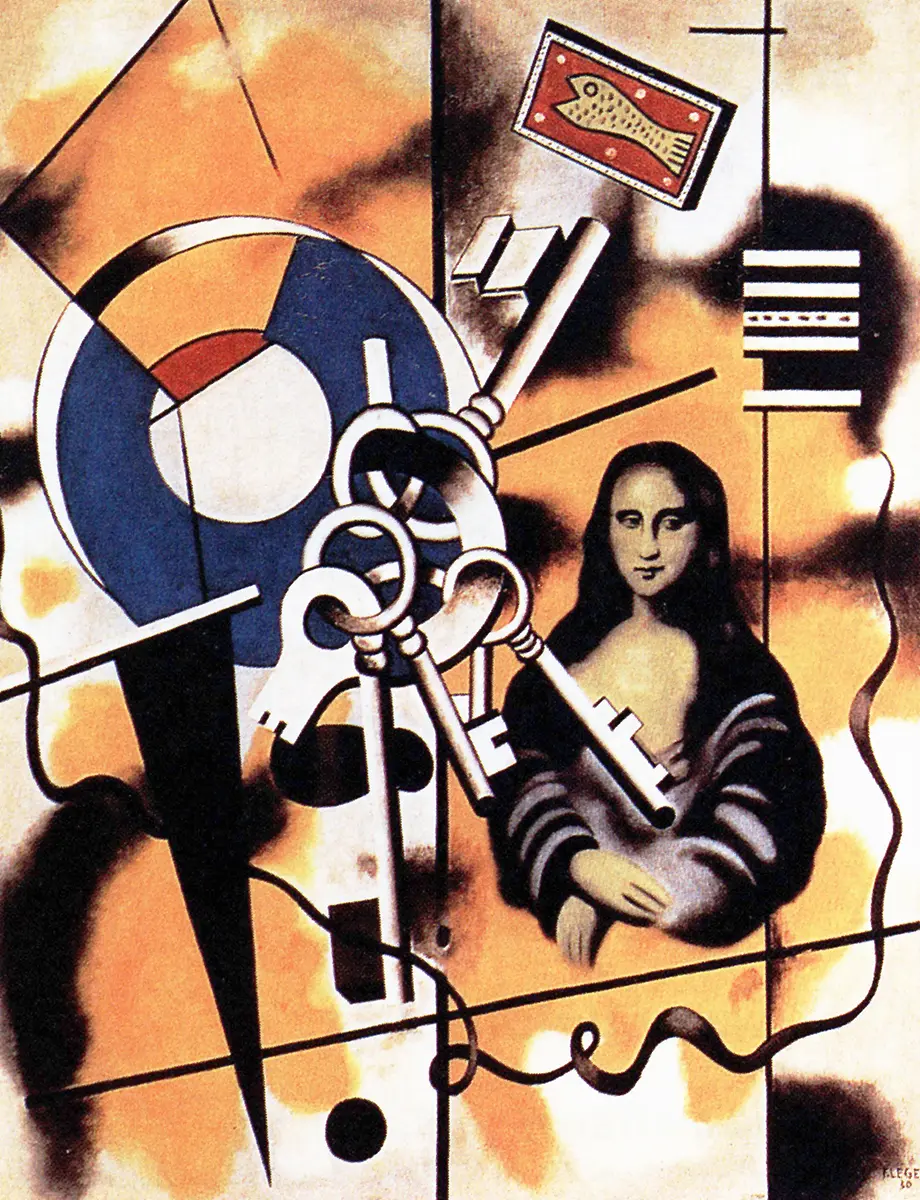
Léger's vision is that of a bucolic industrialism. He does not attempt to accept icons imposed by consumption, as would take place later in the sixties with Pop, but rather extend the repertory of the models deserving of representation in order to achieve the desired effect. That expansion came to include the painting itself in La Joconde aux clés (Mona Lisa With Keys) from 1930, in which Léger introduced a version of Leonardo's painting. Commenting on the work, he writes that after painting the keys he interrupted his work, aware that the painting needed a contrast. He went to take a walk and in a store, window saw a postcard of the Mona Lisa: "How could he achieve a better contrast with his keys? That is how I placed Mona Lisa on the canvas. Afterward, I went on to add a sardine can (...). It is a painting I like and will not sell (...)I have created a very audacious painting with respect to contrasting objects. Because for me, the Mona Lisa is an object like any other."1
Léger combines, in exceptional form for its time, the typical, free pictorial search of formal modernist investigation, with an ideological backbone. It is a precarious balance that embroiled him in polemics from both the left and the right. His interest in industrial life and aesthetics is combined with an interest in the life of the worker, which also led him to align himself with many social causes. His final act in the United States in 1946, after an exile forced on him by the French occupation and days before returning to his country, was to become a member of the French Communist Party. If he had waited a few days he could have done so in France. It is interesting how Léger, despite his political leanings (which had been exacerbated in part by his experiences during the First World War), and a language that could easily be used to create pamphlets and other propaganda, always shunned programmatic painting. It is as if he had decided that the integration of humble, everyday objects was enough to democratize his art. Opposed to social realism, he engaged in strenuous arguments with the poet Louis Aragon. Léger's position was that the lack of communication between modern art and the people was due to nothing other than the social order and taking this position as his base, he refused to make concessions in his art.
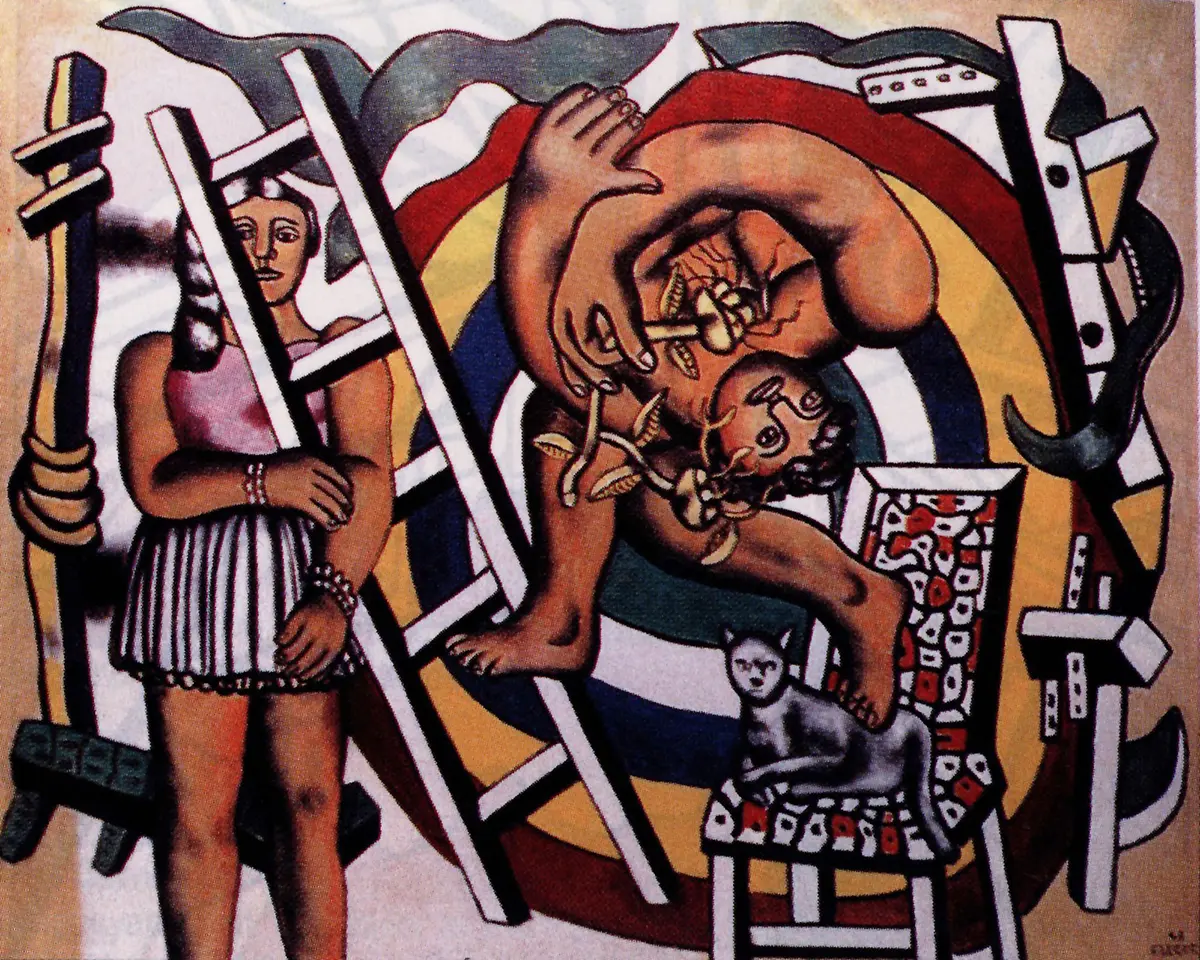
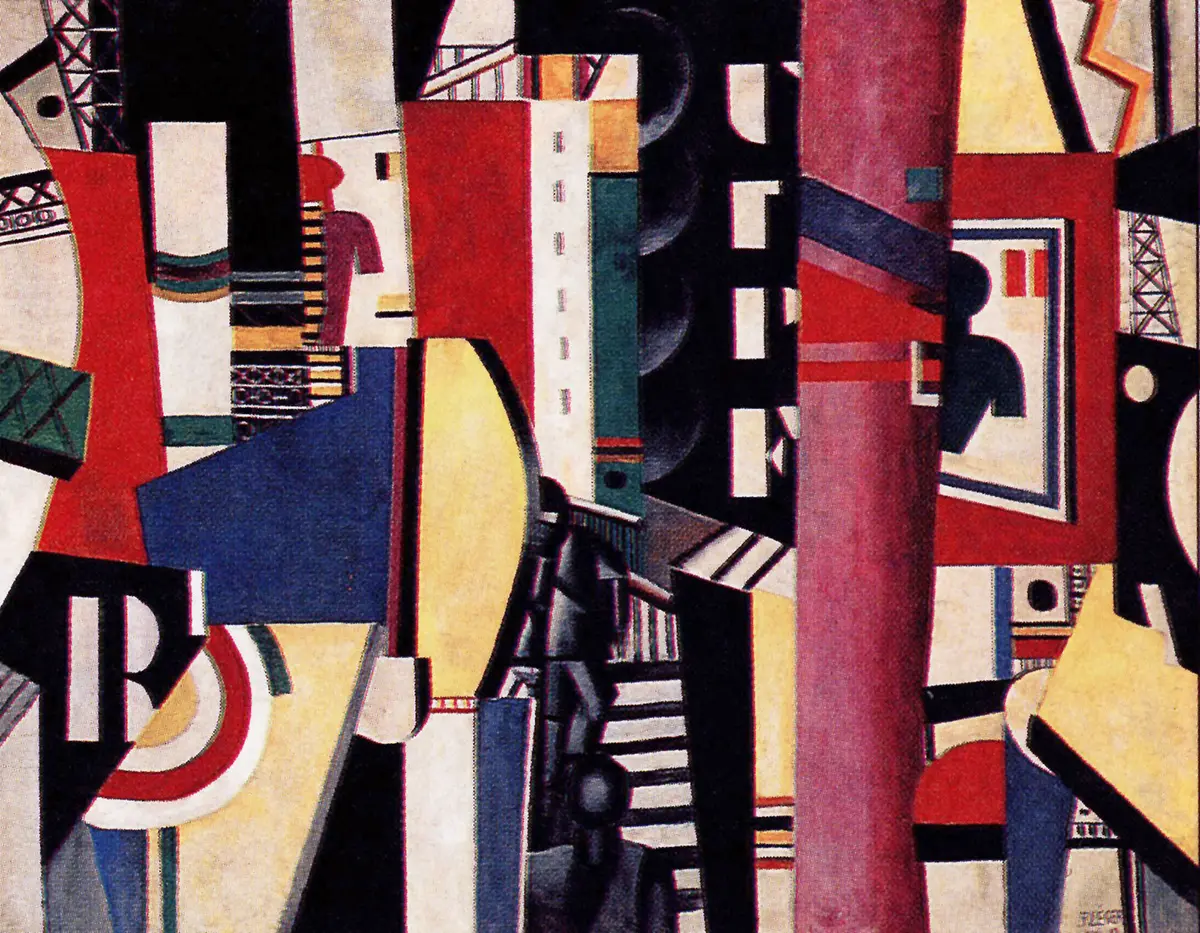
His Contrast of Forms, a series of paintings from 1913 painted on rough canvas and in some cases, on sackcloth, served to announce his interest in the mechanical world, in the construction of things, the processes of their making by means of manufacturing or factory processes. If a class ideology or conscience led him to choose this theme, it certainly did not influence how he painted, a characteristic that would continue throughout his career. To a certain extent, these early paintings are sketches. They celebrate their unfinished quality with immediate brushstrokes and areas of unpainted canvas, accentuated by the roughness of the fabric. Simultaneous to that which could be called "carelessness", the accumulations of forms, the placement of white to denote brilliance in what suggests volumetric, metallicized pieces, without errors or impairment.
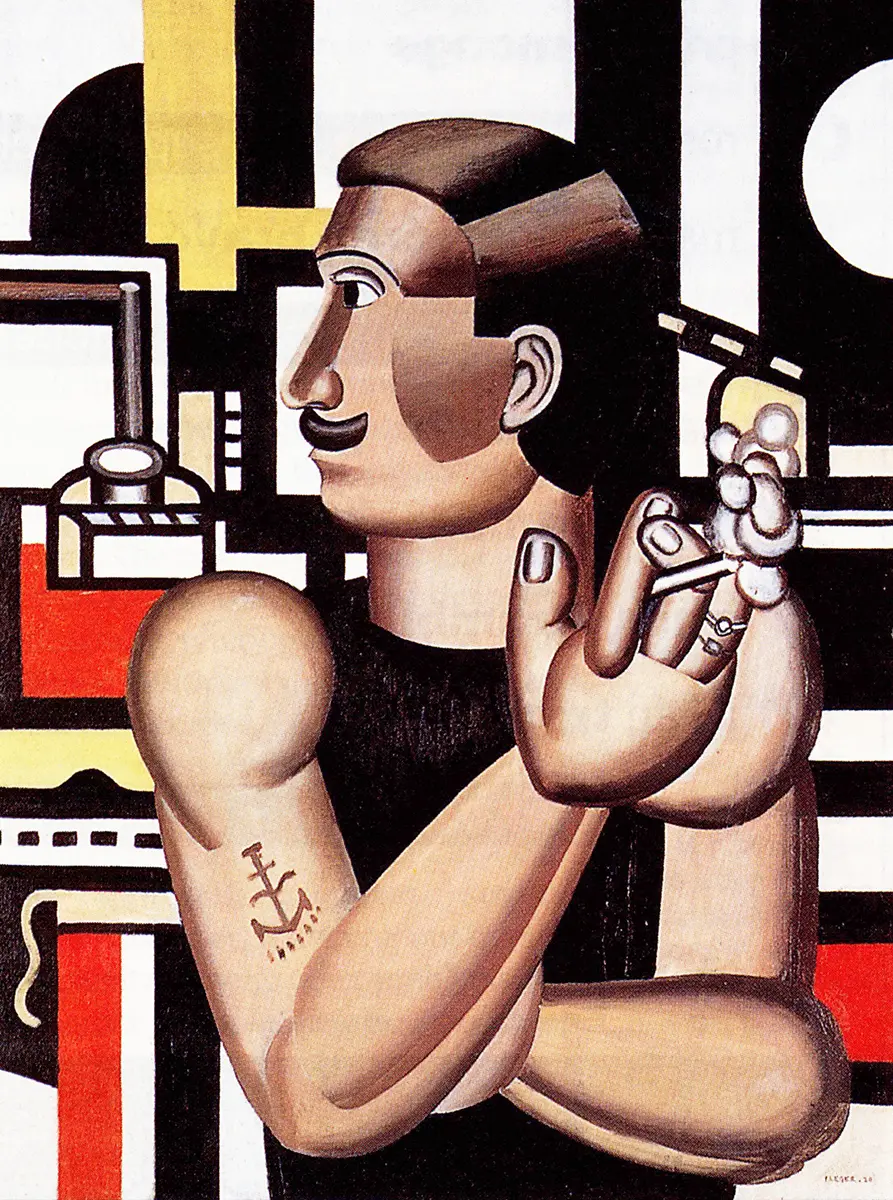
Later on, the forms are distilled and the painting is ordered into a clearer and more determined figuration. In the period from 1914 to 1920, Léger frees himself from the previous cubist influence to focus even more clearly on the mechanical world. In 1920, with Le Mécanicen (The Mechanic), his mechanistic figures emerge. Le Grand Déjeuner from 1921 provides another example. The years from 1920 to 1923 are represented at MoMA by exquisite drawings—in general, preliminary studies for his paintings but in which the most important aspect seems to be a unification of total reality by means of the pencil.
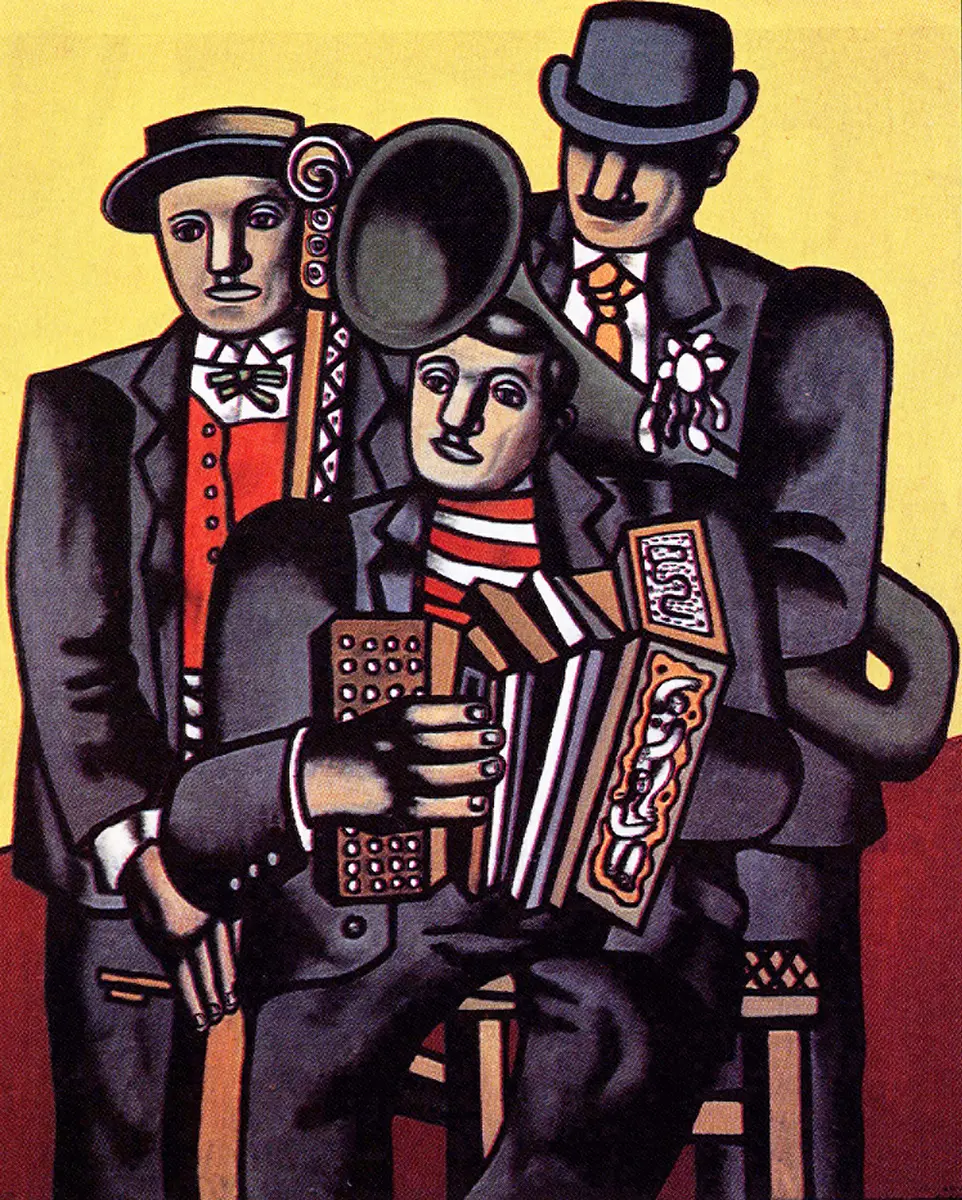
The exploration of the human figure, comprised of mechanical parts, gives Léger a new starting point from which to return to the inanimate object. That which is made of flesh and that which is manufactured are covered by the same skin, no longer clearly organic. It is a hybrid and might refer as well to a plant as to a book. In fact, it is a skin that covers the commonplace and renders it recognizable as such, even in moments of his greatest abstraction. Léger adhered to no aesthetic dogmas; he fluctuated between abstraction and figuration without scruples, quite frequently shifting between elements from both worlds in the same image. But it is Léger's solution for the human face that becomes a sort of signature for the artist. It is what turns Léger's figures into "characters" and relates them superficially to the work of Botero.
The relationship is superficial because Léger is not a narrator. His formal manner of stereotyping is graphic, not literary. When literary illusion enters his canvases it does so first of all as a compositional sign. The literal meaning of what is described by a line is of no importance: it is an abstract composition that gives it order. And this is what explains the uninterrupted range from figuration to abstraction along which Léger moves with such ease. So, for example, the stained-glass windows of the Church of Audincour (1951) are nearly conceived as a musical accompaniment to quotes from the New Testament, primarily as non-referential forms (with the exception of a few trees in certain isolated cases), exploiting the relationship of its black lines to the divisions of the panes.
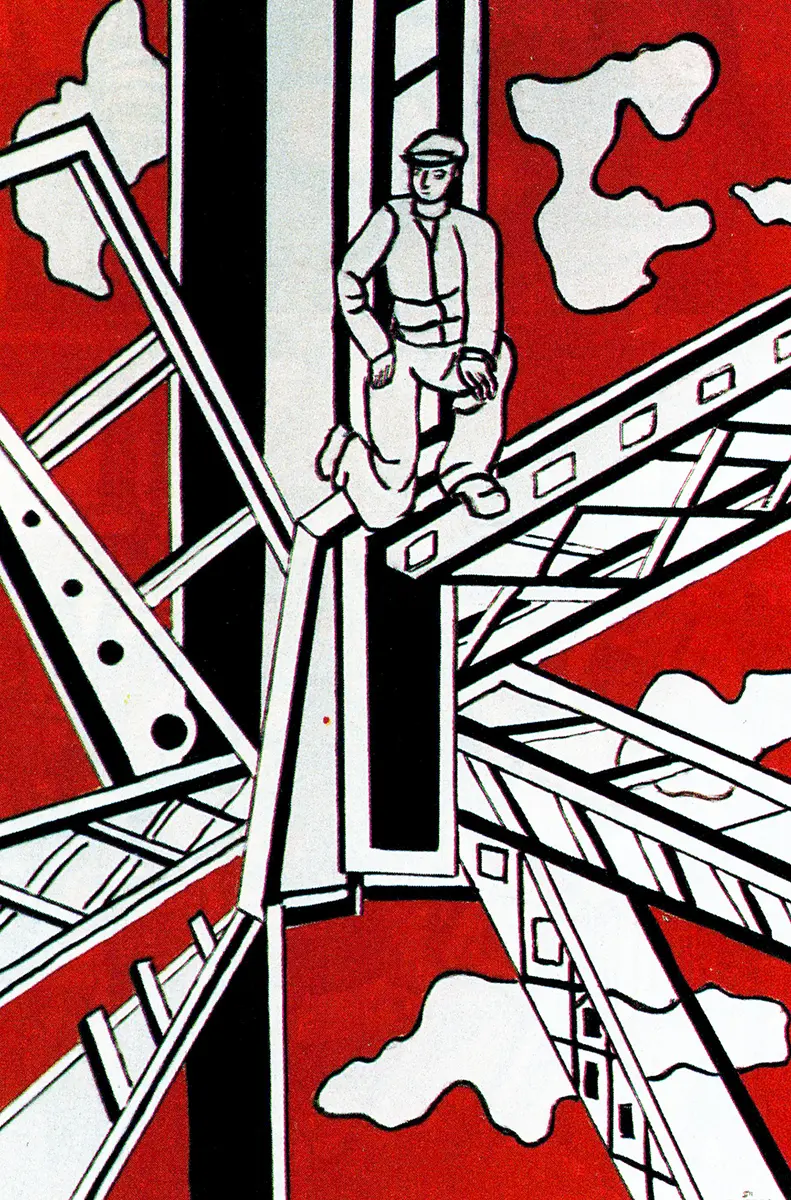
The MoMA exhibit highlights the strong ties Léger had to the United States. This is the theme of the main essay of the catalog,2 and though it might appear to be a distortion for a show of this type, it is in reality a fairly important theme. The industrialism that Léger is connected to corresponded in his day more to develop in the United States than in France. To this is added the North American patronage he received for his work, his frequent travel there, the time he spent there in exile (1940-1946), and his admiration for New York art deco: "Radio City (...) is the true expression of modern America. America knows how to make things luxurious while at the same time keeping them simple. And it is its social luxuriousness, a lust through which the masses circulate. It had to be discovered."3
It is interesting to view how art deco joins Léger to Lichtenstein, who had his own passion for the movement. Yet it separated them as well. For Lichtenstein, deco constituted a formal, coherent repertoire that nourished his work for years, but did so in a decontextualized form. For Léger, on the other hand, it constituted a formalization of a social relationship, the construction of a sort of architectural demagoguery that clarified his role as an artist. With respect to its formal aspects, Léger did not take from art deco but rather, contributed to it.
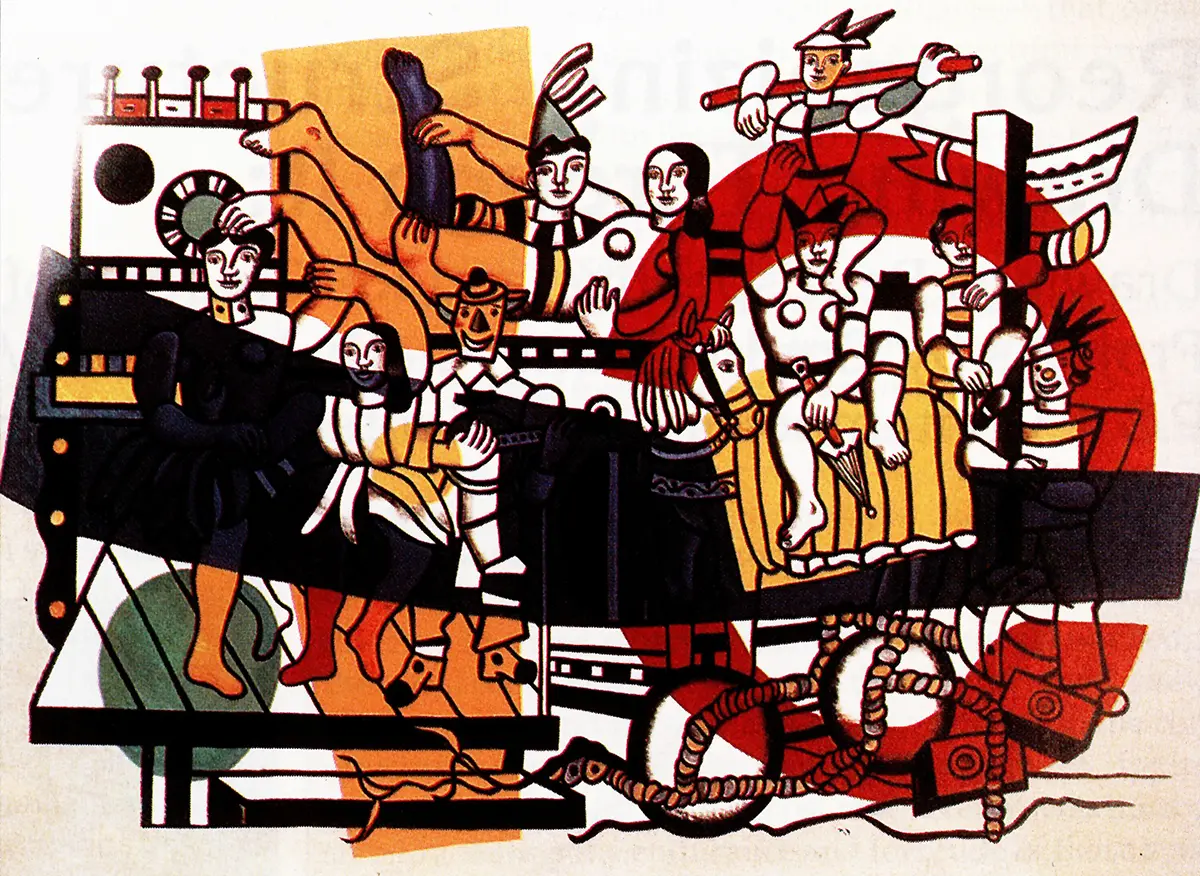
Léger's relationship with the United States is also established through his pedagogical activities. Although he never managed to find work in the United States (in part, certainly, because he didn't speak English), his studio in Paris brought many people together. After the Second World War when the United States funded the studies of former soldiers, many artists went to Paris to work with Léger. He had begun to teach more than twenty years earlier, in 1924, in the Académie Moderne. Over the course of a long career, his studio attracted a wide range of artists, including many Latin Americans led by Tarsila de Amaral and Miguel Angel Pareja from Uruguay, toward the end of his life. Louise Bourgeoise studied with him in 1938. Then in 1947 that he opened his Atelier Léger and a number of prominent North American artists studied there with him, including Sam Francis, Richard Stankiewicz, Kenneth Noland, Jules Olitsky, and Robert Colescott.
And after all this, without having taken a single misstep (apart from the fact that one painting might be less convincing than others), Léger created his own, undeniably interesting world. He created an original language, and as this exhibit shows, never lapsed into the simplistic formula generally attributed to him. He did not shun difficulty, he experimented constantly, and was unorthodox and anti-dogmatic.
But despite all this, despite having met all the demands of first-class modernism and of having been a first-class painter, there is something that doesn't all come together. I don't know how to respond to these doubts, at least not in words. (I should try copying one of his faces again.) Decades ago, the critic Jean Cassou described Léger as "a primitive in an erudite and scientific era." It was meant as praise, underscoring his ability to "extract all poetry alive." Perhaps it is that "primitiveness" that is an obstacle today. Léger was probably the most hedonistic painter of his generation and, at the same time, the one who aesthetically most closely approximated a classical sense of art. Both qualities seduce the spectator but also date his work. It is dated in par by what, for Léger, was—utopic and deserving of struggle. Now, for us, it has become pure fantasy. What Léger now extracts is no longer living poetry, it is remote poetry, and fine paint is all that remains of it.
NOTES
1. Fernand Léger, Haus der Kunst, Munich, 1997, 85.
2. Carolyn Lanchner, "Fernand Léger: American Connections," Fernand Léger (New York: The Museum of Modem Art, 1998).
3. “The New Realism," Art Front, New York, 1935, Vol. 2,8:10, quoted in the exhibit catalog of the Museum of Modern Art, 42.
LUIS CAMNITZER
Uruguayan artist. Professor at the Visual Arts Department in the New York State University College at Old Westbury.