
Horacio Zabala (1943) recently presented an exhibition of his work from the 1970s, 1980s, and 1990s at the Museum of Modern Art of Buenos Aires, The show, in the form of a succinct retrospective, highlighted the main concerns which have interested this artist over the decades.
An Argentinean-born resident of Switzerland since 1992, Zabala was a member of the original nucleus of the Grupo de Los Trece (1971), which was set up under the auspices of the Center of Art and Communication (CAYC), headed by Jorge Glusberg. The members included Jacques Bedel, Luis Fernando Benedit, Gregorio Dujovny, Carlos Guinzburg, Jorge Glusberg, Víctor Grippo, Jorge González Mir, Vicente Lucas Marotta, Luis Pazos, Alfredo Portillos, Juan Carlos Romero, Julio Teich. Some members left the group and others joined and the original number of 13 was reduced to six. From 1975, under the name of the CAYC group, the members were Bedel, Benedict, Portillos, Grippo, Testa, and Glusberg.
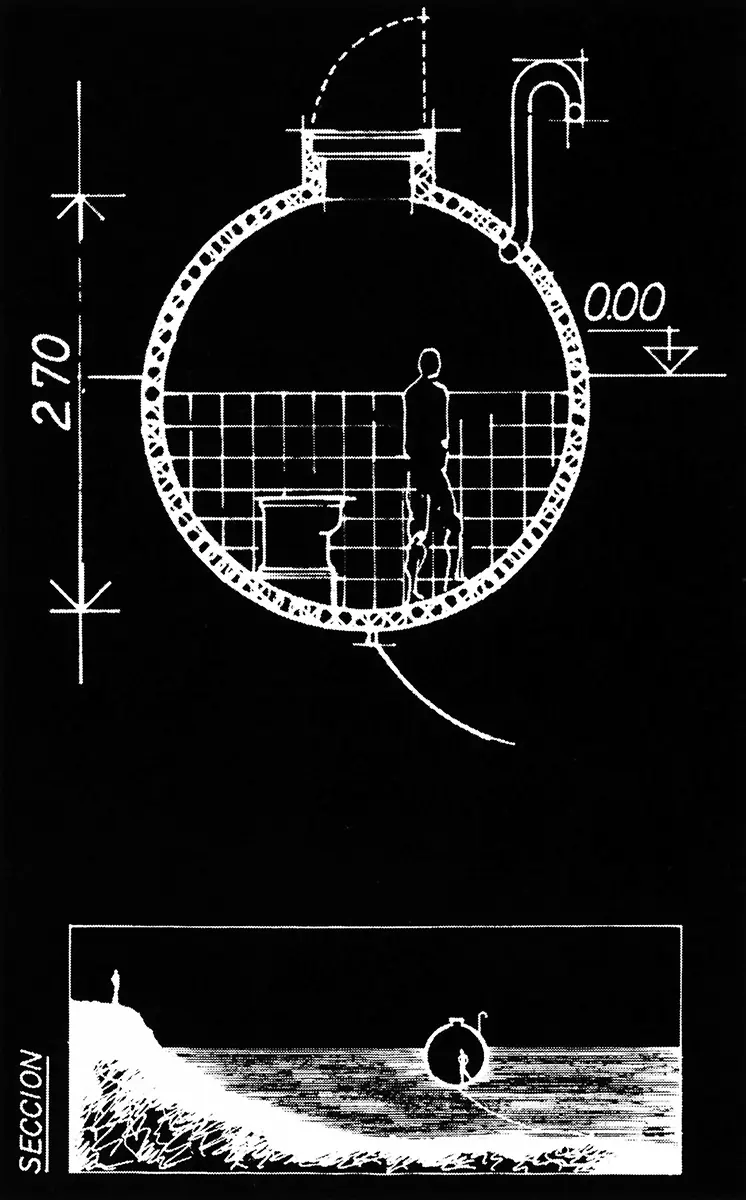
Like most of his colleagues in the Grupo de Los Trece, Zabala adopted in the 1970s a critical conceptualism closely linked to social reality. He sensed the violence of the military coup of 1976 styled as the Process for National Reorganization. Hence his Preliminary plans for a Latin American prison architecture for artists (1973-1974), included a small cell floating in the River Plate. Finally, the artist, who is also an architect, opted for exile in Europe. He lived successively in Rome, Milan, and Vienna, before moving to Geneva, where he now lives and teaches art and new technologies at various universities as a visiting lecturer.
"My works —he has said — are located halfway between confession and criticism”. In line with this view, the theme of violence gave way in the 1980s to a critique of information systems, with the press being the main target. His production from this time consists of drawings of pages of newspapers where the texts have been erased. There remains only the formal design, the structure, and the effect of color in the memory of the reader. The content, which is always absent or veiled, speaks effectively of an administered world, a world that is accelerated, over-informed, and dominated by transitoriness, evanescence, and void. “I am interested in contemplation, repose, writing and its slowness, which are all disappearing”, the artist says. But these works do not only refer to the general negation of writing in the contemporary world. They also denounce, through the elimination of information, a particular situation of censure, distortion, and disappearance of events that really took place.
Paradoxically, from a technical point of view, Zabala’s works from the I980 become unique pieces, unrepeatable, although they derive from copies that transcend, in their multiple destiny, the idea of the original.
In his work from the 1990s, Zabala turned to new technological media. Art or the World for the Second Time is an interactive work, an infinite work in progress produced by the Centre pour l'image Contemporaine of Geneva. This book game is presented on the Internet (http://www.sgg.ch/zabala) as a hypertext document that includes 1.000 quotations from 547 authors: artists, poets, historians, architects, philosophers, musicians, and thinkers from all ages. The spectator is invited to leave his or her own message on the net. Through writing —a sinuous trace of a virtual journey— the visitor can become a co-author of the hypertext and a reader of himself or herself. In line with his interest in works that deal with “memory and imagination”, Zabala proposes to reply, in particular, to ten questions concerning art, beauty, death, time, globalization, the abuse of images, and amnesia.
"This an unfinished project, a place of transit which can be crossed at any time; it is not a spectacle, it is a place for reflection, a fabric which is being woven all the time, Zabala has said in defining his current work, which is the subject of a forthcoming publication by the National University of Rosario, titled El Arte o el Mundo por Segunda Vez."
It remains to be seen whether essays of even timid participation as proposed by Zabala can be considered authentic acts of creativity or as merely approximate parodies of the latter. Only time will tell.
ELENA OLIVERAS