
Juan Calzadilla (Venezuela, 1935) is better known as an art critic and poet than as a draughtsman. However, his artistic efforts go back to 1959, when he participated in the Official Salon of Venezuelan Art, and 1962, when he had his first one-man show. Since then, he has constantly participated in group exhibitions and has held solo exhibitions approximately every two years. In 1997 he was awarded the National Plastic Arts Prize, for his contribution to the development of Venezuelan art in the disciplines of plastic creation and art criticism.
The constant nature and quality of his work have enabled him to acquire a special place as an artist in the cultural environment of the country. Speaking as one critic to another, here I am using Caizadilla’s own words, "drawing is closely linked to writing. In a sense, one draws in a way that is very like that used in writing by hand. So much so that I believe that drawing is like a kind of visual writing, composed of meaningful images and in which, in plastic terms, both sign and meaning are the same. So I find in the first draft of a poem or the page of an article, written by hand, a correspondence with the page of support in which, following the direction of the calligraphy, a drawing is made, whose forms may be abstract or figurative. The habit of writing by hand and then using a typewriter or word processor has had an influence on more than one of our draughtsmen, in terms of ideas or material which may be anecdotal, descriptive, autobiographical, deliberately symbolic, or of any kind."
Juan Calzadilla’s drawing brings into movement the sense of experience, by recording a human action. Thus his characters are wandering figures which he places on the artistic scene. The human race as a whole in a pose, a gesture, or attitude, enters into complicity with the spectator as the horizontal columns of contorting figures assume their autonomous positions. There is a sequential repetition of little figures in constant movement, which stand out and yet become blurred in space, without losing their autonomy. Calzadilla has said in speaking of his work that "the drawing techniques which I use have been, in this respect, those which have been closest to the writer's craft, and those which, paradoxically, most refuse to discover in drawing any literary objectives, any sense of mimesis or the representation of any given thing ... the image emerges in one go through the impulse which generates it, and that's it. Thus does Calzadilla define his conceptual discourse."
A pseudo-narrative drawing of little figurative images, of beings coming together in a premeditated manner, and telling, perhaps with a hint of sentimentality, their schematic personal stories. As a means of “composing” his works, Calzadilla establishes a kind of strip of cinematographic film, which does not exist as such, but which acts as a plastic proposal of an infinite kind; in a few revolutions per minute, this strip of film confronts truth with fiction, as in a comic strip. In an atemporal continuum, the almost calligraphic figures make up a kind of scene that begins to move. The strips are silhouettes, stories with self-portraits of figures emerging from the surface of the support, but where also the morphology of the nude questions the conditions of its presence on the support.
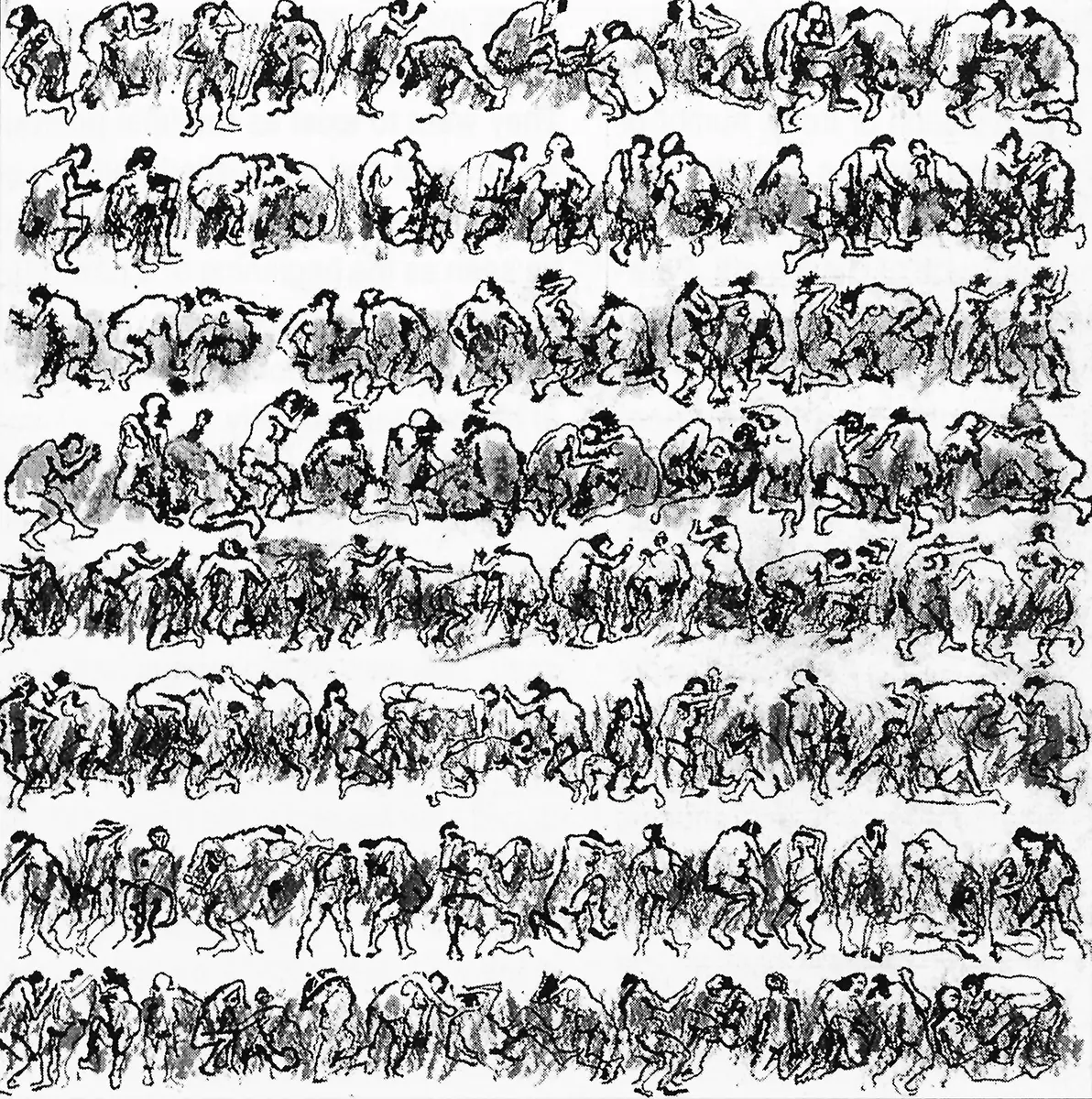
Perhaps what Calzadilla achieves in his linework of contorted figures and oriental calligraphy is a kind of inventory of fables, in which the use of relief creates subtle virtual drawings which are more sculptural than flat, reminiscent of the three-dimensional active lines of the Renaissance. In this way, the artist-poet invents a universe that reveals the artist’s attempt to alter above all the sense of perception, as well as the most everyday signs of the universe most familiar to all human beings: the human figure.
BÉLGICA RODRÍGUEZ