
The image as the vehicle of a poetics that champions appearance over reality, the impact of seductive elements in the illusion of deceiving the eye as an object of art, but real in the context of actual reality and space as a means of communicating meaning are all fundamental features of the current work of Pedro Tagliafico (Venezuela, b.1944). From the beginning, Tagliafico has been concerned with the investigation, the search for knowledge, and the exploration of all the possibilities for ensuring that the plastic resources which he himself has invented are useful in the creation of a work or group of works. It is clear that by being constantly exposed to other cultures, and other ways of seeing and living (Tagliafico has lived in various countries of Europe and for a long time has been dividing his time and creative activity between Italy and Venezuela), coupled with his experience in the tropics of the Caribbean, Tagliafico has tempered and shaped his attitudes and thoughts about artistic creation. His work is universal, and his artistic language has been enriched with elements originating in the different countries of the Caribbean (the power of the light, color, and the magic of transparency), the arte povera of Italy, and other currents such as constructivist art and minimal art.
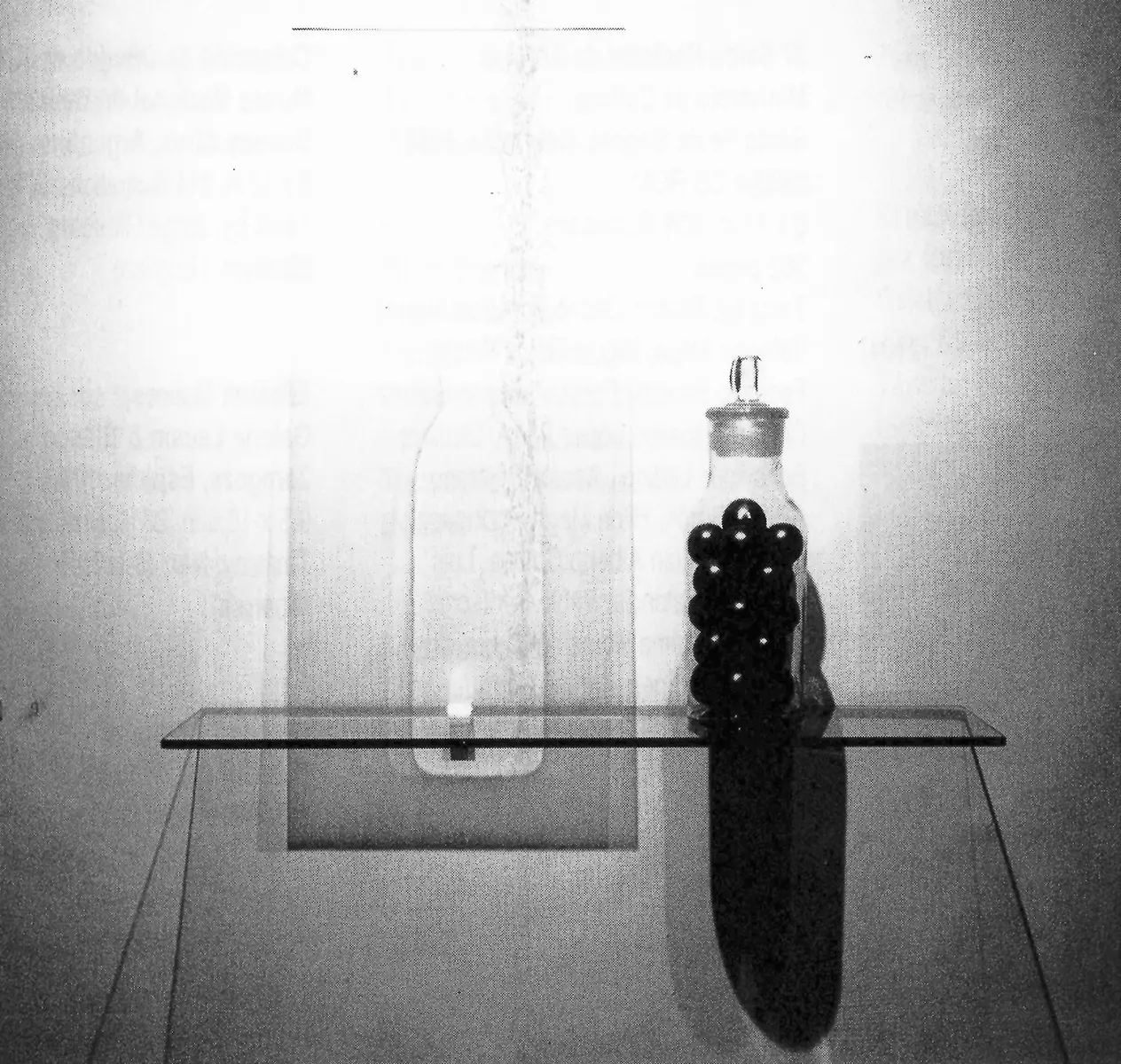
In all his work, he evokes but only evokes reality through the distinction between what is natural and artificial. Using this concept, he has been able to construct a visual body of work that places him amongst the major contemporary conceptual artists, in the ranks of post-contemporaneity, rather than "postmodernism”, which is no longer in vogue. In the 1980s I described his work in terms of an “organic constructivism” when referring to a series of pieces grouped together around a number of boxes systematically organized in terms of their internal elements within a constructivist spatial order. But Tagliafico’s work has moved towards large installations in which the competent use and combination of materials (for example, water with glycerine and rusty metal or salt with copper) have become an important part of the conceptual proposal. His creative process is based on a culture of evanescence, resulting in images that seem to be the product of the moment. A system of "notes” which fixes marks or the moments of events in the everyday life of a human being, but which transcend the mere observation of reality through a poetics that achieves the most sublime forms of immateriality. The elements which the artist uses (crystal, glass, plumbs, words, papier maché balls, empty stretchers, ordinary objects such as coffee pots, bottles, plates), with the wall always being the pretext/ support, are resources that give importance to the act of creation itself. Tagliafico establishes a dialogue between his materials-for example, as in the work 1, 2, 3, 4 (1997-1998), an assemblage in which an empty wooden stretcher acts as an enclosure for a nonexistent conventional composition and drawing based on a synthetic system of four nails as points of tension, and from which four elastic threads hang, ending with four paper balls, and which is projected as a relief work and as a shadow on the wall.
The particular language of each element contributes to the meaning of the image as a whole, making it almost a kind of hermetic visual poetics whose spirit is fully communicated to the spectator. In the wall installation titled I don't know (1997-1998), an art deco bottle, full of ping pong balls colored with black graphite, is repeated in its shadow and on the glass plate, reflecting a constant feature of this artist’s work: his concern with dominating real, fictitious, and spiritual space, through actual physical qualities such as volume, surface, texture, transparency and physical certainty, as well as those of an emotional kind which take account of the affective relationship with the spectator. Good taste, technical perfection, and preciousness in the fabrication of each object are integral parts of the latter as elements that denote meaning and generate emotion. The visual clarity of the concept is surprising and interesting in the almost religious mystery created by each piece placed in the space which belongs to it as a matter of principle, inviting the spectator to engage in an act of emotional and intellectual contemplation. The visual effectiveness is in proportion to the degree of legibility, which although hermetic, is facilitated by the keys and indications provided by the artist which enable the spectator to reach an understanding of the work at both the intellectual and emotional levels.
BÉLGICA RODRÍGUEZ