Latin Americans are still painting. For the better part of the decade of rampant hostility towards the practice, several generations of Latin American painters have illustrated this fact in galleries, museums, and art fairs around the world. Perhaps no one has been more faithful to painting than Ray Smith, an intensely polyglot artist, fluent enough in the shifts of multiple traditions to keep from being pigeonholed by the smug cliches of the art market and political correctness.
What the best artists south of the border understand, namely, that Latin American culture, by reason of its colonial legacy, is inescapably inscribed within a Western tradition, and that successful art must continually repossess this tradition in order to find other ways of being western—Smith evinces in spades. His work, alternately understood as fantastic, magical realist, or surrealist, confidently mines diverse sources from across eras in at least three continents—Europe, Latin, and North America—creating canvases heavy with conflicting imagery and meaning.
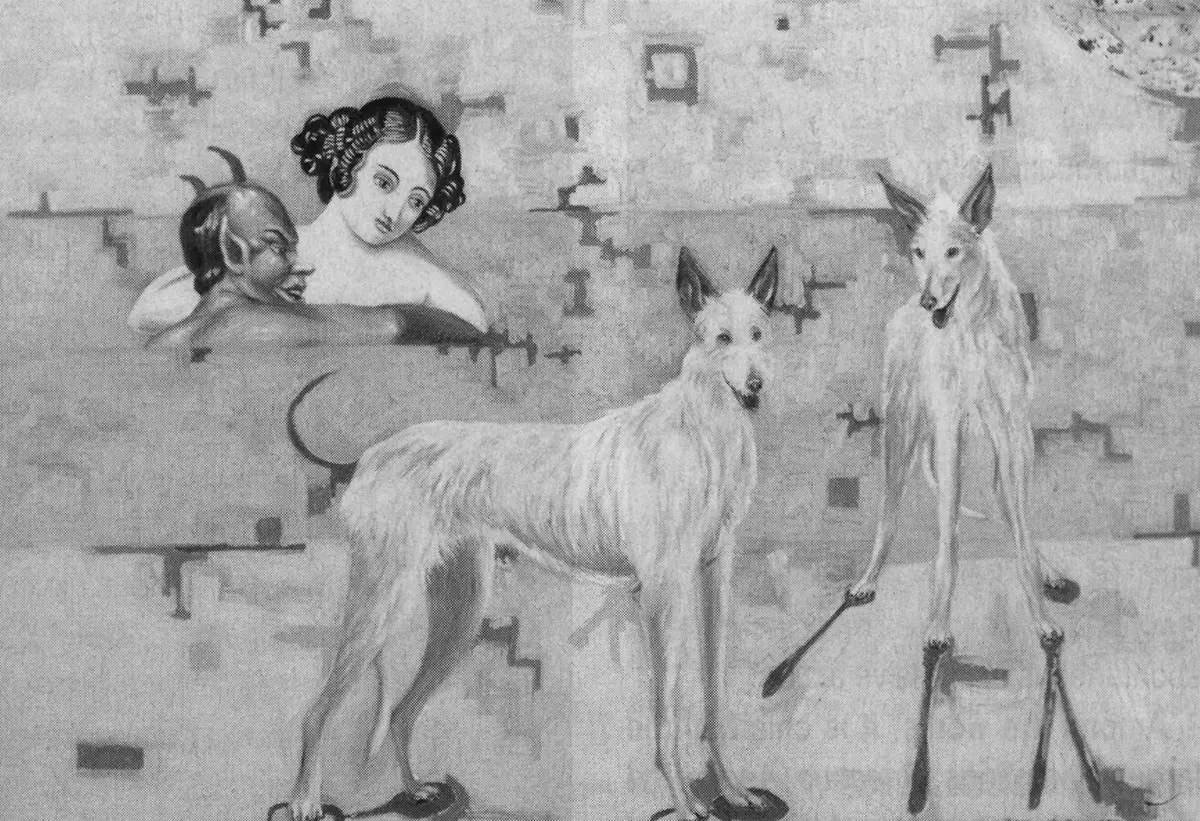
In this most recent exhibition at Ramis Barquet (the Mexican gallerist's second New York show), Smith opened wide his vast imagination to show off two distinct sets of new works. The first, a set of watercolors and paintings, displayed the animal and flamboyant landscape admixtures that have characterized much of his output. In these pieces, Smith's bestiary provides an analog to the mysterious humanity he wants to portray: birds, monkeys, zebras, and winged cats acting as ambiguous stand-ins for human counterparts whose pictorial description he generally avoids.
Paintings like Arbolitos poéticos (Poetic trees), Chihuahua, Perros de piedra (Stone dogs), and Self-portrait with Dogs, allude to the mixed animal and human forms of Aztec and Mayan art while shedding their hieratic roles to cavort with classical iconography and the pinup poses characteristic of Playboy. The first painting, for example, unleashes figures typical of Smith’s store of images: it is a picture of a kneeling woman in medieval dress making an offering of canines to pruned tree- sculptures of the poets Rimbaud and e.e.cummings—a contemporary take on baroque contrivance, featuring dynamic oppositions and jarring contrasts.
The second set of works in the exhibition is three series of “exquisite corpses" done in different mediums. In these pieces, Smith takes perhaps his biggest risk, as they are executed according to the chance laws of this now classic Surrealist game. Combinations of three to four panels, the final assembled pieces stand out the sheer perversity of their mismatched encounters. Saint Clair, presumably after a portrait of the Brazilian artist Saint Clair Cemin, wears lipstick traces on his otherwise respectable face and carries a lady’s handbag. Richard, after the painter Richard Hull, another of Smith’s friends, plays peekaboo with a bunny and a jackass, while seated lotus style with a monstrous bottle of what looks to be the perfume Shalimar. The baroque extravagance of such pictures points to the relative uniqueness of an artist like Smith. After more than ten years of sundry declarations about the end of painting, he remains a figure willing to conflate close and far views of many cultures without resorting to the deadening and vacuous one-liners of our by-now canonical postmodern irony.
CHRISTIAN VIVEROS-FAUNÉ