
What do a family portrait, a series of maps of London s sewage system, various surveillance camera images, a virtual technology company, a hospital shelf, and a personal disco have in common? In a way, they are all manifestations of structures of power and a sense of order: the patriarchy, sanitation engineers and urban planners, the police, corporate barons, the medical institution, and even the DJ. Scattered Affinities, the exhibition curated by Nuria Enguita, brings together six artists whose works are loosely related by the way they ironically reflect on the influence of institutions on our lives.
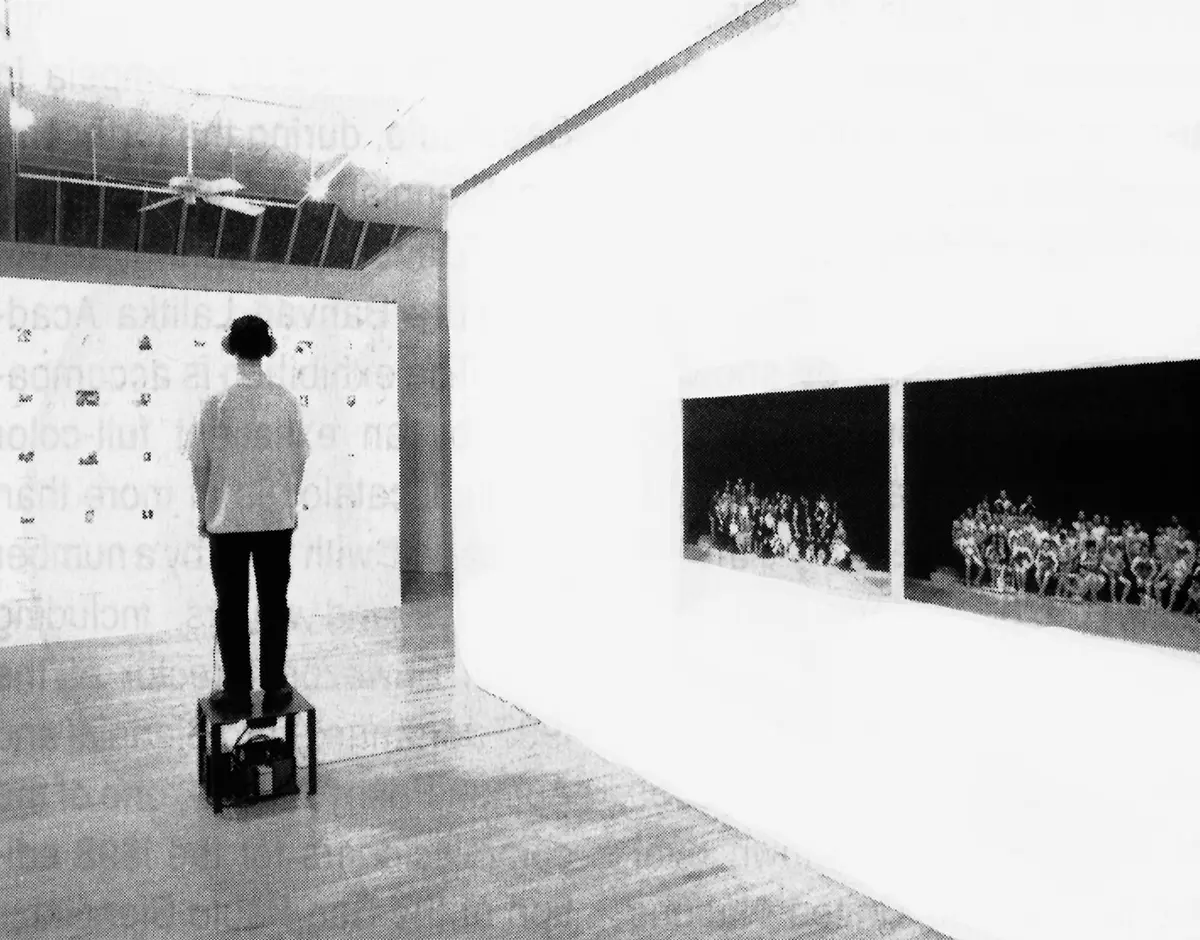
On the most intimate level, the Spanish photographer, Mira Bernabeu, tries to capture in Inner Circle children’s perceptions of their own family through two family portraits. One picture, a conventional group photo, shows the outward image, while the other —in which the same characters pose half-naked and covered with blood— expresses the hidden violence of the family members. Love, hate, unruly desires, frustration, and all sorts of tensions are expressed as blood smeared over the semi-naked characters.
The duality of these images is an ostensibly naive daydream- a nightmare that can be situated somewhere in between the daily dose of sadistic cartoon violence that children consume and the early, bloody performances of Hermann Nitsh. More than a commentary on family dysfunction (something that has become a favored ground for sitcoms and other forms of popular culture), Bernabeu's photos demonstrate that in our culture of excess and exploitation, blood has become a devalued shock currency and an inevitable icon in the children's imagination.
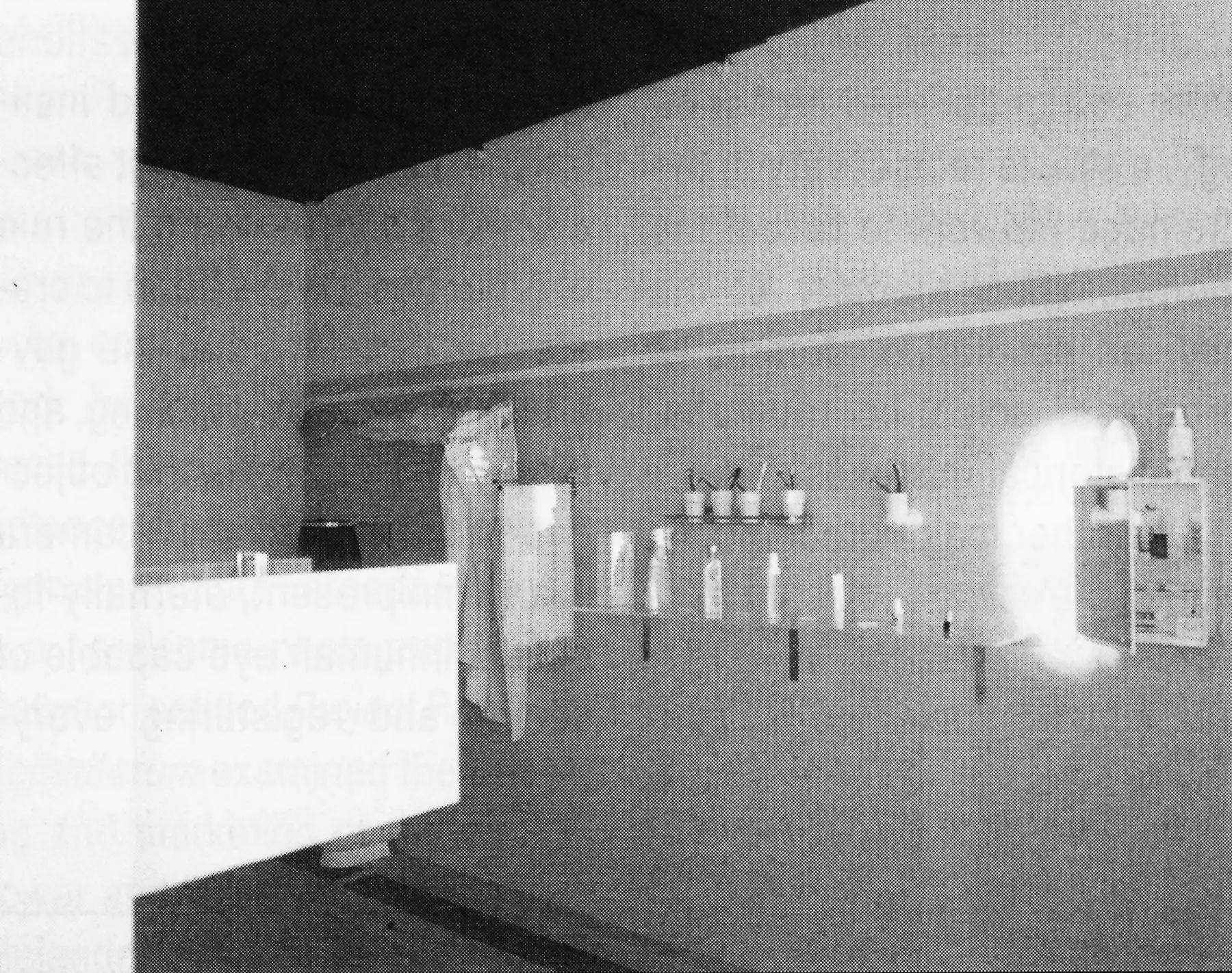
While the sight of blood is welcomed in media, the other bodily fluids are supposed to be kept hidden. Those social institutions dedicated to dealing with secretions and excretions are hospitals and sanitation departments. Eulàlia Valldosera (Spain) has recreated one very important element of the hospital experience in her installation Shelf for a Hospital Bathroom. Any notion of sickness, pain, or suffering is replaced by inanimate objects that represent the healing process, and the sight of any organic tissue has been substituted by “a material, which is both intangible and alive: light.” A series of meticulously arranged hygiene products are illuminated by the reflection of a beam on the mirror door of a cupboard in order to create what the artist defines as an “objectual journey."
The glow creates a spectral presence, a ghostly image that occupies the space left by the absent body.
Colombian artist, Juan Fernando Herrán’s Geographical Transformations, is an installation consisting of a series of drawings on the wall and photographs of London’s network of sewers and drainage systems. Through maps, texts, and images, the artist exhumes the subterranean rivers that were channeled and buried in order to give way to modern urban needs, ranging from roads to sanitation. As we know, any society can be read through its debris, and so the sewer system can be interpreted as an open book for historians and social scientists. Herrán proposes a more straightforward archaeology, a simple rediscovery of the drainage network to reveal the morphological memory of the city, an account of dreams of progress, scientific triumphs, and historical mistakes.
Like other major urban public works, the sewers affected hundreds of thousands of lives, transformed societies, and imposed new social disciplines. To enforce new laws, to control and punish, and, especially, to keep an eye on the population, the police and other protection-defense-repression organizations became professionalized institutions. One of their most effective ways of preserving the rule of the order has always been to create the certainty that the government is always watching, and the perfect device for this objective is the surveillance camera —an omnipresent, eternally-focused, inhuman eye capable of seeing and registering everything. Fixed Viewpoint is an interesting exercise in countersurveillance by British artist Heath Bunting —a sabotage campaign of the street CCTV (Closed Circuit of Television) system, that involves confusing the human operators of the surveillance mechanisms through a variety of methods, essentially relying on the fact that the cameras, even those capable of panning, can only have one fixed viewpoint. Bunting proposes using low-tech resources, like images lying on the pavement, or distributing several pictures of himself all around the city in order to create the illusion of a clone invasion and to present to the camera lenses all sorts of impossible phenomena.
Just as surveillance cameras offer more or less random images of the city and its inhabitants, Daniel García Andújar (Spain) presents Technologies to the People Collection, a series of images downloaded from the Internet deliberately or accidentally in the cache memory of some computers. This readymade, and apparently incoherent, gallery shows a glimpse of a virtual equivalent of the sewer, a technology absolutely necessary to the flow of information that was devised to be unobtrusive, silent, and invisible. The chaotic collection is a memoir of a universe doomed to disappear, an important part of the history of digital communications that will inevitably be erased. Technologies to the People was created by García Andújar as a virtual company whose only product seems to be its own image; it is a parody of corporate ideology, aggressive propaganda campaigns, and marketing strategies.
Finally, Jan-Peter E.R. Sonntag (Germany) offers a modern minimal disco 4, a steel pedestal, and a set of hanging headphones that provide an individual techno-trance experience and, at the same time, transform the viewer into an element of the show. Viewers isolate themselves by immersing in an acoustic space. In this way, the public space turns into a private one while the spectator is transformed into a monument to alienation, a vibrating sculpture controlled by a bombardment of sub-frequencies and pulsating rhythms.
NAIEF YEHYA