In an article titled "The End of Art, "1 the North American philosopher Arthur Danto refers to a statement by Hegel on the dissolution of art in philosophy, a dissolution related to the death of art, a term which in fact does not announce its definitive demise, but which refers to the end of a certain form of art, and with it, that of a certain conception about art. Both philosophers point out the tendency of art toward reflection as a problematic circumstance; romantic art in the case of Hegel and twentieth-century art in Danto. The latter believes that from the avant-gardes to the present, an artistic work inherently involves the existence of a theory that must be known in order to understand or discuss that work. This confirms the prophecies of Hegel since at present, "the artistic object is so imbued with theoretical awareness that the division between object and subject has almost disappeared, and it matters little whether art is philosophy in action or if philosophy is art in thought." A little later, Danto completes these ideas with a quotation from Hegel: "Today, the artist invites us to contemplate it in an act of reflection... in order to discover scientifically its nature" (p.53-54).
Through the Mirror: Self-reflection in Painting, presented at the Museum of Modern Art between March and May of this year was curated by Carmen María Jaramillo. The exhibition took as its starting point precisely the reflective situation of painting, a genre that has also been "threatened with death as a result of the changes which occurred in the 1960s and 1970s, and it did so from the perspective that the issue of the death of painting is obsolete. Such a question would correspond to a Hegelian conception of history, in which a gradual development implied in the idea of progress in art-culminates with the abstraction of the 1950s."2
Thus reflection is shown as an essential characteristic of a painting of this decade, as illustrated in the works of ten Colombian artists "which provide evidence of a gaze towards the painting itself." The artists created specific works for this particular place and event. The curatorial proposals were precise. On the one hand, the account was taken of the fact that painting today shows the clear influence of conceptual art, differentiating it from the painting of the 1980s which was close to expressionism. Now, "the objective is not a strident exaltation of its values, but a careful reflection on the scope of its language and its relocation within the context of contemporary art."3 Furthermore, an essential feature is a link that contemporary painting establishes with the space it occupies; the latter becomes an essential category so that "any painting requires the appropriation of the place where it is located, like any installation."4
What I would like to do in this review is examine the reflective situation of painting, bearing in mind the unity of sensory and conceptual elements, which was an important factor for the curator when, in defining the ground rules, she found that in their production, some artists, despite engaging in a reflection on the medium itself, do not do so from a purely conceptual point of view and reveal their delight in the senses, the enjoyment of their materials and of the act of painting itself. Although the sense of craft has been lost, the sensual element continues to be a decisive factor in approaching a painting. This unity also appears in the perceptive act, insofar as the sense-based approach to the works and an understanding of the ideas that those works contain, fuse together "into a single process because perception is, in the final analysis, a combination of mental, physical, and spiritual processes."5
On entering the first room of the exhibition, the spectator discovered the works of María Fernanda Zuluaga and Jaime Iregui, which illustrated the dialogue that the pieces on display established with their environs. Zuluaga, the youngest participant, presented an installation titled Flight of painting, composed of a series of large format paintings, subtly worked in very light tones on canvas with regular edges set with blue and yellow acrylic sheets, cut into waving forms which, because of their transparency, adapted to the painting and the wall, or established a mimetic relationship with the large windows around the gallery space. These pieces, seen together and from a distance, managed to create a very dynamic relationship with the open space of the museum.
The other work in the room was by Iregui and has been rightly described by the artist as a reflection on three universes that concern not only painting but plastic objects in general. The first is the physical world which is directly related to architecture and dimensions in space, something which can be transformed by the intervention of objects. The second universe is that of language which is related to the universe of feeling. Finally, there is the universe of observation, which concerns the perceptual world of the spectator. His work titled Titanic had a powerful presence. It consisted of four geometrical yellow pieces in various sizes, which created spatial tensions and managed, through their strategic installation on the grey walls of the museum, to interact with a space that in itself was complex, so that the artist’s reflection was evident in the installation of the objects and their inherent material nature, without the need for rhetoric.
On another floor was a work by Danilo Dueñas tiled Preserved Space, that immediately attracted the spectator’s attention. From a distance, it appeared on the corner of a large section of the Museum as a white, rectangular volumetric body, on which the light from a large window fell, with another much small body on the wall indicating the relationship of the work with the wall. When the spectator came closer, he could see an impeccable white Formica surface which, like a table, contained a number of small and medium format paintings, done in a non-traditional manner closer to assemblage. For these pieces the artist used wood, mixed media, and masking tape, preserving, in the process, the language of pure geometrical abstraction. Dueñas' intentions, according to the artist himself, were based on the idea of "doing as an act that implies reflection, moving through the layers of paint to the wooden support, eliminating the abstract image but retaining its strata-imagined strata which constitute paint, lapses of paint. How deep is the color? How deep is its transformation into another?"6
In this work, in which Dueñas works on a more reduced scale than usual —I am thinking specifically of his installation at the 1996 National Salon—he seems to resolve certain ideas which have been in his mind for some time that is related to the relationships his pieces establish with space. According to the curator, "the table which acts as a support for the paintings, also deprives the wall of its role as the natural frame for the pictures. They are presented as they were conceived in the studio, that is to say, on a horizontal plane that alters the codes of reception and exhibition of a work of art."
Seen from a distance, Rafael Ortiz’s work, The cost of leaving things like that, also evoked the stages of abstract painting that have moved throughout this century. Placed directly on the grey walls of the museum, it offered an attractive interplay of color which, like a series of geometric collages, made up a kind of mural which evoked memories of abstract painting. On closer inspection, the visitor was surprised by the fragility of the work used as its support ordinary handkerchiefs which had undergone pictorial treatment. On establishing contact with the materials of the work, the spectator moved from a set of cultured pictorial associations to the everyday world. On questioning its meaning, one only had to bear in mind these two conditions of the perceived object for a world of possible meanings to be opened up related to Ortiz's intentions. His use of handkerchiefs in the work reflected his desire "to activate a deep motivation, namely to link, move and affect public concerns. Concerns, as Ortiz points out, involve little human stories."7
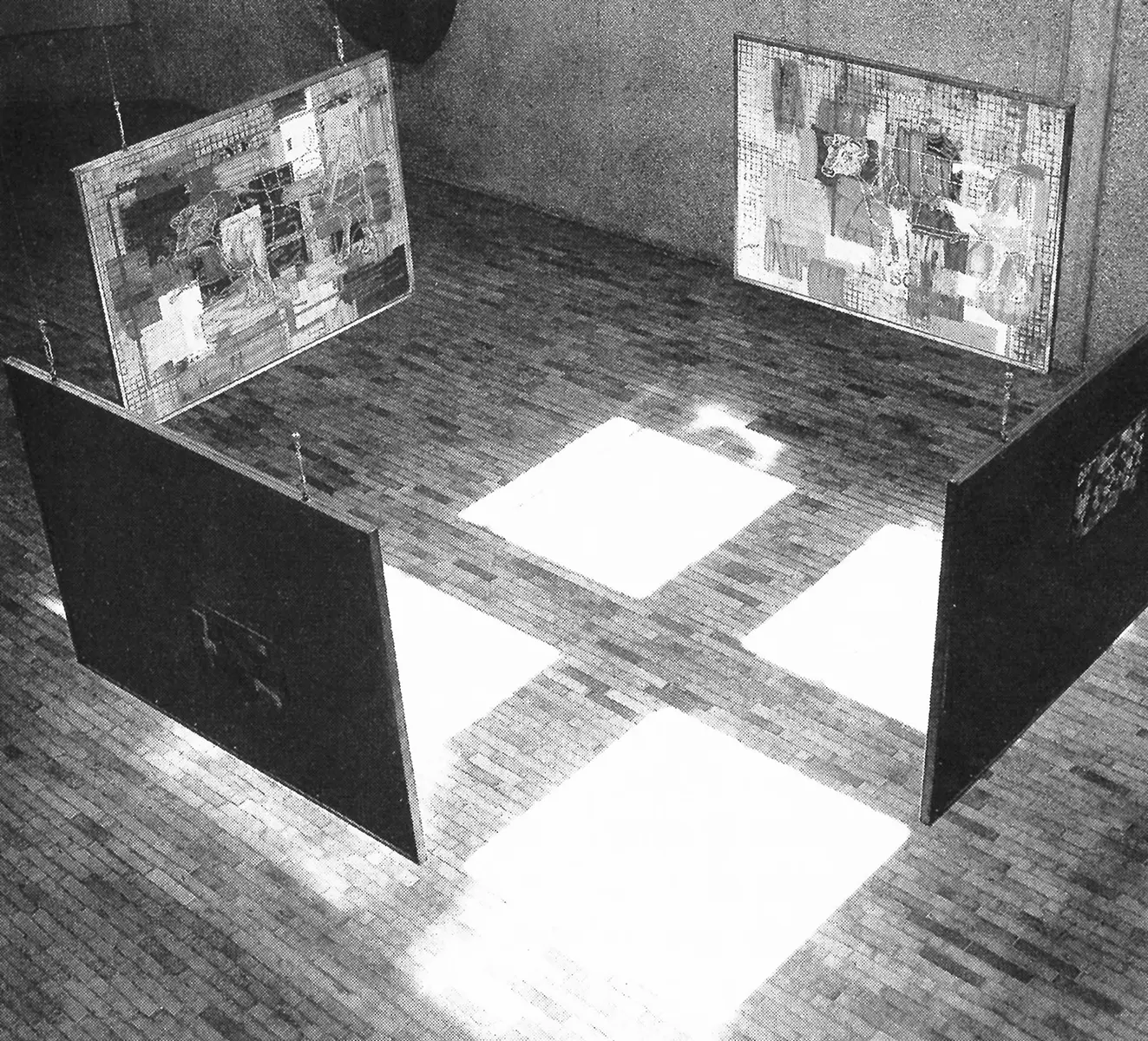
The project of Víctor Laignelet, in his own words, took account of a dichotomy in Western thought between conceptual and material elements, between the spiritual and the sensual: "The true project of painting has always been one of knowledge. What has changed is the scope of the shaft of reality on which it concentrates its attention. There exists, of course, intelligence in the material finish of work and not only at the conceptual level, but the two cannot be divorced: intelligence is emotional and intellectual as well as corporeal."8 Laignelet’s project, titled The docility of the cow, consisted of an apparently simple construction in which the sensory pleasure of the painting was immediately evident. The work was made up of four sheets of iron which served as a surface for the painting of a cow which varied significantly in color, corresponding to the different seasons. The sheets made up a square space, with a circular mirror placed on top that reflected the paintings. Although I said that the form was simple, the meaning of the installation was complex in that its distribution and spatial location, as well as the forms used —the circle and the square— reflected a symbology related to gothic cathedrals, and evoked a spiritual that linked art to life.
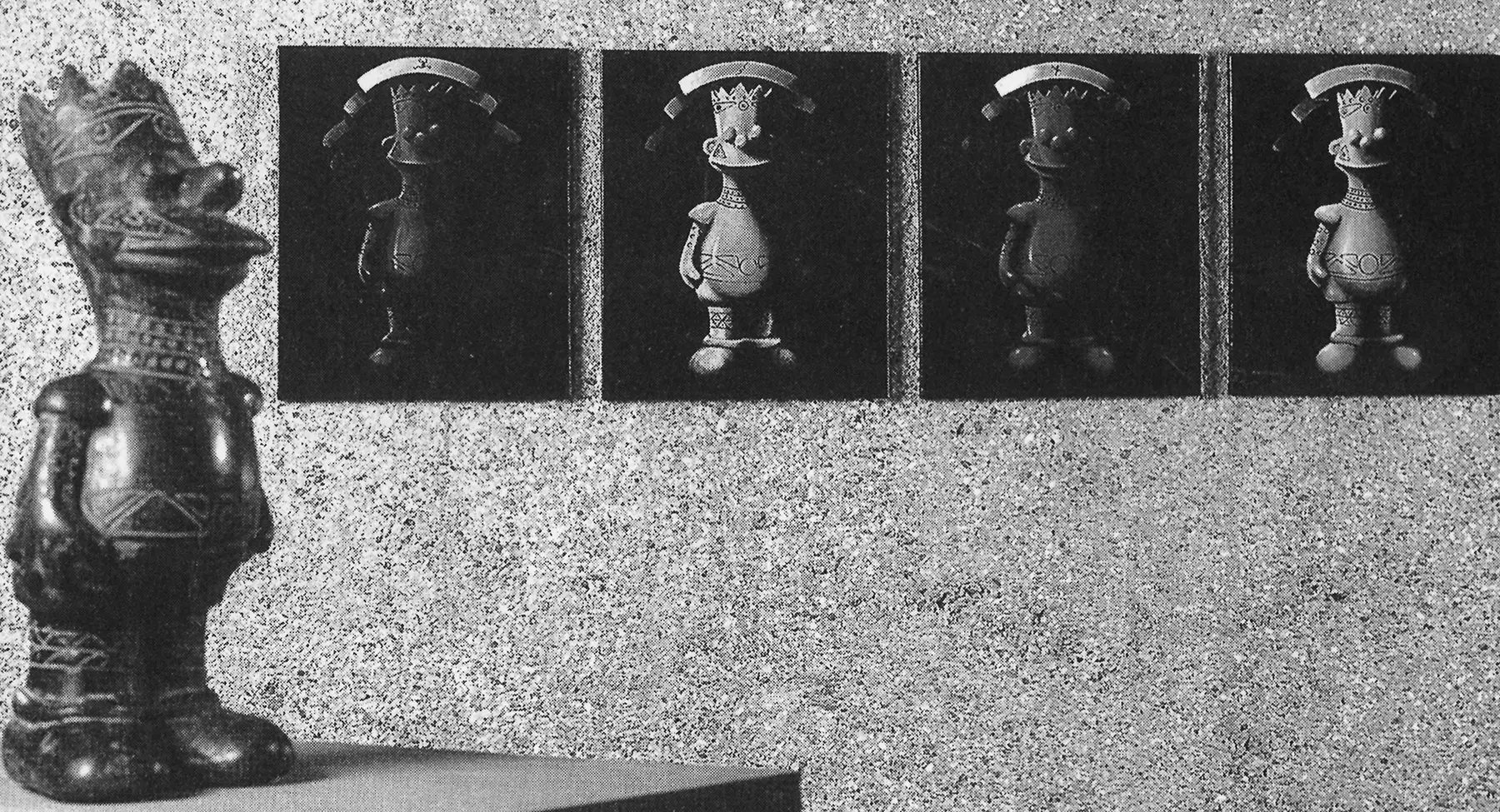
This floor also included works by Nadín Ospina, Carlos Salas Silva, and Luis Luna, who each presented very different pictorial proposals that provided various points of reflection on painting. For example, Ospina has been pursuing a series of reflections on different themes related to the forms of artistic production. On this occasion, through a series of objects and paintings on the theme of Bart Simpson, she examined with considerable humor events dealing with the painter as an author and with the manual materialization of a work. For this project, Ospina acted as the intellectual author who, like a director, gives shape to a project that is carried out with the collaboration of various painters.
Salas presented a fragmented painting in which he re-used a large longitudinal piece of canvas from 1989, with an apparently free finish, stains, and splashes of color. On it, he placed almost monochrome wooden modules, made in 1994, which broke the two dimensions of the canvas. The work established relations with the wall through its careful distribution in space, and also seemed to provide a special link, perhaps one of reflection, to the artist's own work process as it involved the use of earlier works. The upper floor of the museum housed installations by Luis Roldán and Maria Elvira Escallón.
At the end of the exhibition, a catalog was published that presented and analyzed the works on display from the points of view of the artists and the curator who, as noted earlier, made some important observations for the understanding of contemporary art.
NOTES
1. Arthur Danto, El Paseante magazine, triple number, 23-25,1995, p.31.
2. Carmen María Jaramillo, A través del espejo. Autorreflexion de la pintura, exhibition catalogue, Museum of Modern Art, Bogota, 1998, p.9.
3. bid, p.6.
4. Ibid.
5. Ibid, p.8.
6. Danilo Dueñas, A través del espejo, Autorreflexión de la pintura, exhibition catalogue, Museum of Modern Art, Bogota, 1998, p.22.
7. Rafael Ortiz, exhibition catalog, ibid. p.32.
8. Víctor Laignelet, exhibition catalogue, ibid. p28.
MARTA RODRÍGUEZ