
The definition of contemporary art in the Mexican context is a matter that is far from being simple or evident. The relationship of tension that exists between the most creative artists of our country and the situation both beyond and within our national frontiers has on a number of occasions resulted in debates and confrontations which seem unnecessary. However, there would still seem to exist a posture based on a dichotomy between the center and the periphery, which is used as a means of making value judgments and interpretations about the most recent art produced by Mexican artists. In this context, the latest exhibition by Tarcisio raises the question of how we can speak of his work outside the framework of the debates on nationalism and Mexican identity.
However we reply to that question, it seems to me important to set the figure and projects of Tarcisio in the broader context of non-traditional art. Tarcisio's works are part of what might be called the tradition of rupture established by the artistic avant-garde from the final quarter of the nineteenth century. It is here that his work becomes capable of functioning in more than one material, conceptual, regional, aesthetic, and artistic field, as well as being fundamentally characterized by the artist's recognition of and reconciliation with the sense of the ephemeral.
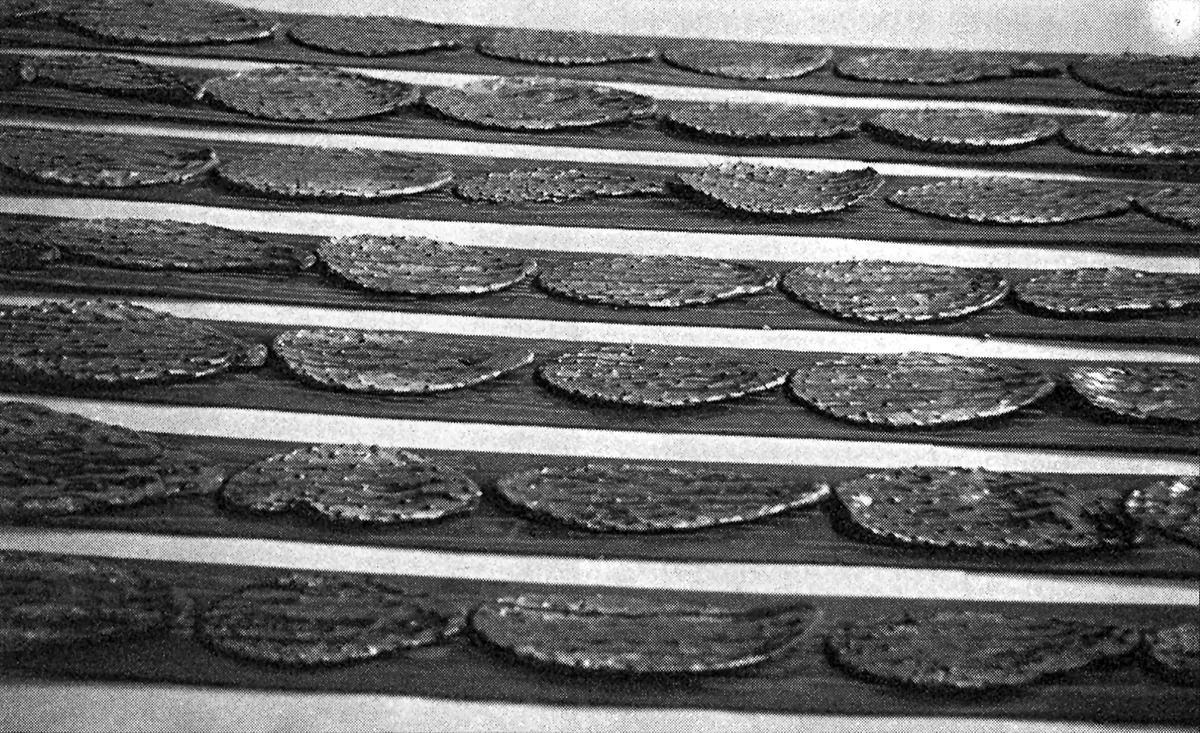
Eloy Tarcisio's works belong to a field of ephemeral art whose subjects are constantly changing, as are the solutions themselves. They evoke experiences that are possible only through such living works as the Seven-day view of Huipana Michoacán, a work that was awarded an honorable mention at the First National Encounter of Young Artists in 1981. It consists of seven wooden planks on which nopal trees daubed with chapopote have been nailed. The work was part of a tribute to the artist's father and to farm work in the Michoacan countryside but was also a protest against the vacuous internationalism symbolized by the Nopal curtain of Cuevas.
A significant feature of all of Tarcisio's work is his capacity to use materials and references that are obviously local, without limiting them to an exclusively semantic or iconographic reading. On the contrary, the formal and compositional aspect of his undertakings has the effect of achieving a transubstantiation of his materials and motifs. They are what one sees-hearts, petals, blood, seeds, nopal trees-but they are also something else, and it is this "something else" which always has to do with a vital and integral aspect of the human condition. In this sense, the ephemeral element is not only literal —in that the materials and supports of the pieces are obviously degradable— but the works are presented during the actual process of transformation, precisely because they are works of art (not objects). From this point of view the process-based character of much of his production is important: the work—it might be better here to speak of an "event"—, is happening before our very eyes, above all because we are there to bear witness to it, to integrate ourselves into the act with our own accumulated experience.
The capacity to distinguish itself as artwork is a constant feature of his production. Whether we speak of his painting on found sheets of waste material, his frameless canvases painted with blood and fruit pulp, or his wooden planks or walls covered with flower petals or prickly pears, it is impossible to confuse any of these things with an accidental event or the exclusive product of chance. These are intentional process-based works that reflect the artist's capacity to conceive of his art in different but simultaneous registers. In other words, the works have a vital function precisely because they do not fuse with everyday life: they are based on everyday elements, but they transform and translate these elements at the aesthetic and artistic levels so that the power of truth that they reveal has much more of an impact.
In his more recent works, Tarcisio has used seeds —either with mud or earth, or alone—to refer to a kind of ephemeral element that is quite different from that of his previous works. Whereas in the Seven-day view, the artist wanted to show the decomposition process of the materials, the current transformations of the seeds have a more productive connotation: the pieces are thought out in a way that enables the seeds to germinate and reproduce. In this sense, we can legitimately speak of rebirth. The career of Eloy Tarcisio thus shows how the two extremes come together in a circle that contains both creation and destruction. It is very probable that in order to reach this point, the artist had to journey through some very desolate, though nonetheless certain, kinds of experience. In any event, it is a creative process in which we can participate.
Thus the work of Eloy Tarcisio is contemporary in two senses. His proposals constitute a formal and conceptual link with the most topical kind of art, but the ephemeral dimension in particular reveals moments, fleeting acts of transit in the lives of those who experience them and who feel affected in such moments, in the presence of the experience, by his art.
ISSA MA. BENÍTEZ