
For the painter Jason Galarraga, a picture is the most appropriate place for meditating on painting, on the icons of the history of art, and on the pictorial space. This concept of the work as a support for the intrinsic ingredients of the visual dimension characterizes the work of Galarraga, who has been active on the Venezuelan scene since the mid-1980s. It was in Paris that he first defined his vision as a painter, and the treasures of the Parisian museums provided the iconographic and informative subjects which repeatedly shaped the profile of his own work. And Paris itself is constantly evoked in the plastic images of this artist.
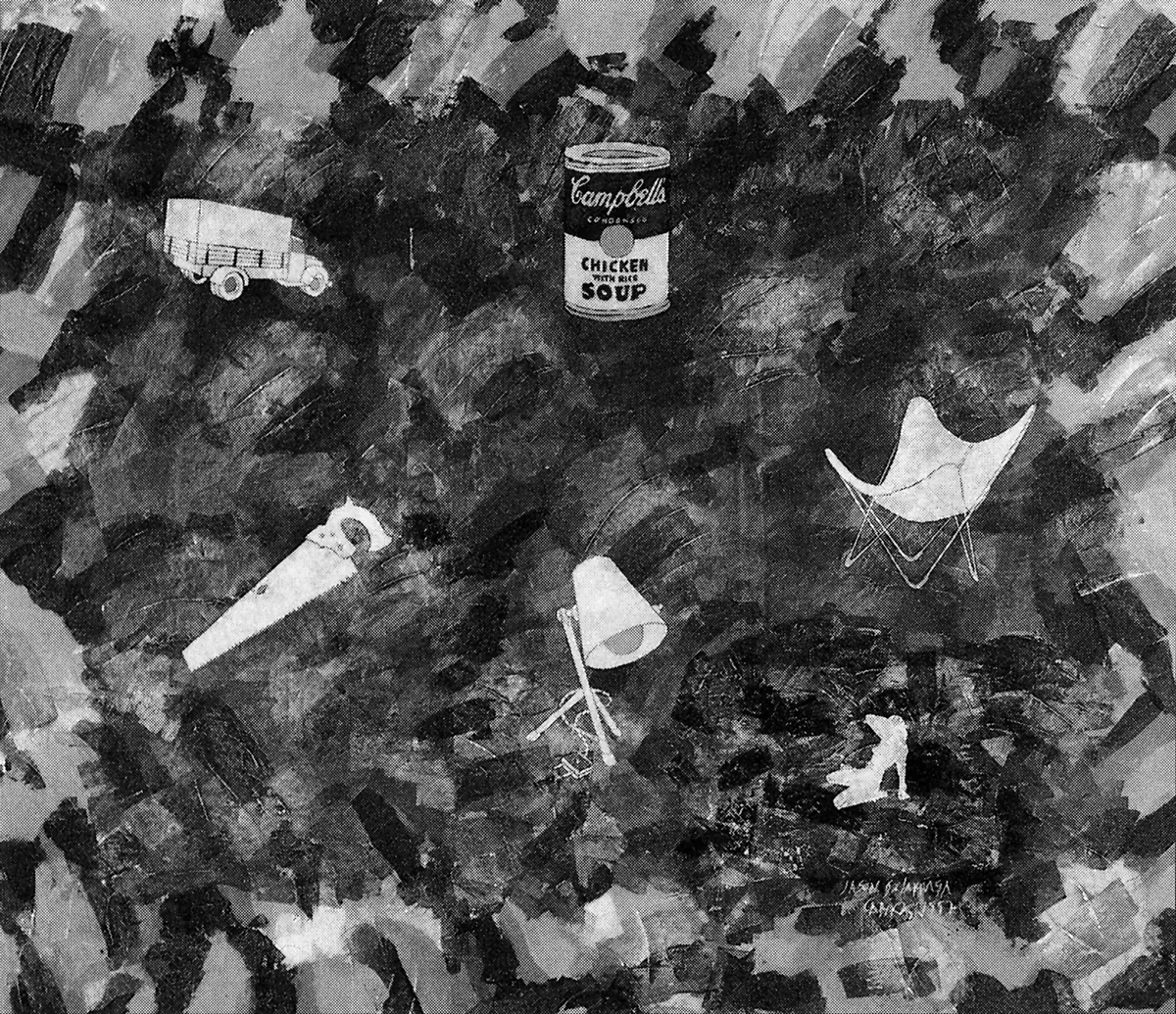
Thus his new show, titled Défense d'afficher, recalled the authoritarian instructions to be found all over the walls of Paris: "Défense d'afficher" (stick no bills). But for Galarraga, the reference is merely a kind of incantation. The canvas is the wall and there are no posters on it but the elements of pictorial phrases, the qualities of a painting with a broad textural register in which we find both openings and changes of direction based on the material itself. Then there are the few brief allusions, constructive notes, serial allusions, geometrical figures, chromatic areas, or references to art, whether to Ingres or Duchamp, as well as the reproduction of popular French designs, including the Gitanes cigarette box.
Galarraga insists on the codes of his painting, at an uncertain frontier between painting proper and drawing, between broad sweeps and detailed references, public and private, in a visual field that is characterized by both a richness of ma- terial-the palette and its progressive contrasts-and the use of letters, writing and printed phrases. The letters might be seen as a kind of alphabet or as forming a particular word, but without reference to its actual meaning since they seem to be functioning within a new pictorial setting where they act as an element in the code being proposed by the artist.
The art critic María Luz Cárdenas was quite right in describing this work as a kind of model to be assembled, "in which (Galarraga) breaks the uniformity of the canvas." Thus Galarraga's great strength is that he works from figurative codes, without proposing theme-based series.
These are large format works, free from motley motifs. They are engaged in a process of mutation with the concept of drawing (he uses acrylic, oil crayons, and graphite on canvas) and utilize characteristic freedom in the way the material functions. Public elements limited to an urban context are combined with letters that suggest common and shared convictions and emblematic images that are immediately recognizable. Yet at the same time, and with equal intensity, there emerges a private realm that provides a means of reflective identification with the codes, features, and atmosphere of a kind of painting that encourages the invention of another im- age-that of memory (within the context of the culture and society which we share) and firms links rooted in the immaterial.
JUAN CARLOS PALENZUELA