A series of works by Luis Frangella (1944-1990) were chosen to inaugurate a new exhibition room in the Borges Cultural Center that will add to its already spacious installation areas. Key works of this paradigmatic figure of the 1980s in Argentina filled the walls of the resplendent new room. Both the works and the place itself created a stunning effect. The art seemed to have found an appropriate setting that allowed the spectator's eye, as well as his body, to move freely around.
An enormous 9,40 m frieze illustrated the artist's capacity for expression. Like other members of his generation, Frangella rediscovered the pleasure of painting in the 1980s, after a period in the conceptualist camp. But despite his decision to once again dirty (his) hands with paint, Frangella maintained his interest in studying the mechanisms of representation. And it was precisely his experiments with the possibilities of painting that gave a unique stamp to all his work. Affective elements coupled with reflection, as well as the combining of spontaneous gesture with the distance imposed by a constructed mental model, were to mark the different stages of his personal poetics over the course of time.
After graduating as an architect in Argentina, Frangella traveled to the United States in 1971 on a scholarship from the University of Buenos Aires, and on the invitation of Professor Gyorgy Kepes, Director of the Center for Advanced Studies at the Massachusetts Institute of Technology (MIT). At the end of his scholarship, he was awarded another grant from the Center, for the period 1973- 1976. In 1976, he settled in New York City, where he died of AIDS in 1990.
Back in 1977, in his native city, Frangella won a prize that was sacred for the artists of his generation: the Marcelo de Rider Prize. Work opportunities and recognition soon followed in the United States. In 1982 he was awarded a Guggenheim Fellowship. Then, along with David Wojnarowicz, Jean-Michel Basquiat, and Keith Haring, among others, he participated in the spontaneous coming together of the graffiti and neo-expressionist artists in the East Village.
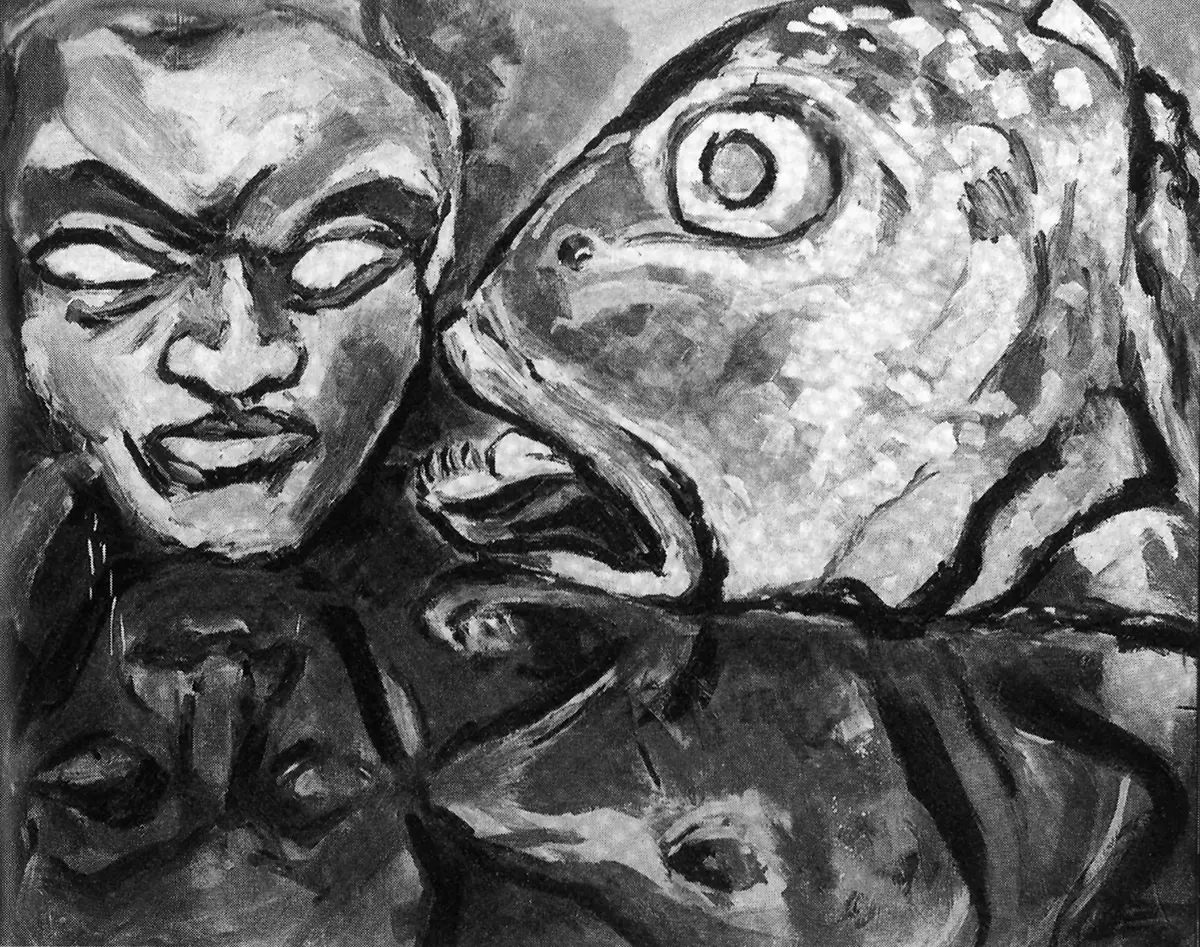
Seen through the prism of time, Frangella's work appears more and more convincing. The paintings on show at the Borges Cultural Center were a rounded expression of the power, vitality, and exuberance attained by the neo-expressionist movement in the 1980s when painting itself became the main theme. Enormous brush strokes of black, red, yellow, and green color delineate the fragmented images of hands, feet, heads, and torsos which can only be read as such from a certain distance.
Following in the footsteps of Leonardo da Vinci, Frangella seems to have believed more in observation and experimentation than in the philosophy that univocally fixes objects in the world. Hence his interest in unlearning the rules of mimesis. He systematically put to the test the presupposed principles of representation and questioned the protagonism of the figure with respect to the background. For this reason, the figures and backgrounds in his paintings alternate in the foreground. This dynamic situation contrasts with the stable frontality of the drips which reveals the material texture of the support as something real.
Although the image of the classical torso-a dominant motif in the history of art-is repeated in his work, it is not his only theme. It would be more precise to say that it acts as a kind of tray on which the artist serves up the theme of form and color. A careful observer of the objects surrounding him (a tool, a glass, a knife, a pencil, a bibelot, a glass sphere), Frangella takes pains to investigate their formal and chromatic characteristics. He is not interested in extracting contours, but in studying the varied effects of light on the surfaces of things and how, in the reflection and shine of things, a dynamic relationship is established with space and how space penetrates the objects through that brilliance and shine. He seemed to be fascinated with the effect and for this reason, he transposed it to the canvas by modulating the size of space in his objects, with stains and violent, overflowing brush strokes of a masterly kind.
Like John Cage, with whom he collaborated on more than one project, Frangella used to consult I Ching, in order to determine the size and shape of the canvas. Both artists were guardians of the word and of silence. While the word, or rather, the impact of its content predominated in Frangella's gestural paintings, it was a silence that enveloped his immense monochrome surfaces that enclosed very tiny images of a clock, a funnel, or a hat. These and other works such as his series of masks done with pieces of ordinary card- board-were also included in this outstanding exhibition.
ELENA OLIVERAS