
"History leans toward histories lived on the day's edge".1
Art is a curious form of knowledge. It begins with experience and arrives at the idea, without ever losing the emotion. It is a living idea. Luis Roldán's (Cali, 1955) work manifests a form of thought that gathers art history as well as a series of experiences that put him in contact with histories lived day to day, and with the body. If we define the abstract as a thread that displays the sensibility of a period, without the added figures that tell a story, what is interesting in Luis Roldán's work is that he allows us to see a thought that reflects upon basic principles like proportion, the spatial values of color, spot, rhythm, and composition; but he also allows himself to be invaded and contaminated by what is near, like the adventure of walking down the street, emotion and chance. His trajectory shows some pieces more closely attached to the tradition of abstraction, and others that value what is lived, children's games, and myths; he seemed to need both attitudes in order to nourish that multiple reflections.
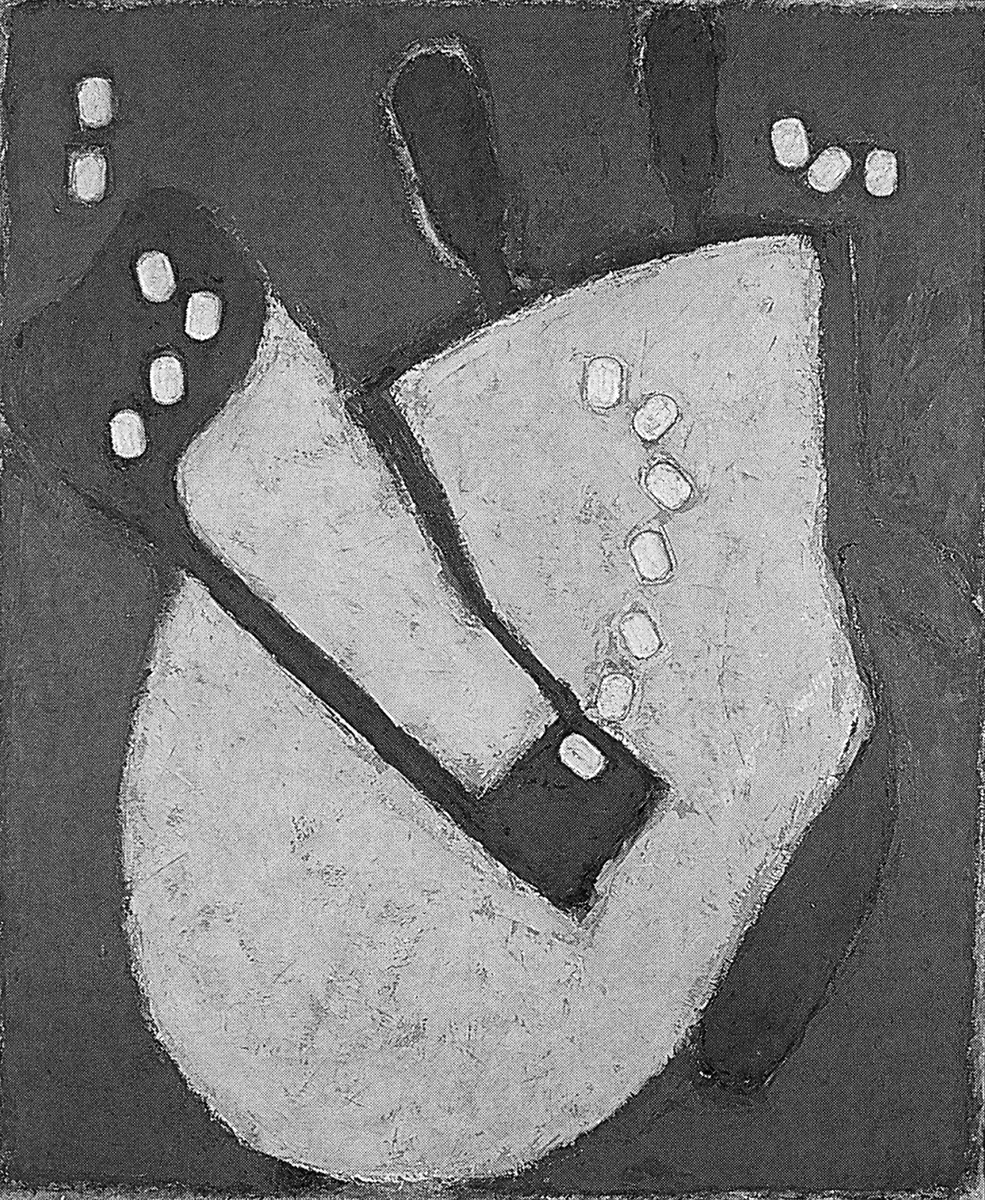
In the beginning, like every artist, he faced various rites of passage: both family-related (like the agreement to finish his degree in architecture) and personal (his encounter with art in Paris between 1979 and 1982). At that time, his influences were many and they had to do with the figure in motion in the works of Eadweard Muybridge, Luis Caballero, and Francis Bacon, which gradually took him to a type of painting halfway between figuration and abstraction. Beginning in Wisconsin in 1986, he entered with full force into that "undifferentiated space," as Clement Greenberg called abstract art,2 and he began a judicious study of painting, color, easel, primers, and rhythm, without forgetting to include unevenness and a couple of seams. It is the moment in which some organic points appear in his paintings. These points find their bearing on the surface, playing with classical proportions and rhythm, based on Mayan writings and calendars as well as art history as a first route toward orienting the forms in space: the motion of the blind who slowly fall off of Pieter Bruegel's canvas becomes a compositional motif; Giotto's angels become a lesson in flight for his forms; and Piero Della Francesca's blue becomes a lesson in depth. The triptych Anoche (To Night/Last Night, 1990), for example, is actually six meters of yellowish, earth-toned fabric, pierced by a single ribbon-like line. It is based on Rembrandt's Night Watch. The line and points find inspiration in the position of the heads, the harquebus, the lance, the foot, and the flags of the original painting. This demonstrates that painting is a true attitude of meditation (as the previous drawings show), which gives the same importance to the complex and to the small, to composition and to details, in order to rotate, change the orientation of, and reinvent a motion. The organic points are also syntheses of the faces of one of Tamayo's paintings, or perhaps they simply repeat like the cabbalistic numbers of omens, since the form is also oriented with a sense of humor and drama. Fusilamientos (Executions, 1996), a piece that also measures six meters in length, has as its motif the fundamental structure of Goya's work, which completely disappears behind all the possibilities of gesture and brush strokes accumulated through the long experience of abstract artists. In fact, the theme of this piece is contemporary art's possible for all kinds of executions, the common local word for referring to appropriating what is given. In a more recent piece, the old records, some with English lessons that insist on the phrase Repeat after me (1998), are the perfect support for recovering the essence of Van Gogh's or Noland's spot. Around 1990, his painting underwent a transformation. The large forms began to grow and corral the smaller forms until they disappeared and expanded, leaving only a cracked matter. The spot, then, would become the protagonist of his pieces, frequently cited as a fragment of art history: Edward Manet and Andres de Santamaria.3 Presagios (Presages, 1992), which at first sight looks like a transfigured gate, is actually a composition made of yellow, blue, and red textured spots; like the measles, says the artist, because the work makes reference to the 500 years since the Spaniards' arrived at America. The spot became a garden in the show Parque de la Independencia (Independence park) at Bogota's Museum of Modern Art (1994). This show particularly revealed the true form of measuring time in art, which is the accumulation of layers of matter and personal experiences, one upon the other.
Painting's strata, which had always been his concern, began to be exchanged for recycled materials, at once a support and a source of specific spots.
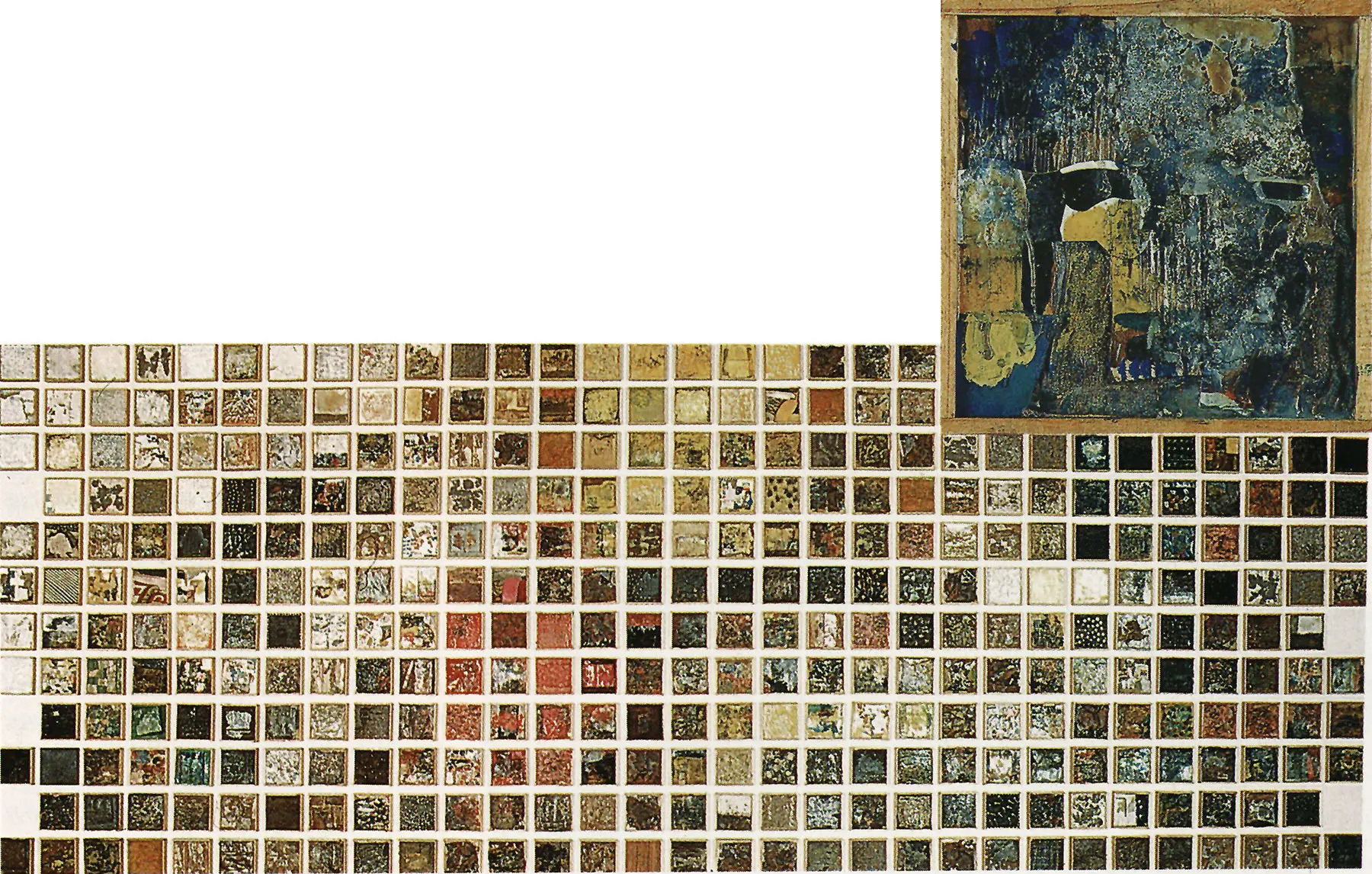
In Calendario (Calendar), which won an award at the National Gallery of Artists in 1996, the residues of his studio, newspapers, and books were gathered into 365 boxes, which actually looked like the back of a small easel, in order to receive that superposition of time and information. Enclosed in his studio, the artist knows that the history of violence in the country is gathered by newspapers in a much less careful way, in a chaotic and painful way; and in books, sentences like that of Tolstoi remind us that by penetrating into ourselves we come closer to everyone else. Luis Roldán finds himself here with an entire tradition of Colombian abstract art: artists like Edgar Negret, Manuel Hernández, Carlos Rojas, and Eduardo Ramírez Villamizar, who have always raised questions on form and abstract space. But with an unexpected turn of perception, history, trivial accidents, and humor are able to combine universal problems with local significance. To be in contact with the landscape and events has hindered a pure abstraction. And in an explicit fashion, the Baroque, pre-Columbian forms, nature, color, and urban materials make up part of his work.
The shine, wax, and phosphorescent pigments that are mixed with paper on the Calendar manifest Roldán's particular brand of abstraction, a "cohabitation, and non-substitution" of materials labeled as being of good or bad taste, a comprehensive approach to daily life, which is what changes the perception of objects and events. In this case, culture is intuitively assumed as a personal experience and not a general and static concept. In reality, customs shape history and, finally, what is called culture turns out to be a network of small, unforeseen personal experiences that only appear if one is willing to live with a certain level of uncertainty and neighborly contact.
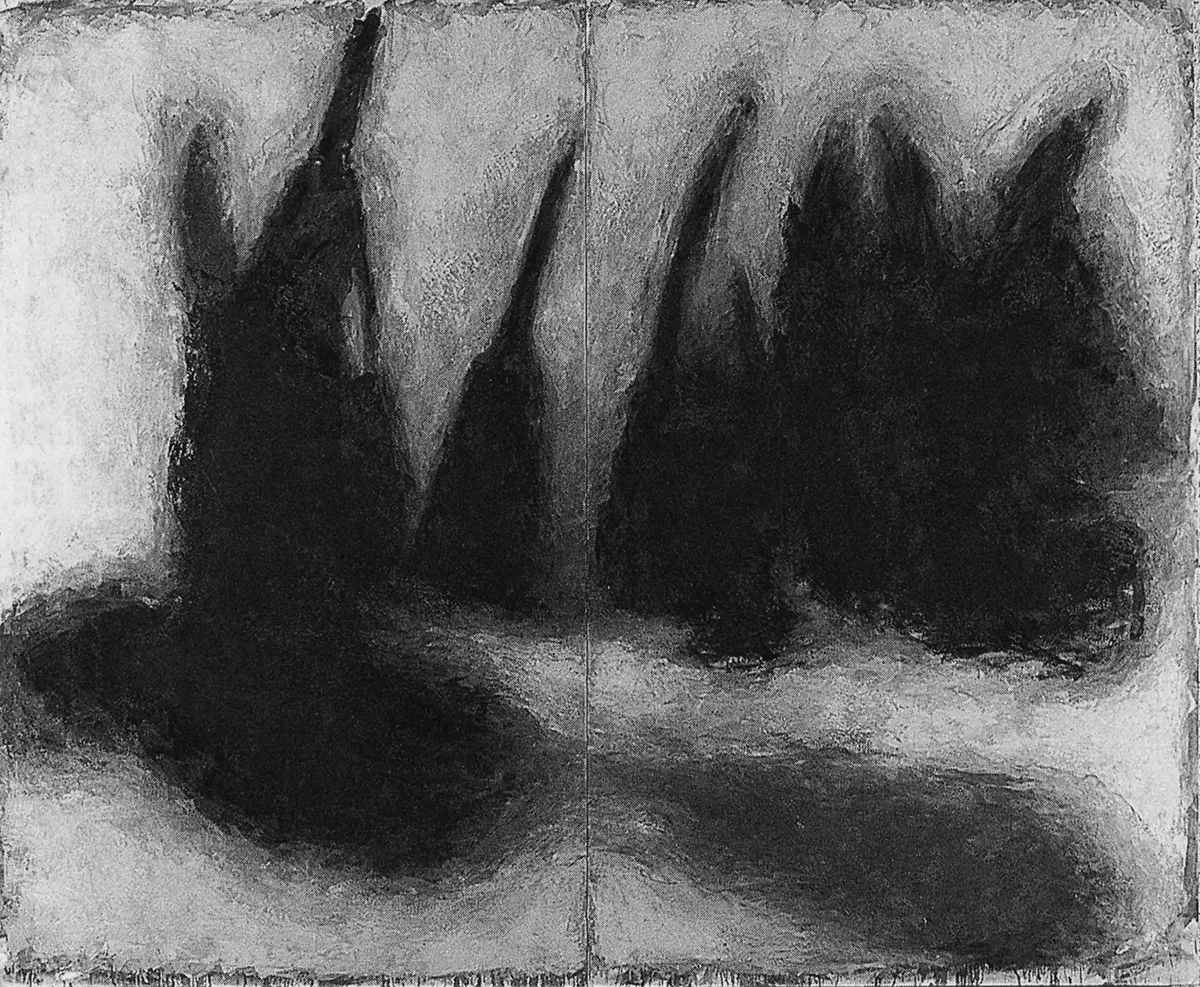
This attitude makes the form in Roldán's work search not only for an ideal structure at which it must arrive—or shapelessness, where the gushes and flows are a search for dissolution—but also for a door that opens in two directions. This comes close to "form is meaning," where each work establishes a bridge as a point of intersection between conscious thought and desires and silence, denying labels and accepting life mixed with the erudite brush stroke that allows the painting to be pierced by all types of experiences and redefined. For example, it allows the body to enter, as subversive as the form itself, abandoning the vertical position in order to paint and assume the horizontal position, much less rational and phallic, and more atavistic.4 A position with a certain sense of malaise before established ideas, which does not only accept the representation of things but also a search, with a change of meaning, of the form of the impulses, and of that selfsame interior motion. De rodillas acostado (Kneeling and in bed, 1998) is a piece made up of two very long rolls, with a width equal in proportion to their trunk, painted with an oil bar. The rolls leave traces of brush strokes that, through the urgency of their position, show a great concentrated force. Abstract artists have been labeled transcendent or gestural, 5 but with the thought in continual motion, it is never known with certainty at what point they stop because, as in Roldán's work, behind the brush strokes we can find buried objects or images of personal or collective grief.
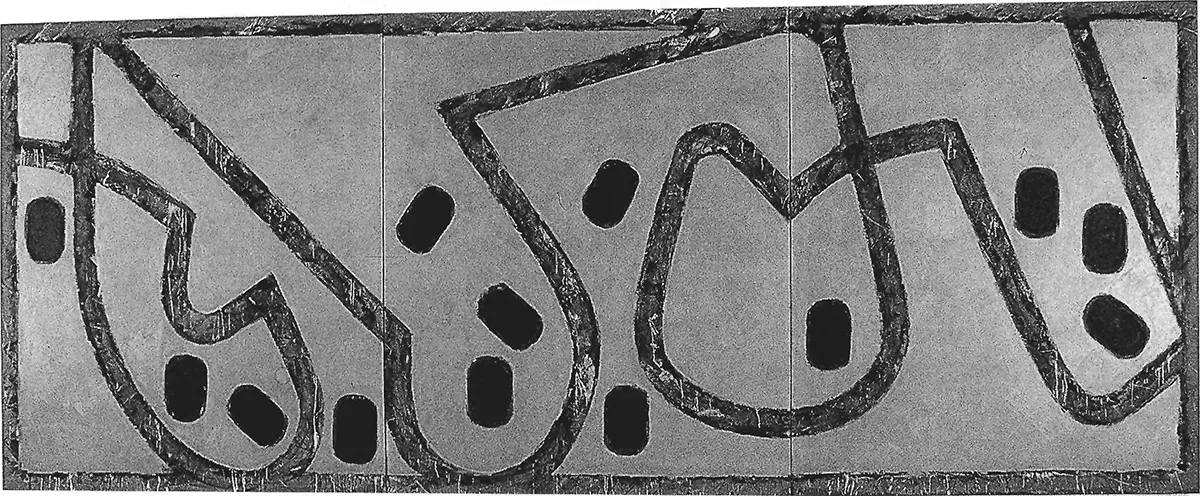
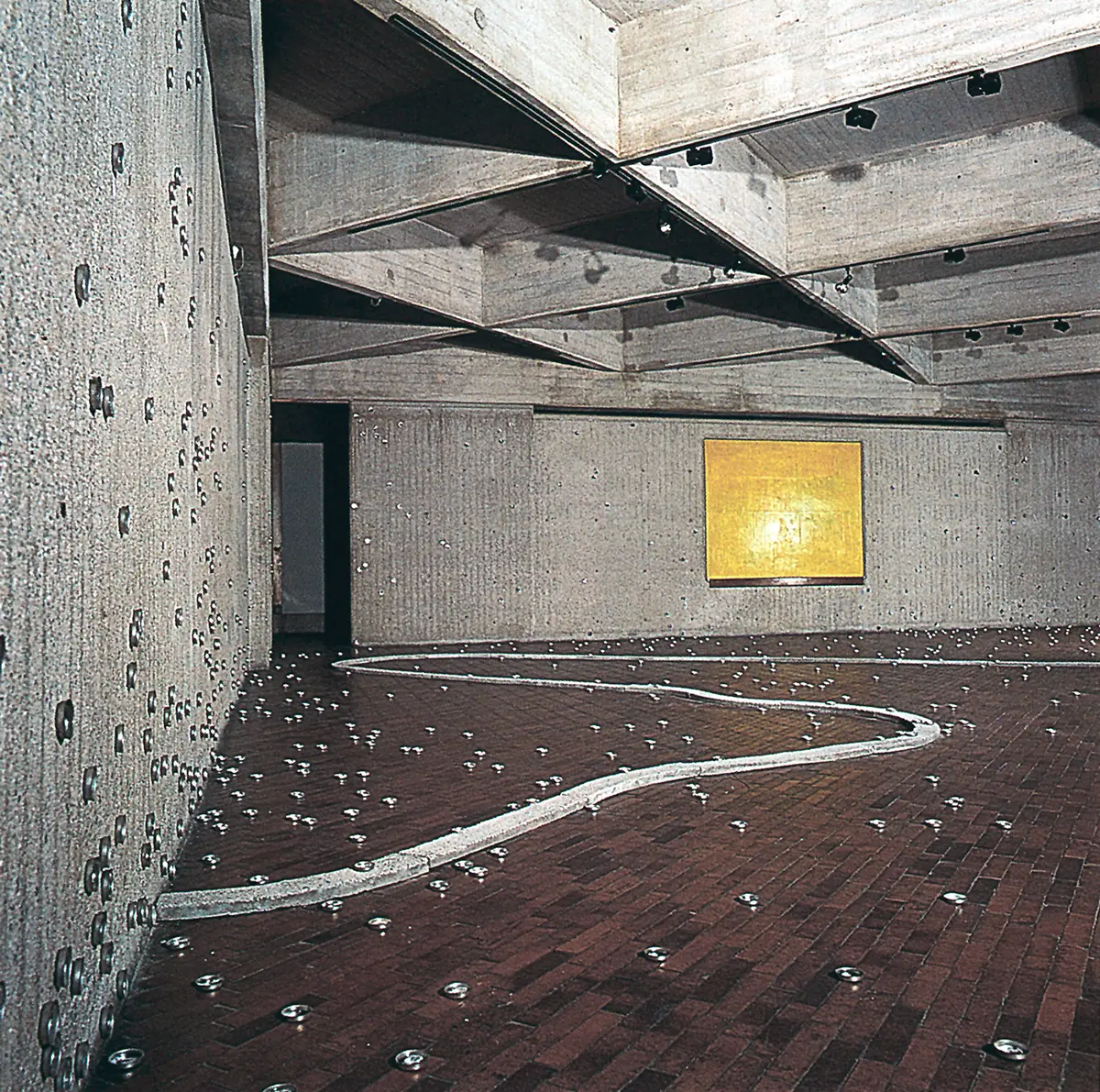
Vitality has been defined as a respectful logic with the complexity of life. To accept each thing and its opposite, and to create the conditions whereby those different aspects of complexity may appear.6 This is why some of Roldán's pieces "let themselves be thought" by the place, like the walls of Bogota's Museum of Modem Art—so textured and "protagonic"—which the artist invades with a constellation of bottle caps made with waste materials: Sabrosito Ya! (Delicious!, 1996). He also allows himself to ask questions on the razor's edge, about existence and emotions, and to invade once more the walls with 1,003 faces of women, photographs in black and white, also framed by small bottle caps; and on the floor, a line of cement that recalls the sidewalk on which just about all kids, perhaps when they reach the age of asking questions, play the game las tapas (marbles played with bottle caps) in Caminito del diablo (Devil's path, 1998). We could take a chance—why not?—and look for a possible answer in the wisdom of tales and myths, and kill Don Juan, the very attitude of assuming the horizontal position, and make invitations to his obsequies at two churches that bear the name of two of Bogota's neighborhoods. One piece is flooded with red paint and varnish, announcing: "Death. Don Juan. Guests: the entire affected community and his 1,003 debts. Date: 12 October 1997, 5:00 a.m. Place: Church of the eternal return. Address: between Solitude and Remembrance." It is quite probable that Don Juan may rise again, and die again, because what is demonstrated by contemporary thought, of which Roldán is a clear exponent, is that it goes from one extreme to another, realizing syntheses that are not a point of arrival, but rather a moment to renew the motion. It is understanding painting as a motif for staying alive, and not without difficulty, in the world. A physical and mental "jogging."
NOTES
1. Michel Maffesoli, "The Time of the Tribes: The Decline of Individualism" in Mass Society, Theory. Culture 8 Society (London: Sage, 1996).
2. Clement Greenberg, Art, and Culture: Critical Essays (Boston: Beacon Press. 1984).
3. Eduardo Serrano, Parque de la Independencia (Independence park), Museum ot Modem Art. Bogota, April-May 1994.
4. Yve Alain Bois, Formless: A User's Guide (New York: Zone Books. 1997).
5. CIement Greenberg, op. cit.
6. Michel Maffesoli, op. cit.
NATALIA GUTIÉRREZ
Anthropologist and History of Art teacher at the Universidad de Los Andes, Bogotá.