Airs were the title of the exhibition that Magdalena Fernández presented at the Sala Mendoza in Caracas during the last quarter of 1998. It was an exceptional show of densely perceptual and sensorial qualities, as well as a revelatory experience in the work of this artist.
In order to understand the exhibition, it is worth noting some aspects of her previous works, where the structure made up of modular elements provides the support for the installation. These elements are pure forms, points, or lines which the artist uses to create subtle works full of lightness and fragility. They seem to pose a constant challenge to gravity and to establish a constant relationship with the human body- that of the spectator, who becomes an integral part of the work and thus is seen as a whole. This transparent, light, and mobile image is to a large extent the result of the choice of appropriate materials (nylon, aluminum, polyester, steel, etc.) and the absence, in many cases, of color. Space as a void, rather than as a place to be filled, is seen as something which can strengthen the perception of these light and almost imperceptible structures. Fernández's work has, perhaps questionably, been linked to the constructivist and kinetic artists, and even with such a major artist as Gego.
A graphic designer, Fernández can be seen as a disciple of a school that followed the precepts of the Bauhaus. Subsequently, in Italy, she studied with A.G. Fronzoni, an artist with minimalist tendencies. She had a passion for geometry and mathematics, abstract languages that gave her a sense of certainty and security in her work, coupled with the importance which she attached to perception as a form of access to and appreciation of her work, which can be seen as a re-invention of space. This is achieved through a series of projections or installations based on transparencies, the relationships between filled and empty spaces, asymmetries, etc.
But paradoxically, this sense of abstraction is used to create a more organic condition, by means of grids that establish a correspondence between nature and its most abstract condition. This could be seen in a piece installed in the Jesus Soto Museum in 1997 when she seemed to become aware of the value of space: the room was left shrouded in darkness, with the light playing a protagonistic role from the moment in which sixty-five luminous lines appeared suspended in equilibrium within the sensorial unlimited space. From this work on, the artist began to deconstruct the idea of stable space. Light, water, and air in the movement became the three essential elements taken from nature which allowed her to create an atmosphere of this kind hence the work titled Airs.
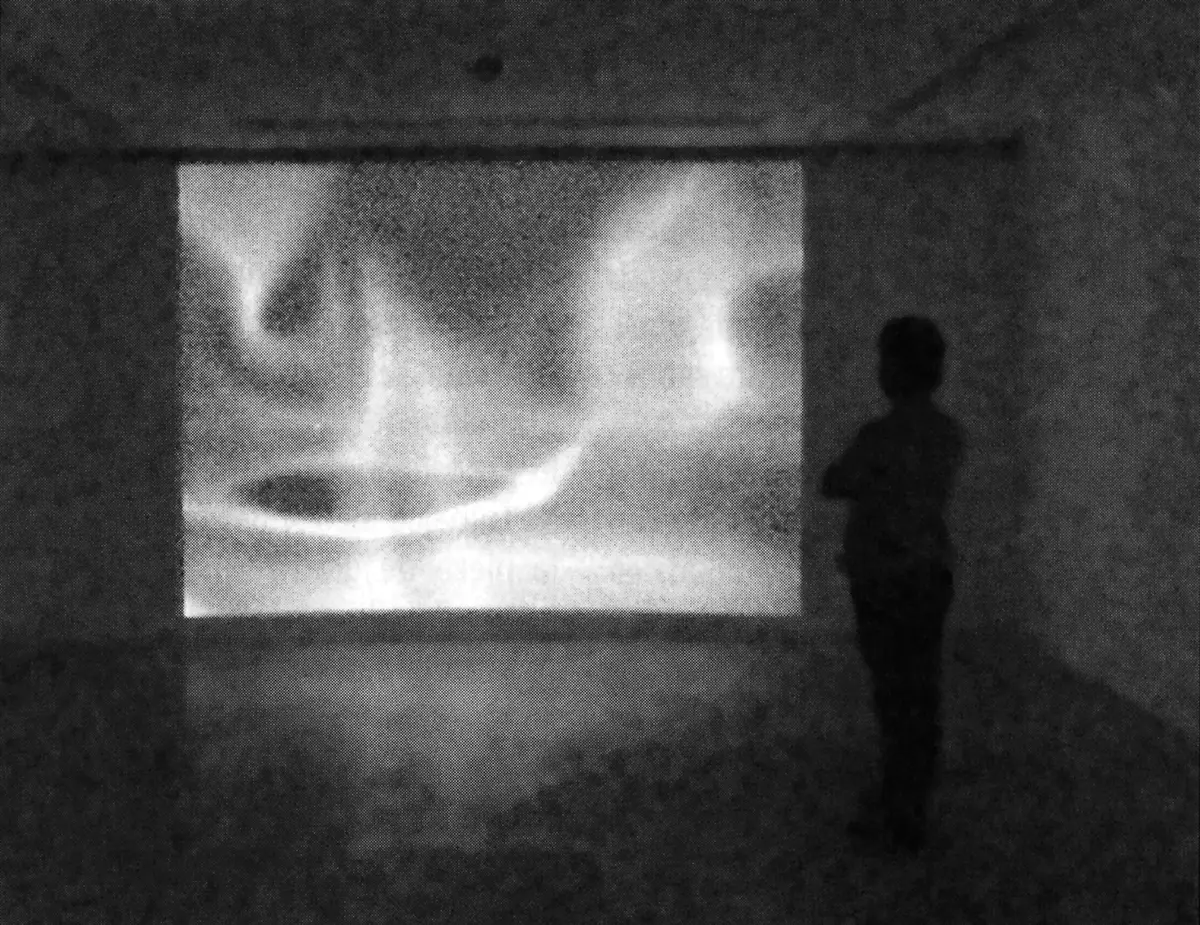
The first piece titled 9i998 places the spectator in a situation of total suspension. "I felt I was flying in a sea of wind," one young visitor said because there is no apparent structure to the work. The installation takes over the room in its entirety, with walls and ceiling providing a large screen for reflecting the waves of the water and creating a series of relationships, asymmetries, and rhythms. What is projected is the organic reticle, the movement of water, rendered possible by the light and with the air of the room providing support. The artist used PVC and glass tanks, which were placed on the floor and filled with water. The water is moved by means of compressors, with the light allowing the image to be projected. The dis-equilibrium which is an invariable feature of Fernández's work is here reflected in the actual condition of a liquid surface. This is an art assumed with an impeccable sense of rationality. The light and the impulses which move the water are all programmed, with the technology of time and rhythm being harnessed in the service of beauty. The result is a total sensorial and poetic experience.
But far from proposing work of a conceptual kind, Fernández in fact recuperates the sense of vision, a visuality which, although beautiful, also involves the spectator by placing him in communion with the work and offering exceptional moments of pleasure, reflection, and meditation. Unlike kineticism, where movement or manipulation by the spectator gives meaning to a work, there is no intervention here and the meaning of the piece is created by the void in the room. Austerity, anonymity, neutrality, and emptiness are concepts that are contrary to traditional kineticism and which yet in no way inhibit the poetic and aesthetic value of the work.
10i998 is a glass receptacle with alcohol burning inside it. The ephemeral piece offers another way of experiencing the beauty and, at the same time, the aggressive force of contained matter. It is, as Rafael Castillo Zapata has rightly pointed out, "a conscious expression of our own materiality."
AJi998 consists of a line done with a mirror, placed on a large white wall that linked the two big rooms of the gallery. It is a simple, elementary form. This line of division, in which everything is reflected, was almost imperceptible in the room- characteristic of the austere and light quality of Fernández's work. In contrast, 11i998 is a video that brings together visions of bubbles and images of water and fire, taken from various of the artist's pieces. The work presents forms undergoing transformation and provides another means of focusing on the dissolution of a structure into unstable bodies. Color plays a decisive role in these images and provides a link from one image to another. The video becomes a focal point of contemplation, surrounded by a halo of fascination and mystery.
There is no doubt that Airs was an exhibition that will become a standard point of reference in Venezuelan art and a crucial step in the investigations and creative work of Magdalena Fernández.
SUSANA BENKO