
"Who's the fairest one of all?" asks the stepmother in the well-known fairy tale, disseminated across the world on film and in cartoons by the Disney fantasy-machine. We know that the mirror constantly reassures the stepmother that she is the most beautiful until the dreaded day when a younger challenger is victorious: Snow White. Rather than relate only the consequences of the original story, we might step back and consider the mirror itself —until recently, the invariable tool of the artistic self-portrait and an object which every woman possesses—and the problem of competition between women for beauty prizes.
This is an idea that goes back to Homer when three Greek goddesses vied with each other for the prize awarded by Venus to the judge (the Trojan prince, Paris) who was married to Helen, the "face that launched a thousand ships." Thus Helen, like Eve before her and Delilah and Salome after her, was the quintessential femme fatale who brought about the fall or destruction of men. Snow White has a special agenda: she gets the prince, but her competitor, the evil stepmother (i.e., other women) is destroyed.
Especially poignant, in this case, is that of the aging woman who is superseded in this beauty contest. Among the stereotypes of older women are images of the destructive stepmother and the interfering mother-in-law. These appendages to the family are maligned as outsiders—they were not of the "clan" in antiquity nor are they of the extended or nuclear family in the present. With their power, they challenge masculine control of the family. These patriarchal constructs become evident when we consider that the stepfather and the father-in-law suffer no such denigrations. "To be born a woman has been to be born, within an allotted and confined space, into the keeping of men. But this has been at the cost of a woman's self-being split in two. A woman must constantly watch herself. She is almost continually accompanied by her own image of herself. Thus she turns herself into an object—and most particularly an object of vision: a sight."
These words, written many years ago by English art critic John Berger, were part of the British Broadcasting Corporation's television series, Ways of Seeing. I would like to be able to say that these attitudes are now part of the past; that we have been liberated from the male gaze as a determinant of who and what we are; that we have ceased to be objects of someone else's vision and have subjectivized ourselves. Nevertheless, we must remain alive to the mythologies and ideologies that are still perpetrated and still practiced. If we wish to update Snow White, we can turn her into a spectacular rock star who peddles her sexuality and call her "Madonna"—surely an oxymoron in any language.
There is one further aspect of Snow White that requires scrutiny: "Fairest" at least in English, has two significations: it pertains to beauty; and it pertains to the whiteness of one's skin —to "snow-whiteness." In fact, the two are made synonymous, and it is from this point of view that we need to critically examine one aspect of the female self-portrait as a genre. I propose to do so from the point of view of Latin American women artists who have three burdens to bear: that of gender, that of color, and that of not being European in a world where Eurocentrism still occupies the central position. In addition, in the Americas, they are artists within countries considered underdeveloped and colonized—a global extension of class differentiation between the First and Third Worlds.
Mirrors alone are obviously insufficient for the Latin American woman. She needs to create an identity that is not only personal but national; that is not concerned with duplicating European standards of "beauty," but with creating new standards based on the mestizo realities of herself and her sisters. In Latin America, identity has long been part of a social problem that requires a political posture. The self-portrait is one of a range of possibilities through which this posture can be explored.
Without a doubt, women in the last twenty years have changed the discourse and no longer depend on mirrors to determine or confirm their possibilities as full human beings. For one thing, women have empowered themselves to be more than ornamental or serviceable for others; for another, women feel free to love other women if they wish, thereby breaking one of the chains of male control, at least over their sexual lives. Generally speaking, women have been involved in deconstructing the mythologies and inequalities inscribed in gender stereotypes—women as spectacle and men as macho. The negotiations have also involved reconstructing alternative modes and models of representation. The new subject matter has been introduced to express female experiences previously unacknowledged, and it is understood that women must speak for themselves, not be spoken for.1 However, as artists, they cannot forget that the control of the art world is still firmly in the hands of men.
It is interesting to me that the woman artist today who commands the greatest attention in the Americas, and the highest prices on the international art market, is a Mexican—Frida Kahlo— a self-taught artist for whom the mirror on the inner canopy of her bed became a magic talisman that permitted her to escape the bed where she was imprisoned for a year by painting her own portrait. In a 1947 self-portrait, she wrote what might be considered a credo for women artists: "Here I myself painted myself. Frida Kahlo with [my] image in the mirror." Self-portraits remained the major subject of her work, though the mirror was only a point of departure for an imaginative exploration of her split personality and her shattered body. As Jean Franco has perceptively pointed out, in Kahlo's self-portraits one persona is adorned in beautiful and exotic clothes, "dressed up" as a Tehuana and therefore visibly different from any bourgeois Western beauty. But in other paintings, there is a naked, mutilated, and helpless Frida whose inert body appears to be controlled by science. The unclothed body is not a "self" but a socialized body, a body that is opened by instruments, technologized, wounded, and its organs displayed to the outside world.2 Frida Kahlo's frankness and open presentation of what was unpresentable in the tradition of the female nude —de-eroticized, blemished, imperfect, bloody bodies— opened the way for other women artists to reexamine themselves and their worlds in innovative ways.
Frida Kahlo was all but ignored in Mexico during her lifetime (1907- 1954), but during the last twenty years, her persona has been fetishized, on the basis of self-portraits that today can bring in over a million dollars at Christie's auction house New York. It is understandable that Chicana artists of the U.S., facing the bleakness of a culture that denied their culture, their presence, their language, and their humanity, should take Frida as a role model. It is more difficult to comprehend why the most contemporary generation of Mexican male and female artists (dubbed the Neo-Mexicans), have developed what is now being referred to as Fridamania, or Fridalatria (as an exhibition in Mexico City called it), and have brought the self-portrait to new prominence.
It is understandable that white women intent on excavating the hidden history of women artists should discover Frida and make her a heroine. What is not so easy to understand is why scores and hundreds of other Latin American women artists are ignored more than twenty years after the excavation began. Excavating a hidden history cannot stop with one example. Nor, as happened in Mexico, can European-born artists like Remedios Varo and Leonora Carrington, suffice to round out the female presence. The surrealism assigned erroneously to Kahlo cannot automatically be paired with European artists and the history book is then closed. If older artists of Latin America remain relatively unknown outside their own countries —artists such as Raquel Forner, Aida Carballo, Norah Borges, Sarah Grilo, Raquel Rabinovich, Tomie Ohtake, Alicia Peñalba of Argentina; Marina Nuñez del Prado and María Luisa Pacheco of Bolivia; Tarsila do Amaral, Lygia Clark, Lygia Pape, Mira Schendel, Djanira da Mota e Silva of Brazil; Gracia Barrios and Roser Bru of Chile; Débora Arango and Olga de Amaral of Colombia; Amelia Peláez, Mirta Cerra, Antonia Eiriz and Carmen Herrera of Cuba; María Izquierdo, Olga Costa, and Cordelia Urueta of Mexico; Tilsa Ysuchiya of Peru; Myrna Baéz of Puerto Rico; Gego (Gertrudis Goldschmidt), Luisa Palacios, and Luisa Richter of Venezuela—then our knowledge of both Latin American art and women artists internationally is sadly incomplete. And this list is merely a sampling. It is true that some of these artists have been spotlighted by international exhibitions and recent publications so the names of Tarsila do Amaral and Remedios Varo has come to the forefront. However, Frida Kahlo still dominates the imagination and recognition of North Americans and Europeans— and even Latin Americans not familiar with women artists outside their own territories.
It is understandable that Luis Valdez—a Chicano playwright and film director of Zoot Suit and La Bamba—wanted to make a film about Frida Kahlo. But what was the interested Madonna in playing the role of Frida Kahlo in her own film? Is it not exploitative of Third World women who are coopted in the First World as "exotica," stripped of their national, personal, and artistic history? How many U.S. Americans can name one other Mexican woman artist or know anything of Frida's true politics? Frida Kahlo, posthumously, replaced the highly-paid Brazilian star Carmen Miranda who, with her bananas and her costumes from Bahia, was the only South American who dominated film and the stage in the United States during the 1940s and 1950s, and is believed to have eventually committed suicide.
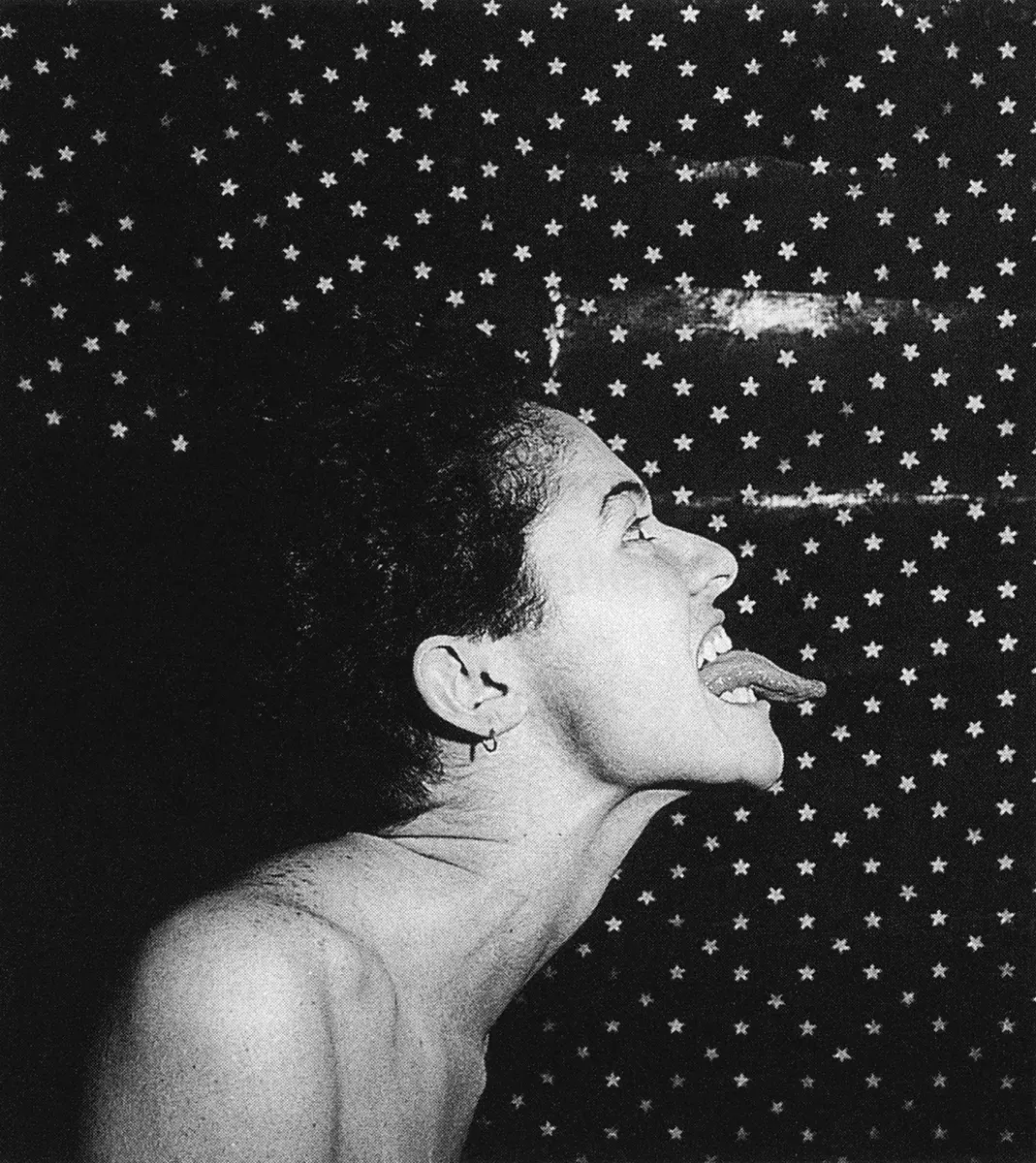
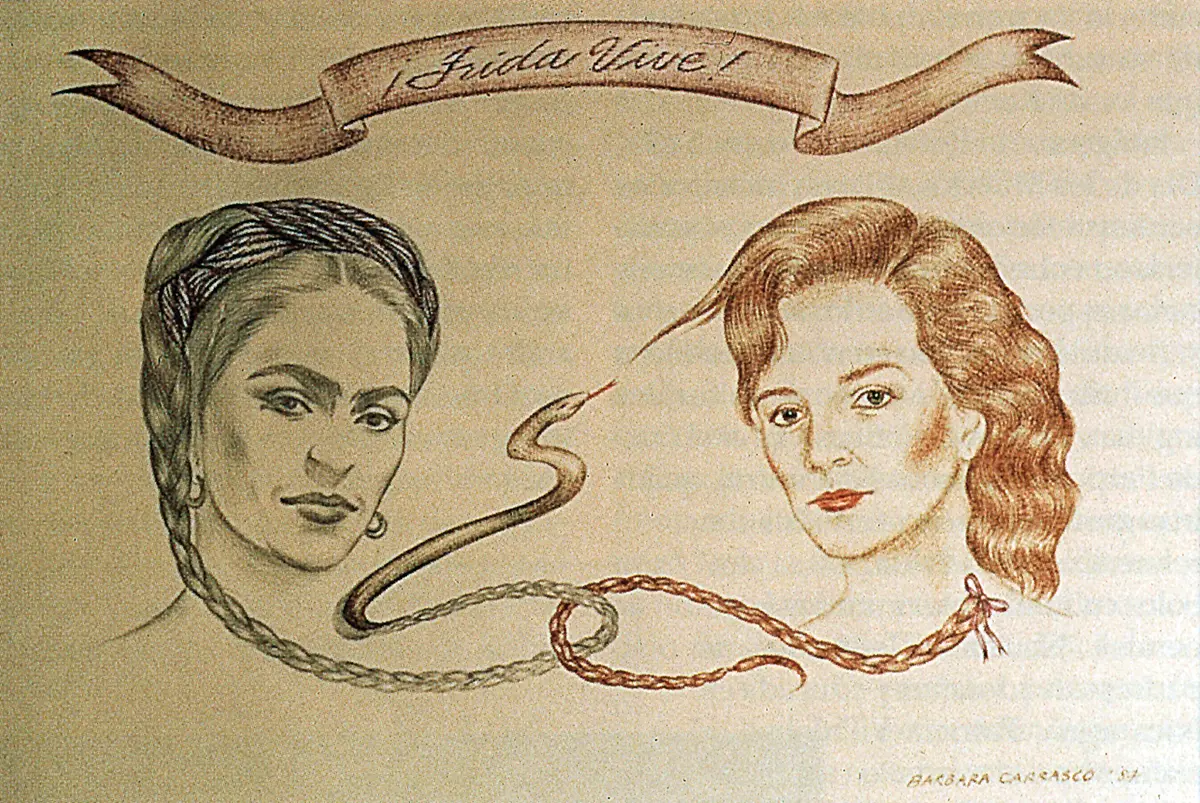
Triggered by the sexual revolution of the 1960s, by the feminist revolution of the 1970s, and by the overhaul of gender and sexual stereotypes by gays and lesbians, women artists emerged in the late seventies who were, though sometimes influenced by Frida Kahlo, not of her generation. They were, in fact, "neo-Frida" or "post-Frida." Many of these artists turned to the self-portrait as a means of establishing identity, of inventing a new subjectivity to replace the older objectification of women by the "male gaze." It is hardly surprising to find that those who most closely identified with Kahlo were the Chicanas of the United States who had long been denigrated by attacks upon their skin color, their closeness to the Indian heritage, their Spanish accents when speaking English, and many cases, their emergence from a working-class insulted, castigated and deported. U.S.-born Bárbara Carrasco became one of a number of Chicanas who made Frida Kahlo her idol. Physically and psychologically identifying with the Mexican artist, Carrasco becomes a "twin": her long braids are knotted to those of Kahlo, though hers were cut off as she eventually outgrew them to join the "hip" Chicano crowd of Los Angeles. At the same time, the serpent terminating Frida's braid reminded Carrasco of the snake that symbolized her Mexicanness—a heritage she needed to reinstate. Even skin color is a curious problem seldom confronted by racists (though the film Imitation of Life is still shown), but well-known in African American communities throughout the Americas. The term "miscegenation" or mestizaje did not conceive of children so light in skin color that it caused embarrassment; the problem, automatically, was placed in reverse: children so dark that they revealed the mixture—the "lowering" of "cast" or the mixing of pure Spanish blood with half-castes or morenos. The güero baby was welcomed by dark-skinned families as a sign of escape from racism; however, the inverse also functioned. The light-skinned child was ill at ease; did not belong to the family; did not share the suffering; was treated differently by the dominant society until "discovered" and thrust back. Carrasco—along with an African American artist like Adrian Piper who made an artistic career of didactically rejecting her own "whiteness" while betraying white racism— questioned her own light skin, as she does in the double portrait where her hair and skin are both lighter than those of Kahlo. Images of Frida, homages to her, Día de los muertos altars, impersonations, and interpretations in performance proliferated among Mexican American artists, especially in the eighties, and eventually became so prolific as to infuse the Anglo cultural structure and non-Mexican Latinas. Such is the case with Patricia Villalobos Echeverría who opened her artistic presence with references not to Frida, but to more general Mexican cultural symbols. Born in Tennessee to Salvadoran parents and raised in Nicaragua, Patricia Villalobos finds herself in a position analogous to that of Chicanas in her bilingualism and biculturalism, except that she uses the postmodern term "transculturation" and refers to the construction of a "hybrid self" who is also bisexual. Combining poetry and sound with images and performance, her fluidity and flexibility are multivalent rather than bicultural: thus her invention of nahuangloñol as her language, which parallels, in a sense, the multiple language usages of U.S.-based Mexican performance artist Guillermo Gómez- Pena. Though Villalobos has used her art to work through her devastating memories of the 1972 Managua, Nicaragua, earthquake (the Teremoto series), her performance- installation Guadalicuo references purely Mexican sources: the Virgin of Guadalupe combined with the great Aztec goddess, Coatlicue.
Marina Gutiérrez is a New-York-born Puerto Rican who presents her self-portrait in triplicate which is suspended on wires the multiple objects that are symbols of her two worlds. The ship, the fish, the cloud, the moon, and the sun (in eclipse so they fuse) pertain to Puerto Rico, while others—the suit of the powerful man headless though he is, the skyscraper, the factory belching smoke, the atom bomb, the television, represent the United States.
Josely Carvalho makes her home in New York. Her Memory Books of Bahia uses photo silkscreen in a composition of fragments and compartments. In the eighties, Carvalho frequently employed symbols taken from the world of women, or from legends and fiction of her native Brazil for her expressionist work. Her personal features appear very little; she makes self-portraits in the sense of a collective of women, or in the sense of a mythological image that includes her life. On a much more intimate level are the paintings and drawings of Argentine-born New Yorker, Norma Bessouet. Part of an extended series of self-portraits, in paintings and drawings, these works are infused with melancholy, loneliness, and hidden sexual desires elicited by the absence of an awaited lover. The woman in this series refers to an interior, rather than an actual mirror to register her sensations and yearnings symbolically and metaphorically. The pelona or "bald woman" of the series is exquisitely drawn and painted, surreal in her manifestations. A large black bird, like the raven of Edgar Allan Poe who responded to all questions with the dire prediction "Nevermore," appears repeatedly; while the triptych Fragments to Dominate Silence, speaks to sensual self-gratification which emerged in the liberated eighties as one possibility among many.
Magdalena Campos-Pons exhibited Jardín exótico in her native Cuba, opening up the puritanical atmosphere surrounding sexuality by focusing on the female experience of sex. Her garden is formed of various tropical plants, in forms that suggest African gods or rituals. At the same time, a biological form that appears as both a plant and as a vagina and sexual organs of a woman has inserted an inter-uterine device. For centuries, contraception was a woman's responsibility, whether counting the days on a calendar as the Catholic Church commanded, inserting devices deep into her body, or consuming medications which prevented pregnancy—the latter two were sometimes accompanied by medical dangers. It took an originally male-dominated "plague" like AIDS/SIDA to bring the lowly condom which, among heterosexuals requires masculine responsibility not always trusted by women, back into contemplation.
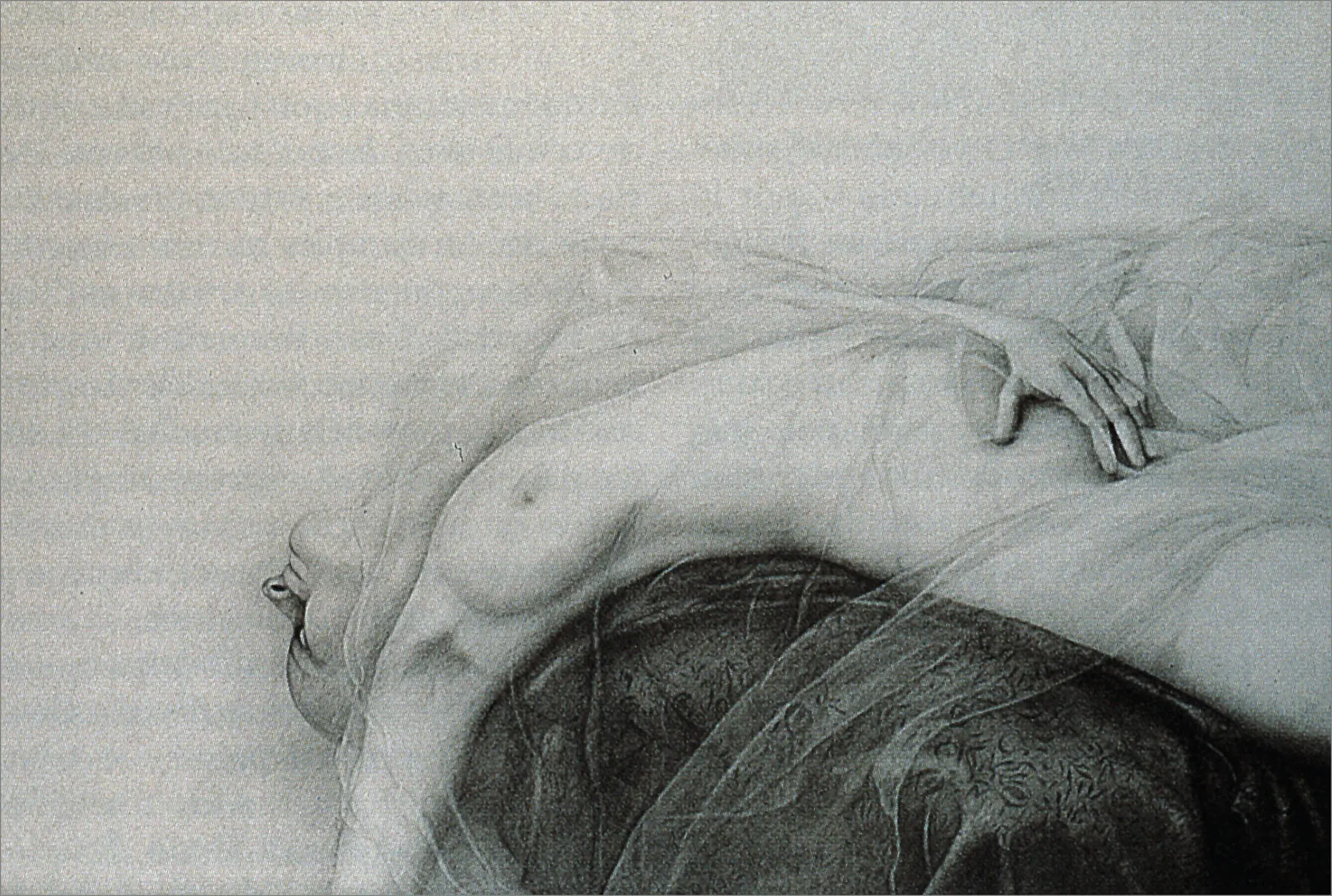
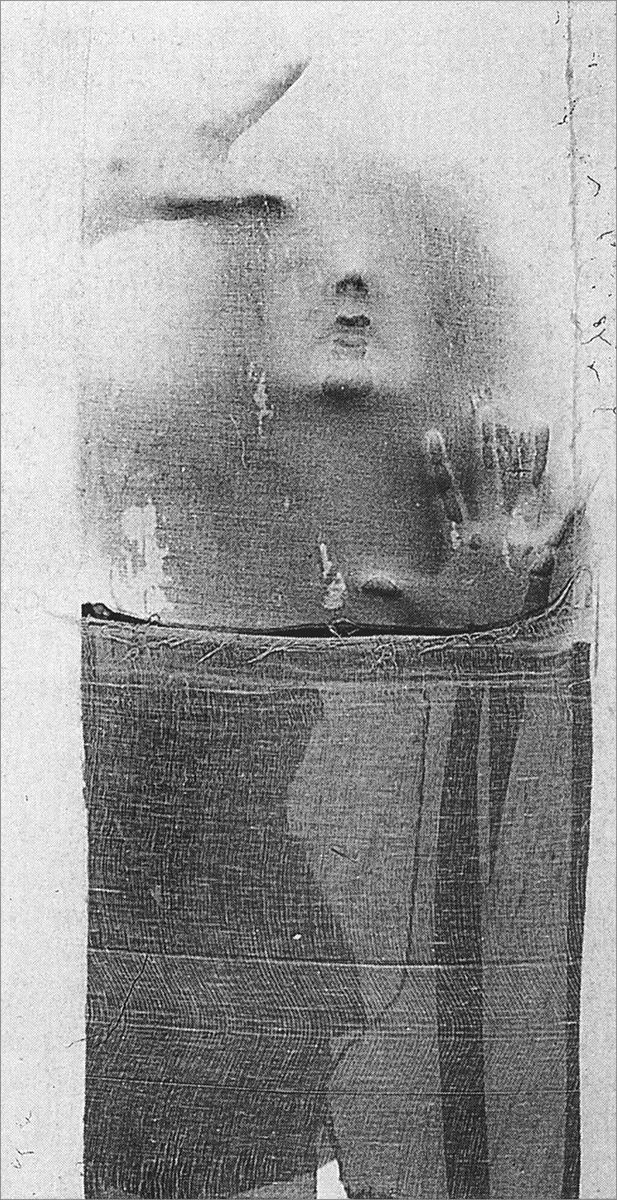
In the late 1980s, as the dictatorship of Uruguay began to draw to a close, Nelbia Romero did a series of photographic works for which she modeled, that featured a woman trying to break from behind an imprisoning net of cotton gauze. Resurrections are one such series. With these works, and with a large multimedia installation, Romero risked her liberty, perhaps her life, to express the anguish of repression and the great desire for its demise.
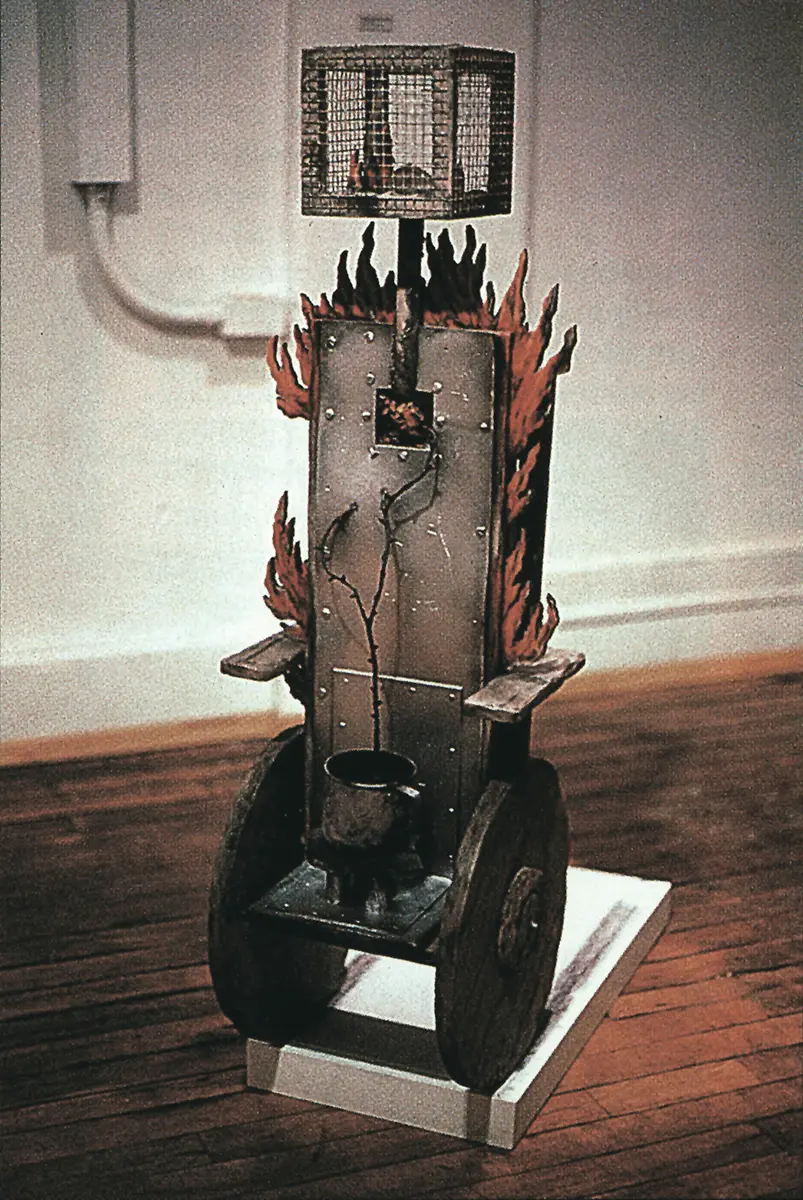
María Brito, a Cuban-born artist living in Miami, is at her most compelling with her installations which frequently are autobiographical. They mirror her feelings, and memories of the past including references to Cuba, and comment on the problems and transcendent moments in life. In this case, she makes a comparison between herself and a rose in flames encased in metal armor. Above can be seen a wire cage that serves as a mausoleum.
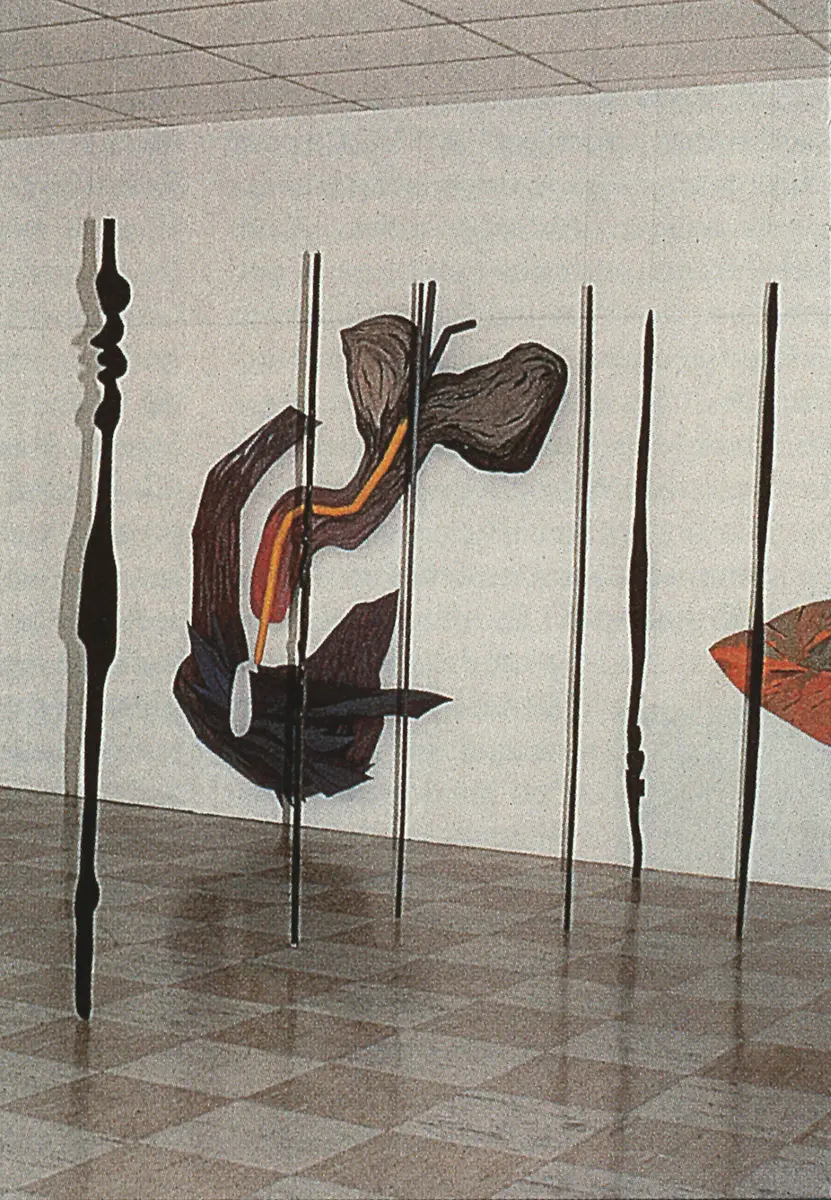
Mónica Castillo of Mexico City has long been an iconoclast experimenting with paintings and installations that transfer human conditions into an inventive symbolic language particular to herself. Woman becomes a cake, or a salad, invaded by male consumers. She has parodied European masterworks, changing the bucolic into the Pop. In the 1990s, Castillo continued her unrelenting exploration with a series of self-portraits contradicting the return of a consumerist world. As fashion shows and beauty pageants return to the runway, Castillo deliberately casts herself as the antithesis of revived Femininity. Her self-portrait draws on an explicitness more familiar to Chuck Close than any female representation. If she allows the skin to remain on, she pocks it with every coarse pore, wrinkle, freckle, or fold that can be observed in a mirror, including uncurled and graying hair. This is not a nude face; but a naked one—to use Kenneth Clark's ancient definition.
To trace the self-portraits produced by Latin American women artists in the twentieth century is to notice the changing script of self-confession which is inherent to the nature of self-portraiture; and to register the widely varied styles, materials, and symbols that women employ today to define themselves. Snow White and her evil stepmother are banished from every stage except that of Disney, which reinfects the juvenile mind with sexism and racism.
NOTES
1. Elizabeth Bakewill, "Frida Kahlo’s Legacy: Awareness of the Body Politic," Pasion por Frida, exh. cat. (Mexico City: Museo Estudio Diego Rivera and De Grazia Art and Cultural Foundation, 1991-1992) 189.
2. Jean Franco, Plotting Women: Gender and Representation in Mexico (New York: Columbia University Press, 1989) p.107.
SHIFRA M. GOLDMAN
Art historian and researcher for the Latin American Center and the Art History department of the University of California, Los Angeles.