
Following the National Plastic Arts Prize awarded to Corral in 1997, the Fototeca organized a retrospective show of his work last October and November. The Aurora publishing company of Italy published a handsome catalogue which brings together the varied and beautiful photographic work of the artist.
Corral's images suggested to me something on which I have often speculated. In such photos as Beauty Rest, Wash and Wear, Blue Jeans and others from the same series, social denunciation of the poverty before the Revolution (it is now different) is combined with a indictment of the rapid Americanization of Cuban life in the 1940s and 1950s, although Corral's approach is based on synthesis, humor and irony as well as respect for his fellow countrymen who suffer from poverty.
These elements mark a difference. My speculation was based on the idea that there is a lot of Latin American photography (not always by Latinos) that bears no trace of these elements of which Corral has mastered. Even work done in good faith does not necessarily escape from a paternalistic gaze (always from above). In general, in Latin American photography, the poor (i.e., mainly the indigenous populations) function as mere objects, however aesthetically oriented the photograph may be. Perhaps the problem is one of class. Photographers are usually fairly well off (you have to have money to make art and a career in photography). When Corrales took his portraits of poor people, he was poor himself. In fact, his lack of financial resources made him into an expert in appreciating images from negatives. Beacause he could only buy the roll, shoot it and not print it, he placed the negative in a lamp tube in his room, enabling him to view the image blown up like a slide. Thus, in his picture of two unclothed children sleeping in a hammock, with a man seen from the back wearing a torn shirt and the lower part of a pair of trousers, Corrales used the method of evoking the whole by its parts. The critic Alejandro G. Alonso has spoken of synecdoche as the repeated artistic goal of his work.
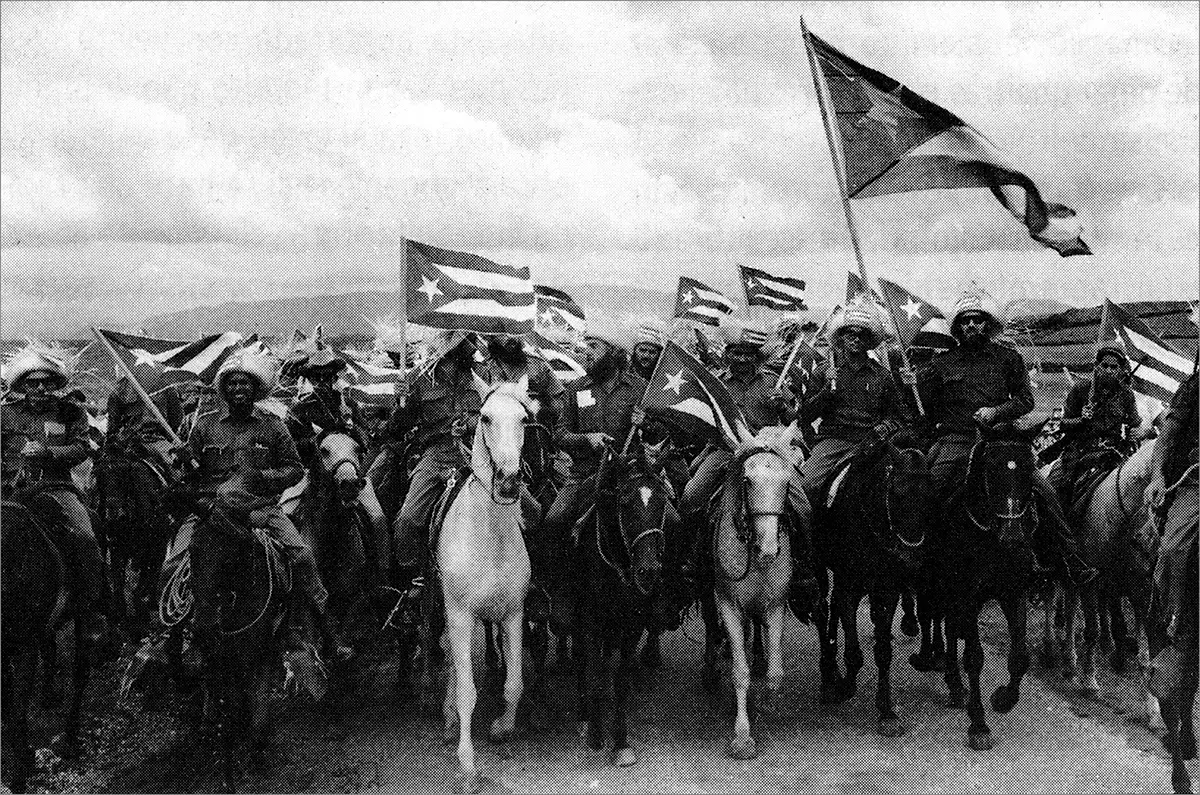
When the Revolutionaries seized power in 1959, Corrales, who had been a communist militant since the age of 13, had the opportunity to enter the history of Cuban photography with images which have now become classic: The Cavalry, The Wedding of the Militia-man, The Dream, Al Turquino con Fidel, Havana Declaration, Giron. These are all from the 1960s, the romantic moment of a new kind of social project, when illusion and faith made people forget about their difficulties and all eyes were fixed on a glowing future. ("Will the dark swallows return...?")
From the 1980s, (a period which many see as one of the best, particularly in the artistic sphere) there were photographs dealing with the school camps, a sui generis Cuban method of teaching (now called into question) in which study is combined with agricultural work-a pedagogical systern which attempts to nurture among adolescents a sense of responsibility towards work. From the same period there were also his images of Nicaragua and those illustrating his faith in the Sandinista movement as an alternative means of achieving social justice.
The epic and the lyrical, the heroic and the everyday, the grandiose made strong through a sense of detail...these have been the overriding features of all Corrales' work, whose titles too have helped give meaning to the images. But however dramatic those images may be, the artist has always managed to evoke a sense of optimism in what he shows.
Corrales learned through practice, training his eye to acquire visual culture, learning about composition, making frames of geometrical design and creating a sense of rhythm, using light to define volumes and to give a sculptural quality to his images. Sometimes, his work acquires the "consistency" of pictorial elements, reflected in the atmosphere and the composition; at other times, the use of counterpoint images creates a sense of mise en scene. Sometimes the image is seeking a sense of spontaneity, other times a sense of impact.
Although he was a photojournalist, Corrales was never one of those cameramen who were in the right place at the right time. Behind each of his images, in addition to his mastery of his craft, we sense the tenderness and sincerity of someone who firmly believes in what he is doing-and in such skeptical times as our own, this is an important feature of his work.
ERENA HERNÁNDEZ