The Peruvian photographer Roberto Huarcaya has just presented the photographic work he carried out recently in Paris thanks to a creative art scholarship from the Cité Internationale des Arts Foundation as well as the work shown last September in Barcelona, in an exhibition titled La nave del olvido (The Ship of Oblivion) with poems by Felipe L. Aranguren and music by Mariano Zuzunaga.
Photography (like video) has for a number of years become increasingly present in the field of artistic creation so it now occupies a significant place in exhibitions. It has done so because it can provide a response to the rapid evolution of the discourses of creation by remaining in tune with the urgent need for rapid communication and by establishing a relationship with the real which is both immediate and staggered, distanced yet near. Furthermore, the technical characteristics of the medium permit modes of intervention-at at the formal, spatial, and finally scenographic (museum) levels-which are absolutely contemporary.
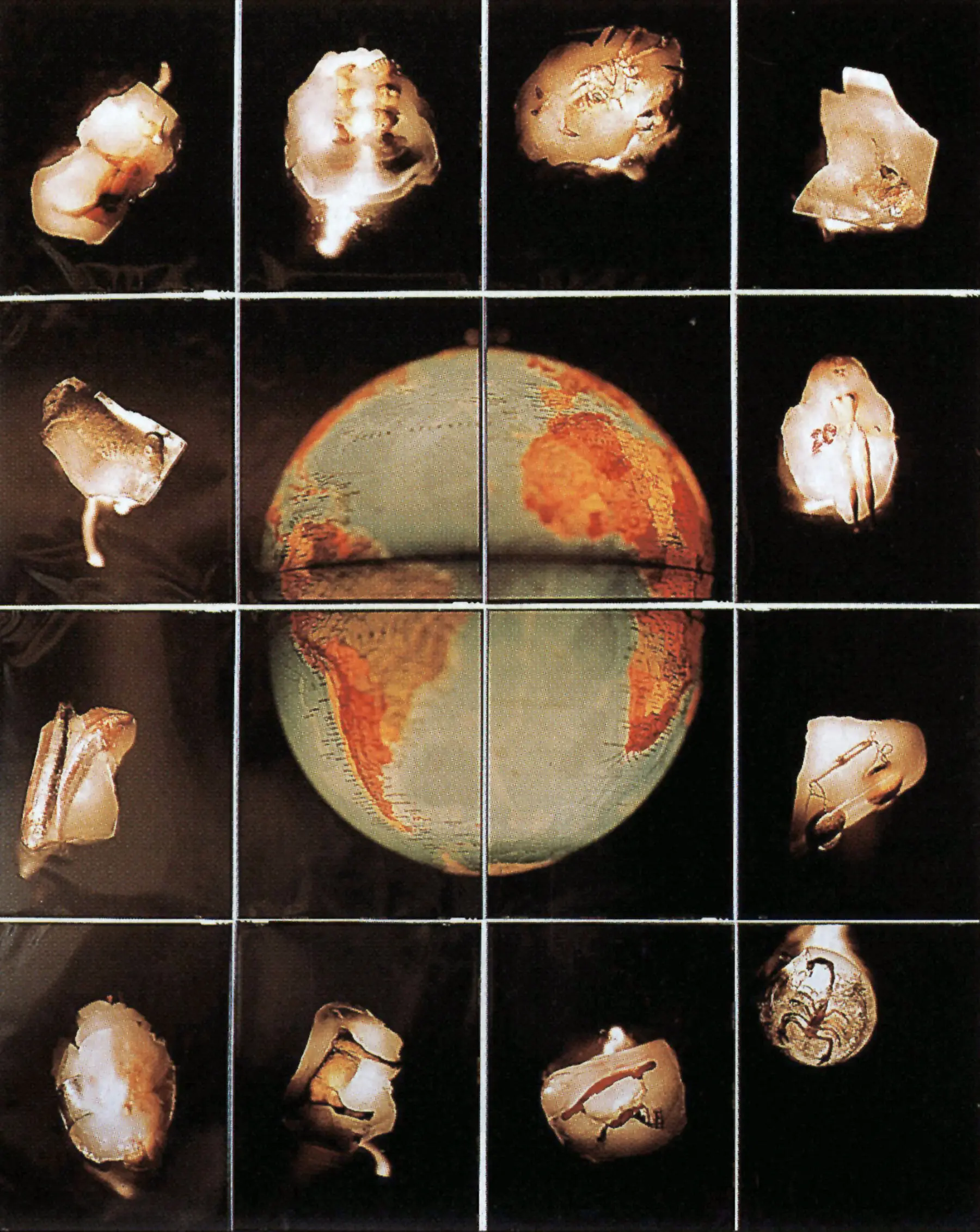
Roberto Huarcaya has had an unusual career. There is no doubt that his early training in psychology —which lasted six years— established the analytical distance that has encouraged the sense of reflection embodied in his pictures, irrespective of their various forms of conception and approach. I shall speak here only of the first exhibition titled Temps rêves. First of all, with regard to the mode of presentation, Roberto Huarcaya uses slides (all of the same size, i.e. 20 cm x 25 cm), juxtaposed one against the other as on a checkerboard, barely separated by the ridge formed by the junction of two plastic pockets containing the photographs. These are suspended and shown against the light, perpendicular to the floor, with the air and the daylight passing through them. The artificial light which had been planned for mounting the works in boxes could not be used here for reasons of presentation. Six subjects were presented in thematic sequences and organized into six distinct panels providing the visitor with an idea of the overall coherence and meaning. The photographer established at the conceptual level the "path" to be followed through the exhibition—which was followed by 70% of the visitors— as follows: Paradise (2,40 x 2 m), The omens (1,65 x l,05 m), The flood (1,25 x 1,05), Hell (1,25 x 1,05 m), The ice age (1,80 x 1 m) and Creation (1,65 x 1,05 m).
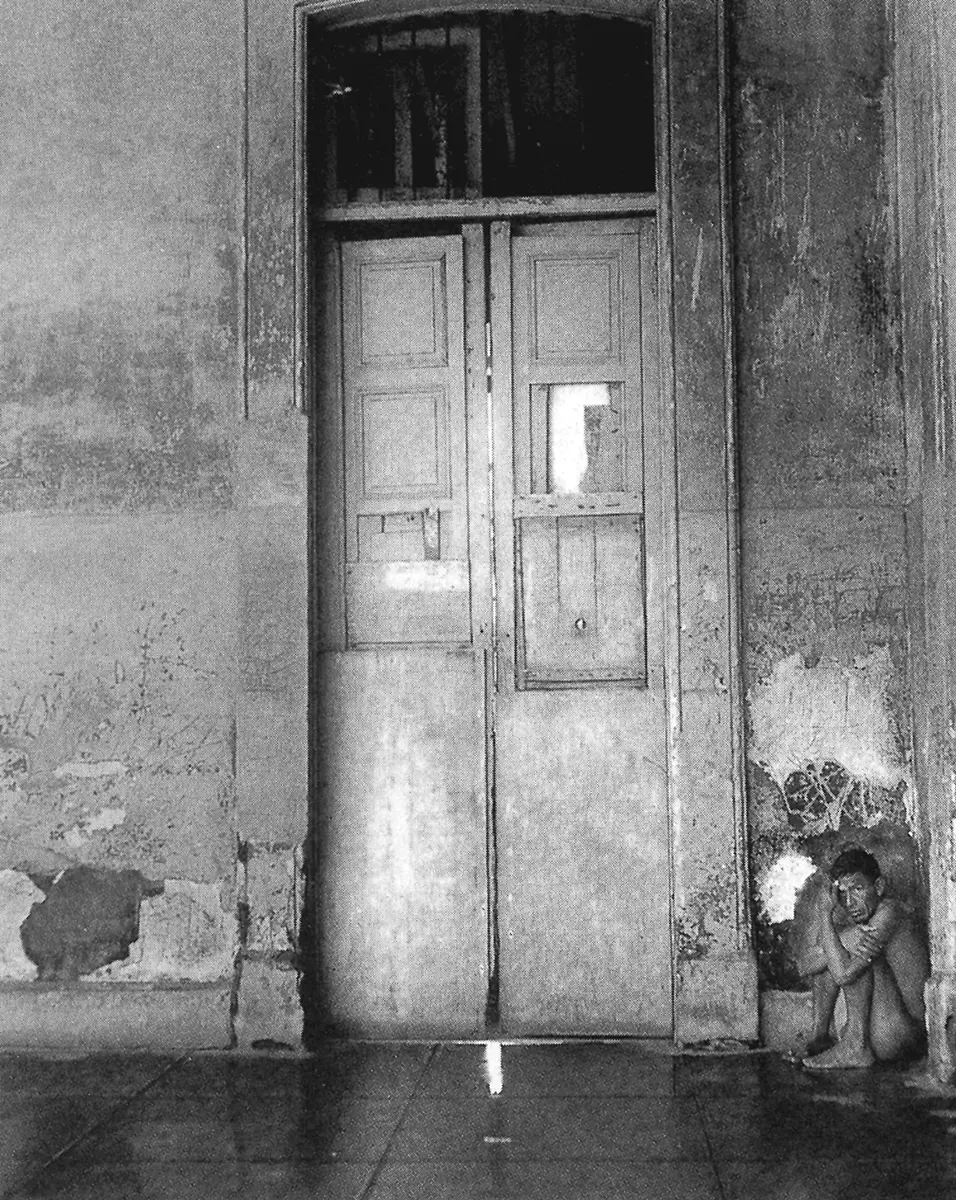
Roberto Huarcaya is essentially interested in a man. Not in the alienated citizen in a hurry, a kind of anonymous social entity, but in the double of himself, with flesh and a mind capable of feeling things, struggling with the invention of the world. It is being itself, his being, which he is questioning (by sometimes projecting himself as a subject, sometimes in The creation) and exploring through the meanderings of his imagination and dreams. Several of his works and in particular in Return of forgotten things, which he presented at the sixth edition of the Havana Biennial, are existential exercises in the symbolism of life and death. Night, water, and air are the fundamental signposts of his visual and mental system of discourse. But he also constructs his narratives in a manner that recalls that of the medieval tabulators: he re-articulates the rituals of everyday life that besiege or disturb or transport us, "gardens of delight" (or delirium) in which he constantly exorcizes his own fears and ghosts.
In this nocturnal environment created by the artist, the color black is not a gratuitous element. Darkness in the work of Roberto Huarcaya is not the darkness of night, nor that of the "nothingness" described by Kandinsky when he speaks of black; it is neither chaos nor anguish, but fertile earth, the underside of the reality which we see, the "bowels of the earth where the regeneration of the diurnal world takes place." His place of imagination, a kind of vital visual cocoon, is like a constellation of icons in which the chiaroscuro flashes appear to be stars, the to-and-fro flashing of eyes and the intelligence, moving from dreams to reality or from reality to dreams. The images emerge from the night, fragments of the real that weave in the disorder an onomatopoeic vision of a world upside down. Paris, as a city, appears like a phantasmagorical vision in the midst of these revisited images, inhabited by other stories which Huarcaya has introduced (an illuminated bridge in Paradise, a flight of steps in Montmartre in The flood, or the Eiffel Tower in flames in Hell). The visitor's gaze lingers on and retains an image that will reveal the magical words providing entry into the universe of these new myths.
The formal aspect, which to a large extent relies on the techniques used, is an essential aspect of our perception of the work. It is by using as a filter an ordinary blue colored drinking glass to give the image a blue hue that Roberto Huarcaya demystifies the apparent sophistication of the work in its form and reveals the simplicity of its technical elaboration. The artist uses an ordinary photographic camera. There is no computerized intervention, no synthetic images, and no complex processing. And yet, the virtuality is there, with the fantastical element emerging from the almost artisanal approach of the artist. The technique obliges the photographer to fragment his "scenes" and enables him to establish a material empathy with the explosion of the dreams. The construction is thus subject to an onirical process that is nevertheless regulated, compartmentalized, and organized. A false kind of chaos is created in these constructed scenes in which one image serves as the starting point for another and where a random linking is created, sometimes unbeknown to the artist.
Huarcaya's formal writing is developed in accordance with conceptual stages which transform his discourse into the universal projection of a personal world. The photographer is not afraid to use a theoretical corpus as his point of departure and he himself says that the idea of construction emerges from the construction of the dream in terms of psychoanalytical theory. In The omens, the composition is longitudinal; in The flood, it is transversal, while in The ice age, it is circular, like the cosmos. Huarcaya here presents a more optimistic and smiling vision than in the earlier installations titled Creation and Paradise (with their flowers, butterflies, child with a ball, and merry-go-round).
Huarcaya's imagery, which is taken from the world of night, can be seen as a photographic variant of automatic writing, where myths alternate and overlap. Nothing is mortal. Everything dies and is reborn. It may well be that this revelation of fragility can also lead us toward other discoveries and journeys within our memory.
CHRISTINE FRÉROT