Teresa Sanchez is an artist from Santa Marta who since the early 1980s has been producing sculptural work that initially had strong links with painting. Her early pieces were done with polychromed wood and were meant to be hung on the wall, like two-dimensional works. But over time, they have become eminently three-dimensional, although sometimes there remains a strong link between the wall and floor.
The various pieces by Sánchez which were presented in the Diners Gallery last November and December established contact with the essence of the pure forms that underlie the complex and varied natural world. This essentialness becomes reality in the carefully sculpted and polished fine wood objects which, as the curator of the show, Germán Rubiano, pointed out, once perceived with the sense of vision immediately encourage us to discover them through the sense of touch. They invite us to handle and caress them, with their delicate forms and rich surfaces that above all respect the nature of the material used, both wood and metals.
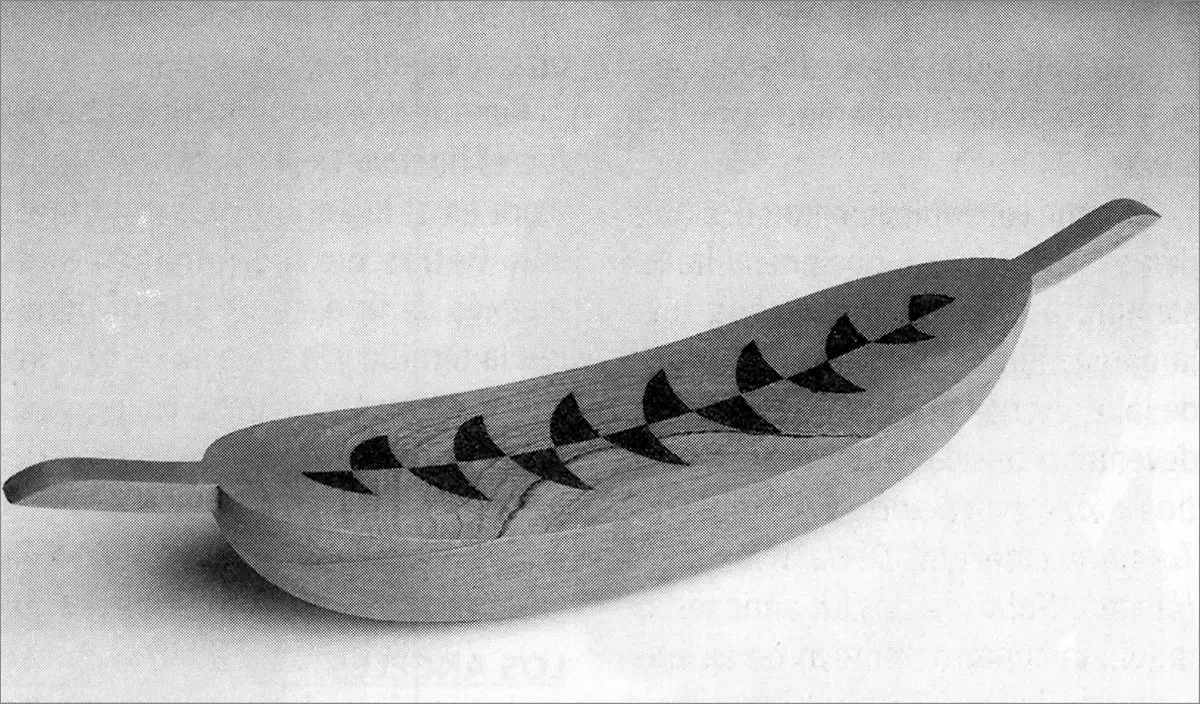
The work of Sánchez is extremely evocative. There is, first of all, the presence of the natural world, which the artist takes as her point of departure, in such pieces as Guama, Fruit, and Fruit of the Medlar-tree. These works explicitly allude to the order of the seeds of a fruit: we can see the axes of symmetry and the contrasts of harmonious and perfect forms resolved in a way that borders on the language of pure geometry, as in Fruit of the Medlar-tree III, in aluminum and bronze, where the artist works with perfect circular forms. In other pieces, she evokes the rhythms of the scales on the dynamic body of a fish, as in Scales and Barracuda. Another work, titled Bird, reflects the undulations that characterize the bodies of birds which in this case, acquire a lightness reminiscent of a softly falling leaf. At the same time, however, Sánchez's approach to nature and her artistic methods reveal the presence of the history of art in the twentieth century.
Her pieces reflect the imprint of modern sculpture in their cleanness of form and the maximum economy of their elements: in a sense, she complies with the famous dictum that less is more. This minimalist austerity seems to be present in such essential and sober works as Clam, in which the sculpting results in a perfect oval revealing the red color and veins of the Nazareno wood, delicately contrasting with a fine white border worked in ivory. This formal purity is also evident in the works placed against the wall like Great Thorn and Oval, in which the light of the ivory combines with the darker tones of the walnut wood. The former is nothing more than a lightly curved and elongated line whose volume narrows out towards the tip, while the latter, as the title indicates, consists of a very closed oval form interrupted at the top with an extreme delicacy that recalls the atavistic and delicate work of primitive cultures that have served as possible models for the language and aesthetics of modern art. Something similar occurs with one of the most outstanding works in this show, Untitled, an elongated piece in ivory wood resting on two iron supports, that was reproduced on the cover of the catalog. With great simplicity, the piece evokes the essentialness of nature and at the same time might well refer to some kind of tool or useful object endowed with great beauty and simplicity. These works by Teresa Sánchez reflect a profound respect for the artist's craft and the materials used. Sánchez enhances the warmth of her materials, revealing the veins in the wood and above all surprising us with the fineness of the surfaces and the delicacy of the forms. Such works are eloquent testimony to the laborious manual skills required for the sculpting of wood. The works were carefully laid out in the exhibition space to reveal all these characteristics so that each could be fully appreciated in all their dimensions. This provided the visitor with pleasant surprises as the eye roamed from the small objects set on white wooden bases towards the larger works placed against the wall.
MARTA RODRÍGUEZ