Unfinished History is Francesco Bonami's assertively poetic group exhibition that focuses on the art of the 1990s. Assisted at the Walker Art Center by Assistant Curator Douglas Fogle, Unfinished History, rather than take an encyclopedic survey format as the term history may imply, demonstrates the cacophonous chatter of today's artistic voices as filtered through the focused lens of the curator. While many international exhibitions seem to want to present the artist as representative of a particular place or culture, this show placed ample and precise emphasis on specific, significant works that show the artists at their very best. By acknowledging the tenuous grasp of the present and the ever-changing mood of society at the end of the millennium, the platform of Unfinished History inherently allows room for curatorial creativity.
At the Walker, the design of the exhibition emphasized a nonlinear approach, perhaps in opposition to the traditional "Point A to Point B" proposition of most visual art exhibitions. Anchoring the show at separate ends of the space (defined by museum entrances) are the Italians (Alighiero Boetti and Maurizio Cattelan) and at the opposite end Bodys Isek Kingelez and Gabriel Orozco.
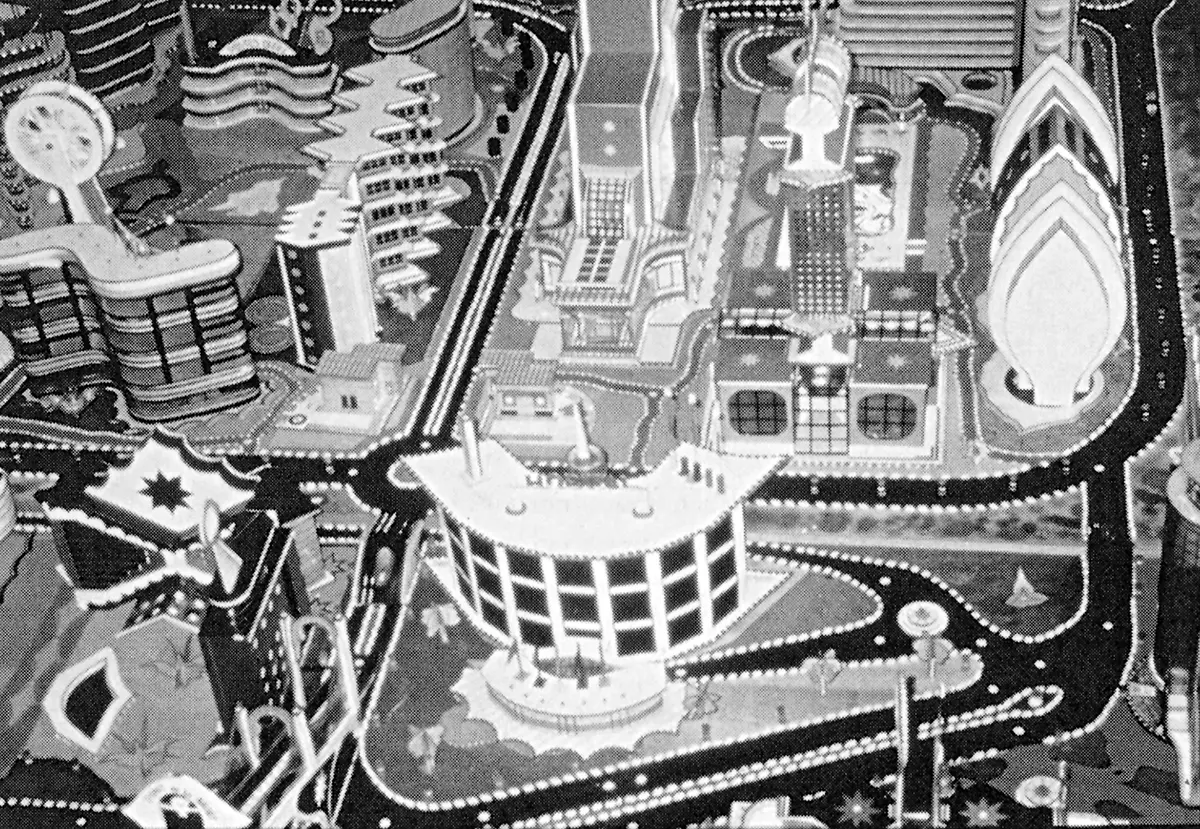
Placing Boetti's Mappa (1992- 1993) and Cattelan's Novecento (Twentieth Century) (1997) near each other speaks volumes on Italian art in the second half of the twentieth century beyond the lyrical meanderings of Clemente and Cucchi, and with a fine-tuned ear for all that, the technological revolution has wrought. With Italy's illustrious art history, the challenge of creating static objects today can seem rather muted. Both Cattelan and Boetti (the only dead artist in the show) succeed, often by working interactively and cross-culturally. Boetti employed Afghani women to weave the tapestries in Mappa, outlining the man-made borders of the world with the essential detail of the flag of each country. Boetti's classic text-based images from his series Ordine e Disordine lines the vertical edges of the fabric while Arabic writing runs horizontally across the top and bottom edges. Cattelan's 1993 work Stadium placed an African immigrant soccer team against native Italians in a friendly table-football match that evoked the politically charged and complex relationship between natives and recent immigrants in Italy. Novecento is a taxidermic horse hanging from the ceiling, with its long limbs dangling down to earth. Metaphorically, the work offers a plethora of valid associations but my own is that of the cyclical nature of history and the parabolic character of the exhibition as a whole, which allows for the circular theoretical flow that can be broken and then interpreted from any point, like an ever-changing oral production.
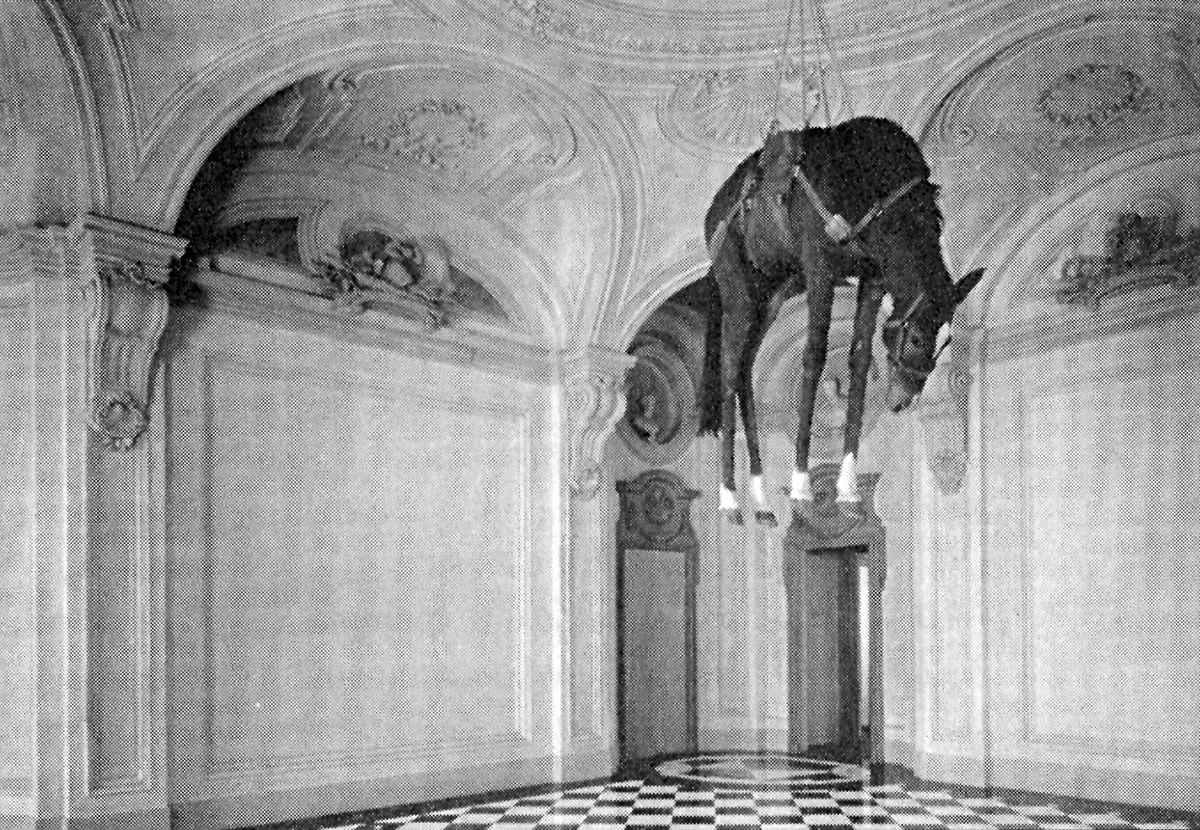
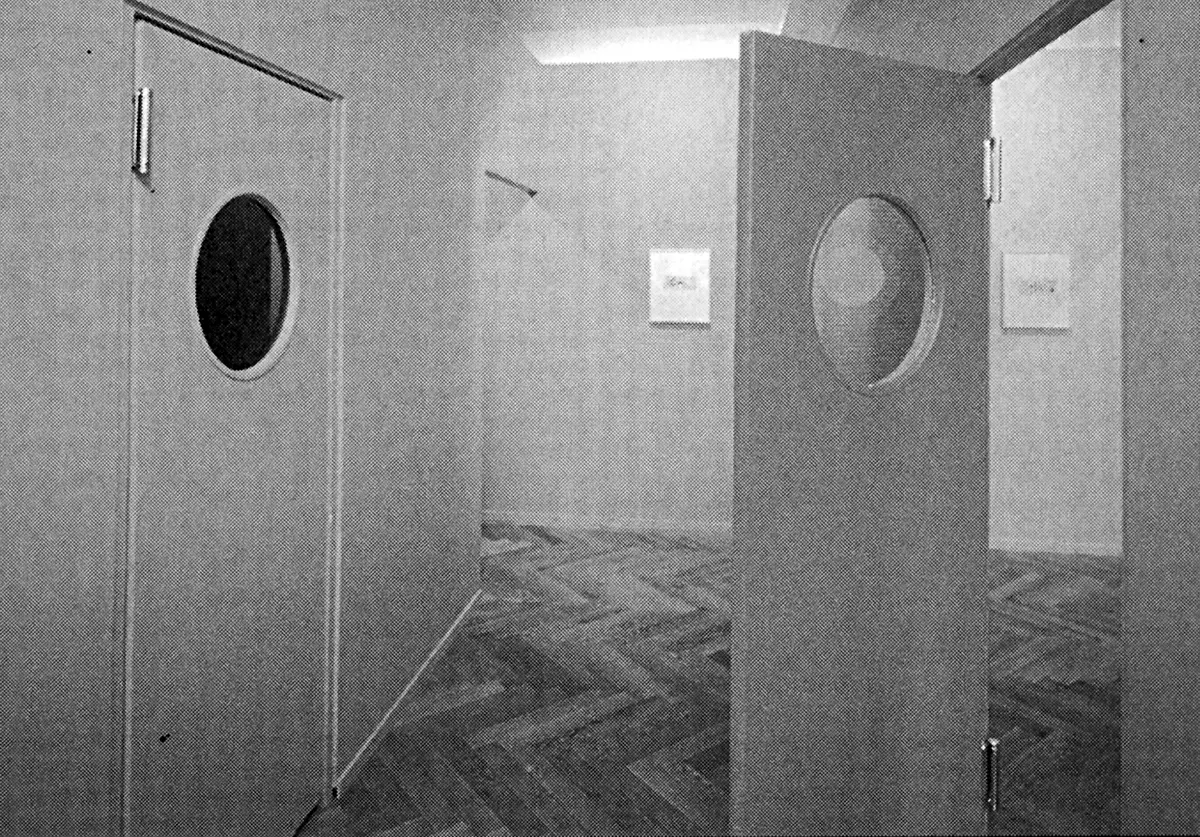
Kingelez's Ville Fantôme (1996) and Orozco's Kitchen Door Maze (1997) are also monumental in scale and significance. Intricately constructed of paper, plastic, and cardboard, Ville Fantôme appears to be an architectural model of a fantastic imagined city. Almost twenty feet long and eight feet wide, it is Kingelez's native Kinshasa, a city in Zaire, a city in Congo—unfinished history? Part Vegas and part Afrofuturistic metropolis, the work is populated by densely separated spiraling skyscrapers and curvy squat buildings in colorful detail. The signs and symbols of an international big business jostle with lingering French names on the facades of towers. Orozco's Kitchen Door Maze also references cities but from his trademark existential ambiguity. Two-way doors lead us through a labyrinth of colored spaces while each optional direction taken leads to a small drawing upon a European train ticket—Torino, Paris, etc. Entering the space of the bright orange and yellow installation is a mystery beckoning like a puzzle alluding to a heightened sense of possibility amidst the chaos.
In addition to these large-scale objects are excellent rooms of video installations by Doug Aitken, Pan Sonic, and Shirin Neshat. Neshat's Turbulent (1998) is a tour-de-force pushing the limits on video as a medium, apart from its installation. Two screens in opposition depict a man and then a woman. The man addresses his audience of men and sings his song and as the applause drowns out, the voice of the woman fills the room, as he turns to listen. She has no audience because she is not allowed an audience. Of course, Neshat's piece draws attention to the subject of female repression throughout the world but, the sounds, the light, the contrasting shades of grey, and the camera movements make this a strong and gorgeous statement. Exhibited as a project room last year at ARCO in Madrid, Turbulent won an exhibition prize. The work was also presented in Minneapolis, London, and New York simultaneously last fall.
Minneapolis-based Wing Young Huie brings this global affair locally and is the essential ingredient that makes this exhibition a resounding success. His large-scale photographs show the world just outside the Walker. And while the international makeup of this exhibition is evident, Wing's portraits partially explain why all of these works speak together so fluently. His portraits show the incredible diversity of a small city like Minneapolis, where Native, African, Asian, and European Americans are the populace. Mexico City, Milan, Kinshasa —contemporary artists, though responding first and foremost to issues and subjects of individually determined immediacy, are dealing with many similar issues around the world.
Yet, and still, what most people have come to term "international" art exhibitions often alludes to some degree of patronizing bullshit. Picture a museum doing a show called France: 5.000 Years. That ain't happening. But if it's China in the title or the outrageously ridiculous naming of a continent's artistic output over the span of 5,000 years! —Africa, South America— then people deem it a worthwhile proposition, however ludicrous such sentiments may be. Though these particulars relate directly to specific large institutions that have been around for many years (the Guggenheim's exhibition of African artifacts was accompanied by a survey show of 50 years of African photography) they are evidence of the double-bind between visual representation and exotic display. Where Unfinished History contextualizes works by a variety of artists on equal footing, exhibitions like China: 5,000 Years amplify old stereotypes of non-western peoples as intuitive and unaware of their products beyond their own cultural value system. Aesthetic value aside, some contemporary artists are more apt to be targets of such thinking than others, especially where international representation has been limited if not non-existent in the past. For example, the work of a very good artist like Kcho easily fits into a western stereotype of what a Cuban artist creates: sculptures of stacked wooden boats representing what else but, to get the hell of out of Cuba away from the nasty history of Communism and US embargoes. William Kentridge's solemn projected images of apartheid in South Africa through the eyes of a privileged white man have garnered much international popularity as have Mariko Mori's autoportraits of doting and docile Japanese women. Similarly, the live nude women of Italian artist Vanessa Beecroft's performances have been critically praised although they seem to act as nothing more than fashionable artifice. So while the art world shows more diversity, when is it simply commodifying culture?
Bonami raises this point in his catalog essay with a scathing hypothetical question in regard to the current state of curatorial research. Inspired by the title of the foreign correspondent Edward Behr's 1978 autobiography "Anyone Here Been Raped & Speaks English? the question reads: Has anyone here been raped and know anything about Minimalism?" (Francesco Bonami).
In other words, "tell me your story of pain, tell me how I oppressed you, but tell it to me in my words so that I may understand without fear." The Otherized Other. And I do not mean this in the traditional master-servant idea but in the very existential belief of universal humanitarian morality. Capitalism breeds oppression and we all have a choice in regard to the path we take. The critical nature of the question is remarkable for its honesty and a compliment to the experience of the exhibition.
FRANKLIN SIRMANS