
Waltercio Caldas was born in Rio de Janeiro in 1946 and has lived there for most of his life. Although his work has been widely shown in Brazil and in Europe, this recent exhibition at the Lelong Gallery was his first solo exhibition in the United States.
The Lelong exhibition was made up of seven or eight pieces, the most interesting of which was one with an English title, All of a sudden... It consisted of a table made of very fine steel rods, with a glass top on which other red rods were placed, the tips of which pointed towards the walls. On the walls, there was a series of randomly placed dots, which were red and crystalline in appearance. The table, the rods, and the dots created a little drama in which rays (of light?) from the rods on the glass table seem to have left red dots on the walls. This is the event that the object narrates. We think this is what is happening with this object when we see it. But the evidence of the event disappears immediately, and we are left asking ourselves: What really happened? What is going on here? What has happened to this object?
A small wall work that was hanging almost unnoticed in a corner of the gallery was entitled Chirico. It was interesting that this work was there as if presiding over the show, as it provided a key to its reading. There is much of De Chirico in Caldas, particularly in a work like All of a sudden...something of the secret atmosphere, the sense of a secret scene, of life in abandoned corners of the world. Furthermore, De Chirico is an Italian, and there was a lot of Italy in this show: Morandi, for example. Some of Caldas' works were more or less distorted quotations of Morandithe constructions with rods that create groups of receptacles, for example. Caldas also seems to have Morandi in mind when, in referring to Mondrian in an interview, he said that "the surface in his work pulsates in a terrifying way, but there is nothing behind it."
This is perhaps a good description of what Caldas sets out to do: to create surfaces or lines (there are practically no volumes in his sculptures) that beat, pulsate, and vibrate. In this, he comes very close to Giacometti. But to be close to Giacometti is to be close, first and foremost, to a sculpture that is less interested in volume than in line. Further, Caldas' work seeks to activate the space between things and to make that space beat or pulsate. For Giacometti- and Caldas inherits this concept-a sculpture demarcates a fragment of space, an empty piece of space. But that piece that is marked out is also inaccessible, and thus a curious situation arises: we are left looking at a void from a distance.
This is what happens All of a sudden... The fragment of the room that remains between the rods and their projections on the walls becomes inaccessible, in a way that invites us and even forces us to look at it. In this case, the sculpture remains within a fragment of our space, it constitutes an absence in our space, and in the process destabilizes our position in that space. The space begins to tremble (more specifically, it is made to tremble in a terrifying way).
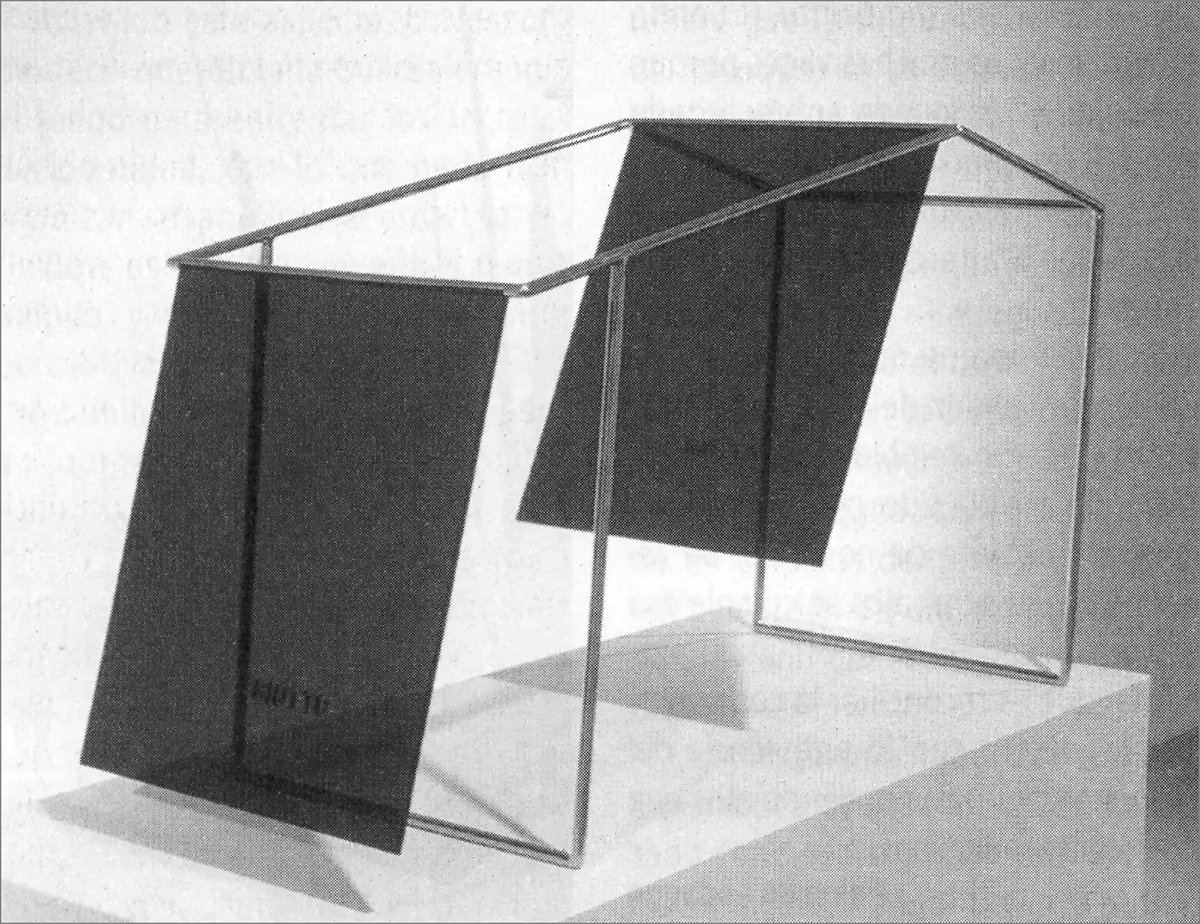
When Caldas achieves this goal, he does so with enormous effectiveness (as in the best pieces by Anish Kapoor or Tony Cragg, to mention his nearest European contemporaries). He does not always succeed, of course. In the Lelong show, however, I believe that he did succeed with All of a sudden..., and perhaps with a small metal and blue Plexiglas object entitled Whispering Giotto. (When his work is less successful, it is often because the composition is overloaded with references to art history, literature, and music, all of which Caldas is very fond of).
In the most dazzling of Caldas' works, the solidity of the object is shaken by a tremor or vibration, so that it appears to emerge before us, all of a sudden. These works reflect the central aspiration of modern sculpture-to reconcile the consistency of the object with the turbulent nature of the event: to create objects that are like whirlpools.
REINALDO LADDAGA