
Last October an exhibition titled The Illustrated Man by the Mexican artist Adriana Calatayud, opened in Guatemala. Organized by the contemporary art project Colloquia, the show consisted of a large collection of digitalized photographs and prints in formats of up to three meters wide. Adriana Calatayud (Mexico City, 1967) studied at the Tecnofot Photographic Training Center in Mexico, and participated in major group shows at the Carrillo Gil Museum of Contemporary Art in 1997 and in the exhibition titled The Body in/of photography in 1998 at the Museum of Art and Contemporary Design of Costa Rica.
The presence in Guatemala of The Illustrated Man was an important visual and conceptual event, particularly given the country's vast current interest in photography. The images of oversized old, wrinkled, and bent-over bodies are a major element in the career of this artist. Both her one-woman show, Split in two, and The Illustrated Man exhibit demonstrated the precise use of technology which, in addition to the realism of the images, the artist used to transgress the frontiers of representation.
In her earlier production, she had created works in which the protagonists were the bodies of young persons of undeniable beauty and perfection. But in The Illustrated Man she savors the possibility of generating friction and exploring our stereotypes of beauty or our general attitude to the body, our repressed feelings, and the effects of sensuality, rejection, or desire.
Within contemporary culture, technology has produced its own face. But Calatayud's work uses such technology wisely. The starting point is undeniably photography and the sophisticated means of technology, but her use of atypical bodies and the overlapping of illustrations of internal organs are more than an act of recording or alteration. Instead, they propose an interesting discourse on the transformations of the body and its ambiguities. In this sense, the work of Adriana Calatayud suggests points of contact between beauty and ugliness, exteriorizes health and illness, and evokes a sense both of joy and of physical pain. In recent years, as art has rediscovered the presence and essential value of the body, new attitudes have emerged toward the latter. Calatayud's work can be seen as an attempt to remind us that the body, in addition to reflecting the notions of traditional beauty, is also a source of smells, roughness, deformations, and secretions which are part of a transformation process that is common to us all.
The body has always fascinated human beings. As a result of a more rigorous approach to our knowledge of its internal elements, marvelous illustrations of the body and its various organs have been produced. Calatayud uses these in an overlapping technique by means of digitalized images. In this way, in her illustrated figures, the distance between the concept of illustration and the possibilities of the digitalized image disappears in confirmation of the human obsession with the human body and its knowledge. This also reminds us that in order to understand the complexity of our bodies, we have had to compartmentalize our knowledge and classify it. Nevertheless, the starting point is always the same: there are no frontiers in the body as regards knowledge and there are no dividing lines between the physical and the subjective.
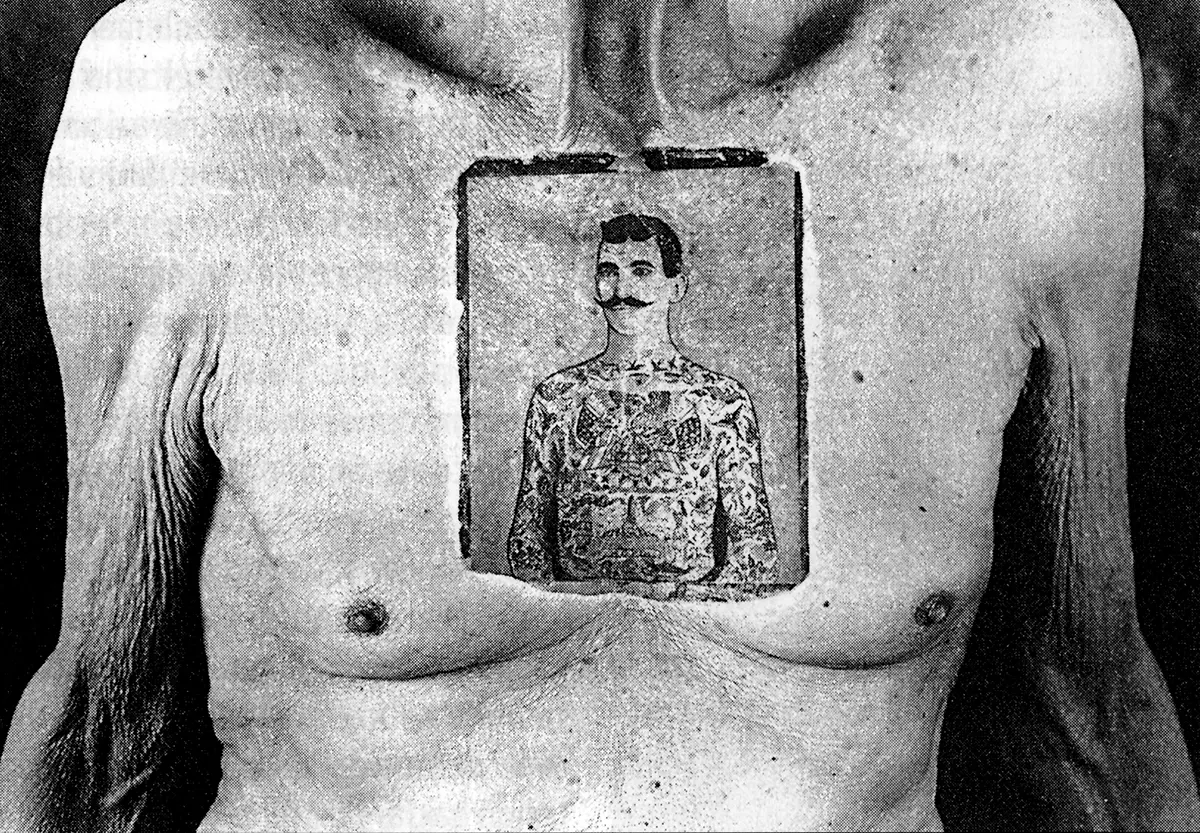
The works of Adriana Calatayud show the body as an intangible identity, to which we can gain access through marks left by time. The works in this show, which were presented as metaphorical readings, suggested a possible explanation of our condition as beings full of life and death, fragile and fleeting, with all of us undergoing a process of relentless deterioration. The photomontage used by the artist functioned as a kind of X-ray, as the only way of bringing together our different levels of existence, the internal and the external.
But as the artist herself has said, "we cannot open up a body to decipher its mystery, just as we cannot open up a clock to discover what time is."
ROSSINA CAZALI