How to resuscitate a dead hare? was the title that Alfredo Prior gave to a performance presented at the Museum of Modern Art in Buenos Aires on November 20th. The announcement in the newspapers of the capital city informed the public that the performance was a response by the Argentinean artist to the performance that Josef Beuys gave at a Dusseldorf gallery in 1965, titled How to explain pictures to a dead hare? The reality of Prior's presentation provided the setting for a complex game of exegesis in which the performance was only the tip of the iceberg and an explanation of the hare-spectators in the paintings of Prior.
Prior has exhibited his work in Buenos Aires since the 1980s. His production, like that of most artists of his generation, has been in pictorial form. Through various shows, Prior has alternately and successively presented a series of artists, alter egos or schizoid fictions, all participating in a collective exhibition; a group of stylistically unified paintings that echoed the titles and subjects of masterworks in the history of painting, combined with vernacular references; a series of characters (a dreadful, easy-going clown, a tiny rabbit) excessively reminiscent of the styles from which they had been born; and other combinations and witty criticisms of the doubtful statues of the painter, author, and style. Throughout this long series of pictorial and conceptual paraphernalia, the artist retained a number of acidic concerns which finally burst forth in this performance-based stage of Prior's work.
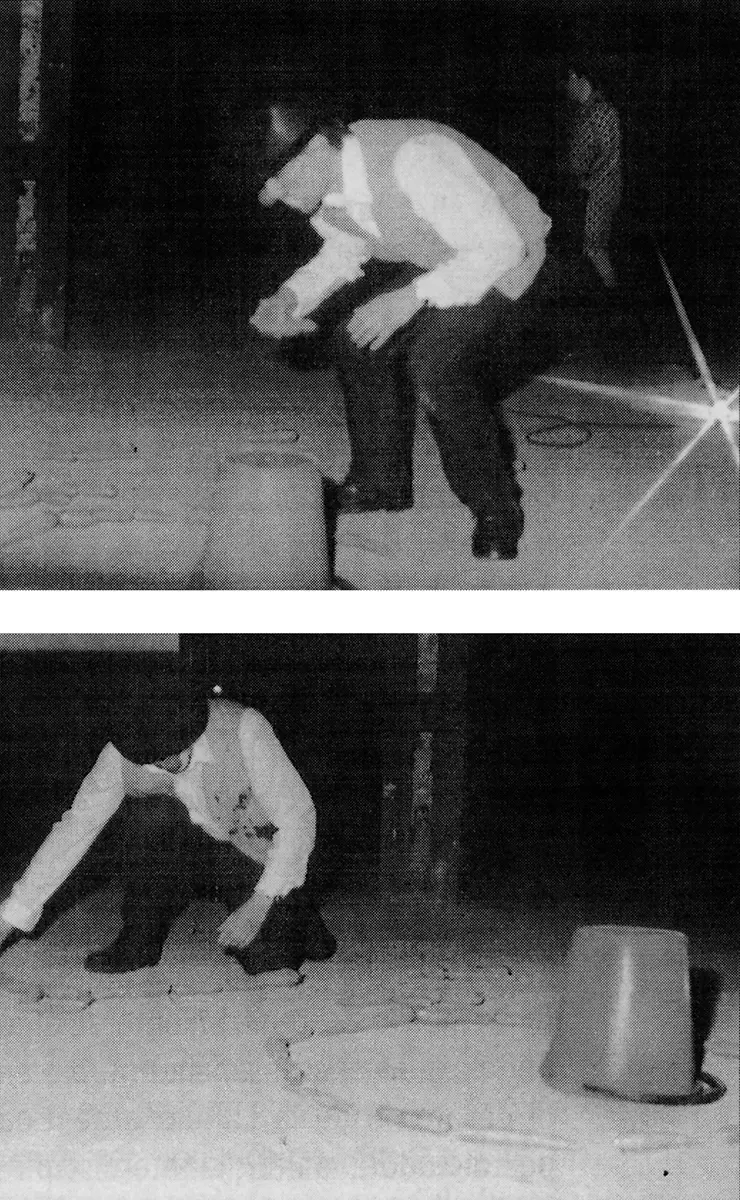
The vehicle chosen to explore both the unbridled desire for self-fictionalization and the disillusioned critique of the circulation/exhibition/ consecration system was a lacerating, lucid, and precise kind of humor. During the long wait and for part of the performance, a hanging screen showed Bugs Bunny cartoons. The rabbit, a ghostly double of Beuys' hare and Prior's painting, reappeared in the artist's solemnly grotesque disguise, which consisted of enormous ears, with a clown's red nose. The room in the Museum, which is still awaiting refurbishing, is a gray, industrial, and undefined kind of place, like the dripping backgrounds of paintings from the 1980s. The performance itself did not make use of any shamanistic or bodily element, nothing that would imply participation by or interaction with the spectators, who were sitting or standing in relatively ordered lines. It was rather like a kind of academic reading of a text, except for the absurd disguise and content. A series of short and aggressive musical interruptions presented by Rafael Cippollini, a literary figure who has written some criticism, was followed by another text, also by Prior, and read by Cippollini, disguised as a fat woman in a nightgown. The event concluded with another burst of music which acted as a curtain to the only action of the performance, when Prior laid out carrots on the floor, in a vague circular geometrical pattern, while the plastic artist Fabio Kacero acted as both himself and spectator at the same time, wandering through the back of the room in a casually crazy sort of attitude.
Prior's texts, which form the heart of the matter, are basically constructed with two vectors, one fictional and the other critical, and both interact in an almost delirious manner. The narrative element, which is Teutonic, full of princesses, hunting, and court scenes, serves as a guide performance, and backdrop for a series of reflections on the function of the artist.
The other text, the one read by Rafael Cippollini, is a witty paraphrase of the tone and style of the art critic writing for the most traditional national morning newspaper and illustrates the content and critical concerns of the original texts with a series of absurd examples about art read in terms of genre.
The strategy adopted by Prior to resolving the dilemma posed by his conceptual painting is clearly literary. It is not only minor literature in itself, but a mimesis of the rituals, forms, and traditions of River Plate literature, i.e., the transformation of Prior's person into a figure that is coherent with the prose itself, and which ends up by making it plausible; the construction of a two-fold narrative, which can be read in one way by the uninitiated, but protagonist by the same readers to whom it is directed, i.e., the initiated who can read the sub-text; and finally, the use of iconographies and traditions which are remote in time and space (Chinese stories, the German medieval period, etc.). The sources of these literary micro-technologies are both illustrious and paradigmatic: Macedonio Fernandez, the novel Adán Buenosayres by Leopoldo Marechal, and the unavoidable figure of Jorge Luis Borges, amongst other canonical references in Argentinean literature.
Prior's literary activity is complemented by his assiduous collaboration with the cultural publication Tokomoma, an opera that will premiere this year, and a countless number of systematic and elusive messages on the answering machines of key actors in the artistic world, with fragments of texts, improvisations, and lapidary critical statements. The brilliant displacement of a work developed at the plastic level towards literature is an indication of the renewal of something which has been notable for its absence in the Argentinean culture of the post-military dictatorship period: interdisciplinary activity. The integrated use of the natural resource par excellence of tradition for an Argentinean-the country's literature- gives Prior, the artist, a considerable semantic and critical density.
NICOLÁS GUAGNINI