
Antonia Sosa exhibits her work only rarely. When she does so, it never goes unnoticed and soon becomes a point of reference for a period or an event. For this reason, Cas(a)nto, the title of her recent exhibition, was important in two respects. Firstly, because it marked the arrival of a long-awaited and excellent show; and secondly, because it expressed a dense and complex meaning.
In Cas(a)nto, the artist brings together several features of her thought and feelings, including aspects (fragments or re-interpretations) of works done in various periods from the mid-1960s down to the present. The show was organized in the following manner.
A metallic Capsule (also called Anto of Light) represented the artist. It was of the same height as her, since the "anto" is an invented unit of measurement, unlike traditional measuring systems. It is equal to 63cm, "not a millimeter more, nor a millimeter less" - the real height of the artist. The Capsule or Anto of Light is made of metal (a kind of protection against violence from outside) and contains a small ovaloid window the form and dimension of which are identical to those of electricity boxes in the streets. Inside, there is a light. The Capsule or Anto of Light is set inside a space reworked on the scale of the artist's own house. In turn, this installation House (Casa) was placed in Room No. 2 of the Museum. Everything outside or around the Capsule represented the world outside the artist. The House, on the other hand, is the expression of her everyday world and is made up of the living room bedrooms, tea room, kitchen, and swimming pool. It also contains revealing objects, including the chairs, newspapers, bed, the dust of her bedroom, etc. Cas(a)nto was therefore a synthesis of at least three meanings: "anto" is a diminutive of "Antonieta"; "House of Anto", with "anto" being a unit of measurement, a model based on her own body and which, when multiplied, modulates the measurements and proportions of all her work; and "House of Art" (Casa de Arte), a relationship established by the curator of the show, through the emphasis given to the central "A" letter.
Various aspects are projected from this center (of the Capsule or Anto of Light) towards the installation as a whole. First, there is a flux between the inside world and the world outside. But also between the present and the past, with a reconsideration, or recontextualization of the past being affected by the present. There are also aspects of the past that are still living today, or which have acted as the seeds for present works. These relationships can be seen through the windows of the house, communicating the inside with the outside, the present with the past, as well as the natural and sensorial worlds with that of the intellect. Through the windows, we can see some works from other periods, aspects of the Museum room, and even the park-nature itself, since the glass of the large windows was removed (North Balcony, South Balcony). The sound outside entered the Museum for the first time. Carmen Hernandez said that it was a space beyond the artist, in which nature opened up and became linked to the cosmos.
Antonieta Sosa comes from painting and constructive work which in a sense is austere in its color. From the two dimensions, she has moved into installation work and bodily expression through performance art. Hence the importance of the integration between her body and the world of emotions and the intellect. The various stages of her artistic development combine in a constant inter-relationship. For example, Stable-Unstable (1965), is a painting whose white grid on a black background was related visually and closely to the jumble of black scaffolding outside the elevator at the entrance to the exhibition. This was From the Body to the Void (1985-1998), an installation- performance in which the artist depicts three distinct stages or moments as seen through three videos: "Dance in a Greek Temple of the XXth Century with the Sounds of the City," in which the aggression of the outside world is expressed through the sounds of the background traffic, while the artist — dressed in red— performs yoga movements which contrast with this saturating atmosphere, as she warms up before continuing with the next stage: Sloth. Here the scene changes. She makes up and puts on a hoisting rope and simulates an animal diming up the scaffolding. The cries and the movement of the body allow her to liberate the animality inside her. Finally, Circle of Light, a tribute to Armando Reverón, prefigures the "anto", through the presence of a white center that permits the concentration of energy. The artist, dressed and made up in white, is sitting on a chair and performing mimes, some without any meaning. What is incomprehensible becomes language through the reiteration of gestures, a ritual that is constant in the work of Antonieta Sosa. This installation performance is in a sense a permanent search in all work: the balance between rational and intellectual states and the emotional state, which sometimes borders on animality. Order entering chaos. In order to work with such opposite extremes, the artist alternates concepts and visual elements with bodily expressions. Art is produced through concentration and the distribution of energy.
Inside the room of the Museum, a contrast emerges between two aspects: the House in itself (placed diagonally to the square space of the Museum) and, on the north wall, five works (Screen for subsequent images, 1965, and four Surfaces, 1984), arranged parallel with the five windows of the north side of the House. All the works and windows measure 90 x 90 cm. On the outside walls of the house, My Skin was set out in a line, consisting of photographs of the skin of various parts of the artist's body. On the south wall, there was the second balcony (South Balcony) without glass (yet another opening onto the light and nature) and, in a corner, Back Patio (1998), a new version of the Hut dating from 1981, whose sharp edges (with glass glued on) reaffirm the violence of the city seeking protection through another's pain. Videos show the destruction of glass windows, a transcendental period in the work of the artist (Performance with Javier Marichal, Breaking of Glass Windows and Urban Walls, all from 1981). Opposite the south wall, Three "antos" measuring up to my body (Urban photographs1 is a visual review of the journey of the artist through slides which served as a kind of museographical guide to the exhibition.
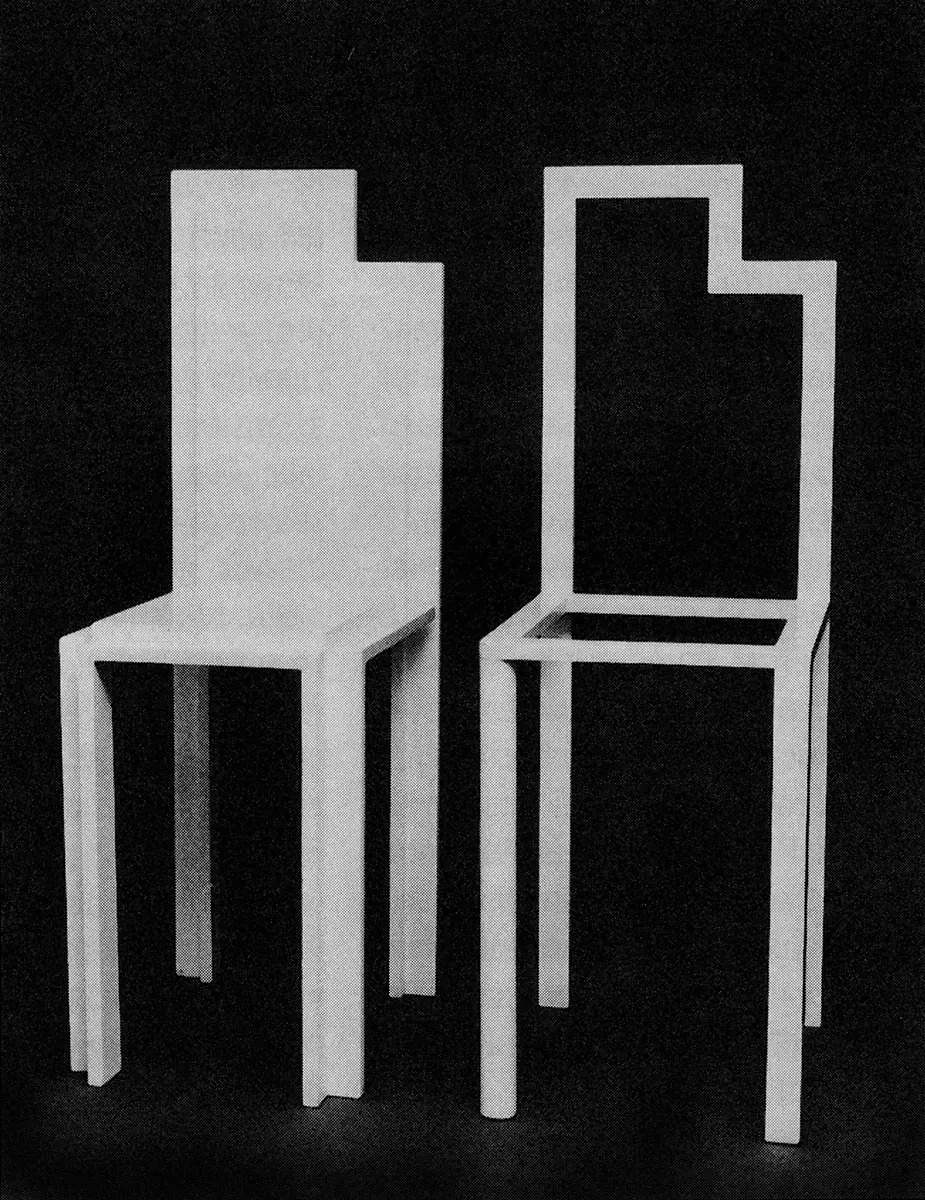
Inside the House, in The Sitting Room, there was the Anto of Light and a few chairs that had participated in earlier events. They were accompanied by a version of the videos Through my chairs (1978) and Antonieta vs. Antonieta (1983), showing those performances in which the artist established a relationship between her bodily movements and resulting forms and the shape of the chairs. The latter, as the artist herself says, "have become transformed over time, just as I transform myself". They include Open Cubist Chair and Closed Cubist Chair, Positive-Negative Chair, Two Chairs and a Half, etc. The vertical line of the body is divided into three segments when the person sits down: vertical, horizontal-vertical, which implies a saving of energy. Sosa bases her work on this principle.
In My Bedroom, there is the bed (The Repose of the Warrior, Workshop of the Artist), with the imprint of her body. It is the acknowledgment of time and, as Hernandez says, a persona! story. The dust in the room is collected week after week and arranged in small pictures like badges or medals (The Dust of My Bedroom). Likewise, there is Rebeca's Bedroom, her daughter, Room of Newspapers, with her notes, press cuttings, and diaries "encapsulated in glass"; Bathroom, with a photograph of exactly what is to be seen in the real bathroom; the Swimming Pool, made of glass and rubber foam, and finally, an important part of this large installation: the Kitchen. The kitchen contains glass pots (originally with marmalade) now used to keep all sorts of things. Each pot represents - and is presented with - ID photographs for each year of the artist's life, from her birth down to the present (Self-Portrait). This is a work of art as a process, but it is also the process of life.
The observation of The Ants in the Kitchen confirms this concept of art which is both spatial and process-based. The artist marks with a pencil the path followed by the ants on the wall. The video records their permanent communication. This is a work that is a reflection of solitude since it is carried out in solitude. This is reaffirmed by the Tea Room, where two silhouettes of the artist, painted on the wall, simulate a conversation, with her voice being heard in the background. Alongside, there is a table, with two chairs facing one another. Each chair has bits of very sharp glass on the seat, one of them, with fragments of fine crystal providing a cutting criticism of the bourgeoisie, including the artist's own family context.
Cas(a)nto is Antonieta Sosa through and through, an X-ray of her work and thought. To see this exhibition is to plumb the depths of her development process. It is a show which will undoubtedly become a historical point of reference.
SUSANA BENKO