
Thirty-five years is still a young age for defining a talent. Or for dying, before one's glory is consecrated. It is therefore humbling to realize that despite Arturo Michelena's sudden disappearance, he managed to leave behind more than seven hundred works, including drawings and paintings, sketches, studies, and unfinished pieces.
An outstanding representative of the nineteenth-century academic spirit in Venezuela, Michelana opened the way up for an epic kind of painting with a national iconography focused on mythology, landscape, and sheer human fortitude. This exhibition titled The Genius and Glory of Arturo Michelena (1863-1898): On the Centenary of his Death was not the first retrospective of his work, but it was the first to present a vision of the seminal works of someone who was the first creole artist to receive major foreign recognition.
The show, which ran from October 1998 to January 1999, reflected the convulsed vitality of the glorious years of the nineteenth century when officialdom and technical rigor established a complex dialogue with genius. Michelena managed to navigate expertly through these waters. The National Art Gallery exhibition presented 45 works dated between 1887 and 1898, a period which the two curators (Rafael Romero and Juan Ignacio Parra) consider to be of fundamental importance for two reasons: "the conclusion of his academic training at the Julien Academy of Paris, under the guidance of Jean-Paul Laurens, and the flowering of his artistic genius, which he developed in Paris and Caracas, and which was cut short by the death of the artist."
The six rooms of the exhibition emphasized Michelena's participation in, and prizes awarded at very competitive international events. This focus provides an eloquent frame of reference and contrast for the period: the Salons of the Society of French Artists (1886-1889 and 189l-1893)and the International Universal Exposition of 1889, both in Paris, and the World Exposition of 1893, held in Chicago. From those years during which Michelena spent two periods of residence in Paris, this show presented a significant number of works. The Sick Child, from 1886 which won the gold medal the following year at the French Salon, was specifically created for participation in the event. The painting captured the spirit of desolation and darkness that was characteristic of the taste of the time. Charity (1888) was another picture that met the prize-winning criteria, without prejudice to the lugubrious and pitiful atmosphere skilfully evoked by the artist.
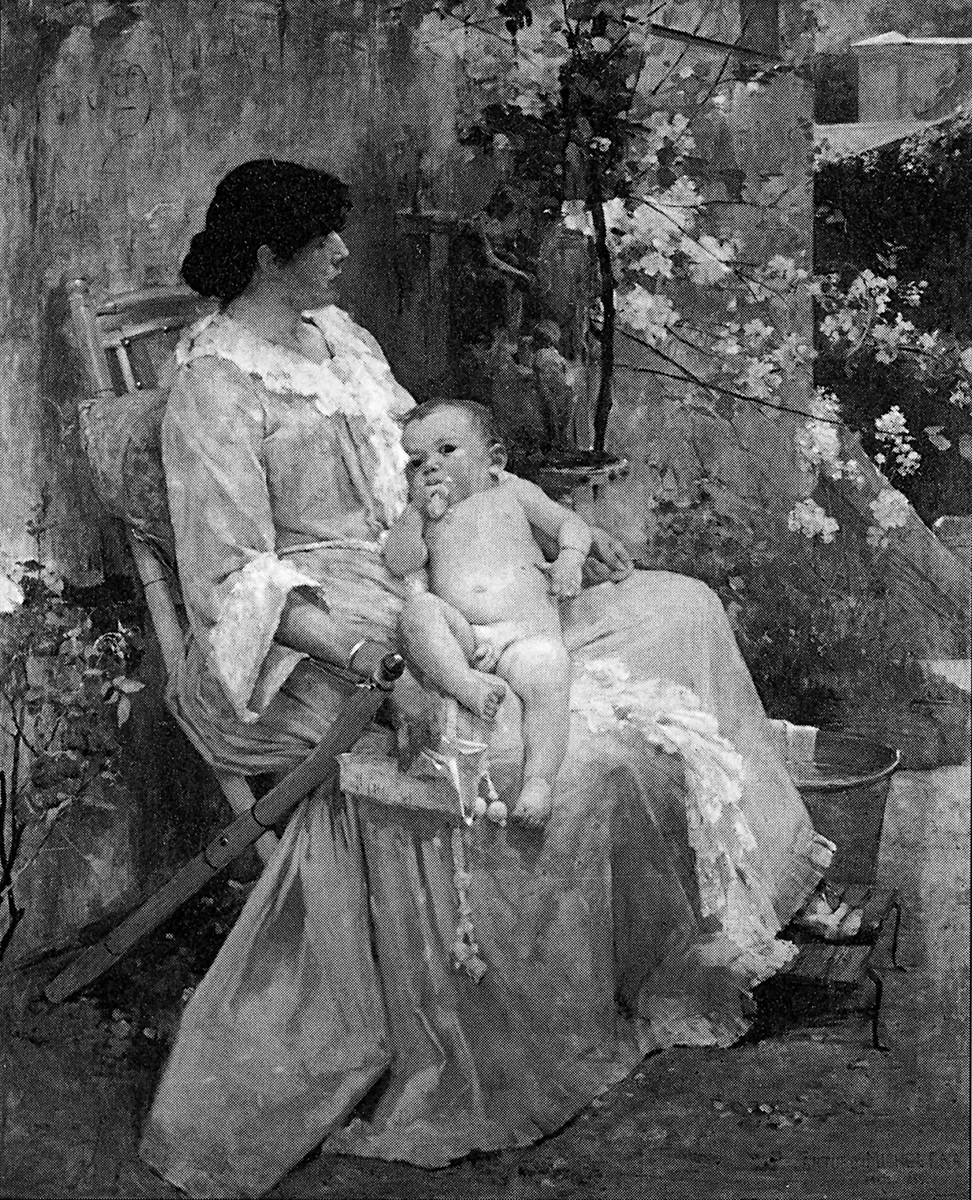
Works of real emotion and beauty were present in this show, including The Hailstones of Rheims (1889), The Young Mother (1889), Carlota Cardoy (1889), Arab Soldiers (1890), and The Swarthy Ones (1889). There were also a few portraits, including the most important and moving pictures of the Liberator Simón Bolivar (although this was not the artist's forte), which reveal the artist's careful eye and steady gesture, as well as a certain sense of serenity.
But the seductive high point of the exhibition was Pentesilea, not only because of the vicissitudes which almost eliminated it from the history of Venezuelan painting, but because it is a work measuring fifteen square meters, and was shown here for the first time on the walls of a museum. The picture, with its mythological theme, was acclaimed by the masses and praised by critics. It was conceived by Michelena during a period of considerable emotional and physical strength. It depicts a bloody battle, full of horses and rough women ready to "conquer or die," with everything being contained within a fast-moving and oppressive yet vital and expressive space.
Miranda's classic works could be appreciated at their full measure within this group. In this context, for example, the picture titled Miranda en la Carraca, acquired an absolutely new dimension, with its urgent and overflowing sense of humanity, the pain of enclosure, and the strength of the brush strokes which transmit the dejection and suffering of a man who, despite everything, remains upright, pensive and surrounded by a few books. Placed in a room where its size did not prove so overwhelming as when it has been shown in isolation, the work is at all events a record of the special poetical treatment of Michelena's world.
Similarly, The Broken Thrust (1892), which deals with the world of bullfighting, manages to move the spectator with its color and rawness. The systematic action of the ritual results in the presentation of the picture of the avatars of an injured bullfighter, a dead horse, a furious bull, and a public whose passions are roused by the event. From the curatorial point of view, there was an interesting presentation of the final sketches of the work, like retablos of the segmented image. This included a self-portrait of the painter wearing a tall hat among the public at the bloody corrida.
Finally, though the spirit of the show did not include the celebration of unfinished works, mention must be made of a large format piece titled The Last Supper, which remained half-finished at the time of Michelena's death. It consists of a bare framework that reveals the intimate work methods of the artist- his finely structured and firm drawing on which he would subsequently and skilfully place his color. Here we can see in a definitive manner the refinement and craft of the artist, the audacity which he would have displayed on canvases that no one will ever be able to see.
JACQUELINE GOLDBERG