Before discussing this exhibition which offered a personal reading of the theme of identity, aspects of Puerto Rican history, and plays as a means of aesthetic and cultural flexibility, I would like to emphasize that identity itself is a changing phenomenon. It, therefore, needs to be seen within a historical context of some flexibility, rather than in terms of rigid aesthetic images of a linear or closed nature, particularly in a world such as ours which has been so influenced by electronics.
With this caveat, Bibiana Suárez chose the theme of the game to tackle the issues of identity, in a way that made her analysis less rigid and more supple and brought her aesthetic proposal closer to a broader public. The initial act of perception, allowed her to establish contact through actual praxis rather than by intellectual means. This Puerto Rican artist, who lives in Chicago, where she is also a teacher, has developed a two-fold approach. Although she respects the established values of certain situations of a religious, popular, political, mythological, and factual kind, at the same time she revises and questions them through the carefully selected theme of the game of dominó which many of us have played at one time or another, and which has been played throughout generations. In this way, instead of creating very large works in which the spectator might feel trapped, Suárez manages to catch our attention with a firm hand by means of formalist, critical, playful, and reflective criteria.
She has also been concerned with the passing of time in her other two- dimensional works. She wanted to present an installation in the Museo del Barrio that would demonstrate her two-fold strategy: to propose a drawing with its infinite richness of detail: "I believe in the temperament of my hand.", and at the same time include the spectator in the idea of something that is not closed. "It is an installation because I want to refer to the game in the process, the effect of a movement carried out on a table or surface used for a game." In this way, the installation suggests that culture, for each of us, is neither static nor individual, but implies both anxiety and searching. The combination of typologies, like the different realities of women in Latin America, is highlighted in various ways-although perhaps what the spectator notices most is the comparison with fruits, as in Custard-apple. But Suárez does not stop here or propose a version of the gender studies so in vogue today, because that would mean once again imposing another kind of closure or limit.
In line with this concept of time, Suárez asks: What has happened to us in Puerto Rico over the last hundred years? For her, there are three subjects: the centenary of the North American occupation of 1898, the year in which her grandfather was born, and all the things that have been assimilated from these events. Three generations were born during those hundred years, and many cultural aspects changed. What has been assimilated during the course of this century? Using a photograph from 1898 and other family photographs of her on the Boqueron beach when she was small, Suárez tries to simulate the dot format of the domino, working with the circle and exploring its expressive possibilities including the circle as a symbolic figure which rotates around itself, just as we turn a problem, a belief or an idea over and over in our minds.
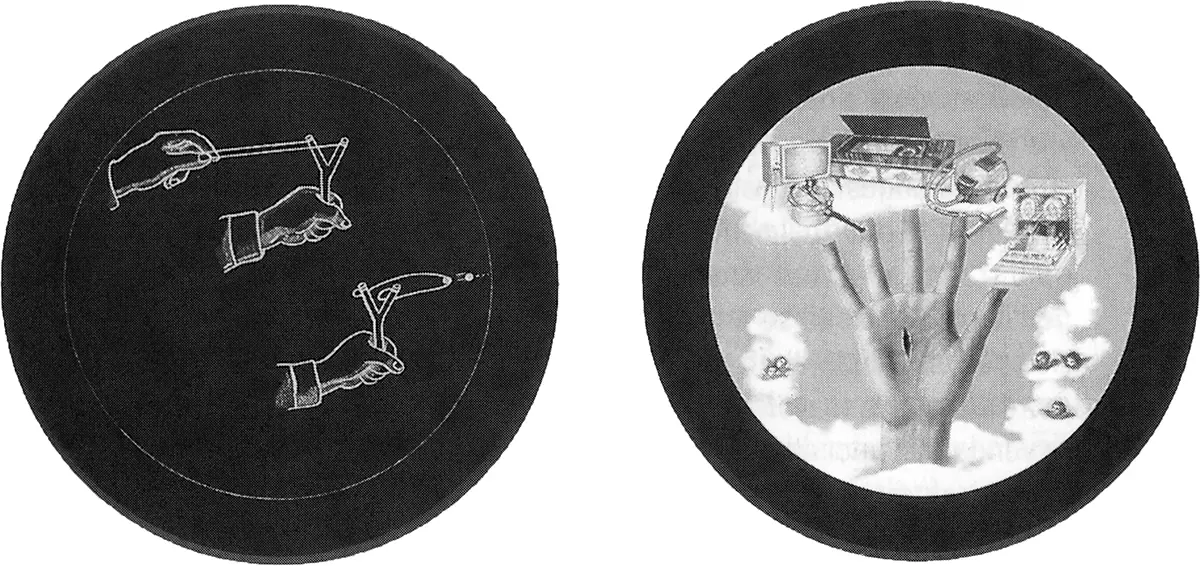
At the technical level, there is a mixture of media, beginning with paper on wood and other elements. The artist prepares sketches with a pencil and marker and uses a projector of opaque bodies, water-based materials, colored crayons, as well as technology since almost all the photographs are digitalized. Although she has said that she wants to work with three-dimensional elements, two images are developed more flatly: The Child Saint of Atocha with the Dalmatian Dogs and The Hand that Represents God the All-Powerful. In the exhibition room, the works were placed in two circles at medium height and successively rising up to the ceiling. The intense and varied color in each circle was controlled with a black contour. Although the works have no literary references, the artist has referred to various sociological studies, such as Divided Borders by Juan Flores, El país de cuatro pisos by Luis Rafael Sánchez, and Insularismo by Pedreira. Dominó is a broad and flexible work: it is not a finished installation and further elements can be incorporated if the show travels. "Dominó provided me with a contemporary voice between my position and that of the spectator. So I was able to speak of cultural and identity politics. When artists work with politics or religion, people run away." Suárez does not cheat as an artist but uses her drawing to tell us not to forget facets of reality, to think about them like the elements of a game, and about the different ways of understanding them if we thought about playing.
GRACIELA KARTOFEL