The artist Freda Sargent was born in London, studied art in her native city and in Paris, and has been living in Bogota for a number of years. In 1970, she began showing her work in Colombia and since then she has become known for her watercolors, paintings, drawings, and terracotta works presented throughout the country and abroad. The pieces exhibited in November and December at the Diners Gallery focused on two themes: The Floor of the Forest and Wuthering Heights. In the first series, despite the presence of flowers and plants that evoke the objectual world, there was a clear affinity with abstraction, whereas in the second, including the title itself, there was the presence of a story and a narrative element. In both cases, the spectator could detect a very unusual sensibility in the handling of color and the brushstroke-a quality that has become a constant feature of Sargent's work.
The show began with a large format painting of a hand of a woman on the left of the picture; it is the hand of the painter, seemingly placed on a table containing the everyday objects around her. At the top part of the picture is a white flower, with a blackbird nearby that symbolizes Bogota, where many such birds are to be found. These figurative elements are placed on the surface of the canvas, without any reference to perspective; it is an eminently pictorial surface. Each figure is worked with a rapid and deft brushstroke which does not linger on any details but instead, through color, places on the surface the precise elements which enable us to understand the meaning of the exhibition. This was an exhibition in which Sargent recalls, in an intimate manner, significant events related to the life that she has lived. Wuthering Heights refers to her reading of the English romantic writer Emily Brontë, who wrote the novel during her adolescence. The Floor of the Forest makes a two-fold reference. The title of the series echoes the work of a Dutch female painter from the seventeenth century who, like other artists of the period, painted flowers, but who, unlike the others, did not depict them as part of a still-life, but as they appeared on the floor of the forest. In this way, her paintings reminded Sargent of the places she had played during her childhood in England.
Beyond personal anecdotes and the artist's memories, the eight pictures which make up the group titled The Floor of the Forest confirm the skill with which Sargent has handled her color. One of these works was titled Rain, a medium size painting (50cm x 50cm) using a half-ochre/half-black stain in the lower part of the picture. It shows how Sargent worked with considerable spontaneity as the starting point for a series of emerging warm tones which, like very fine brushstrokes, illuminate the area and allow us to recognize leaves, stalks, and plants. The scene ends with flowers full of light which are nothing other than transparencies and dense stains of oil ranging from orange to violet.
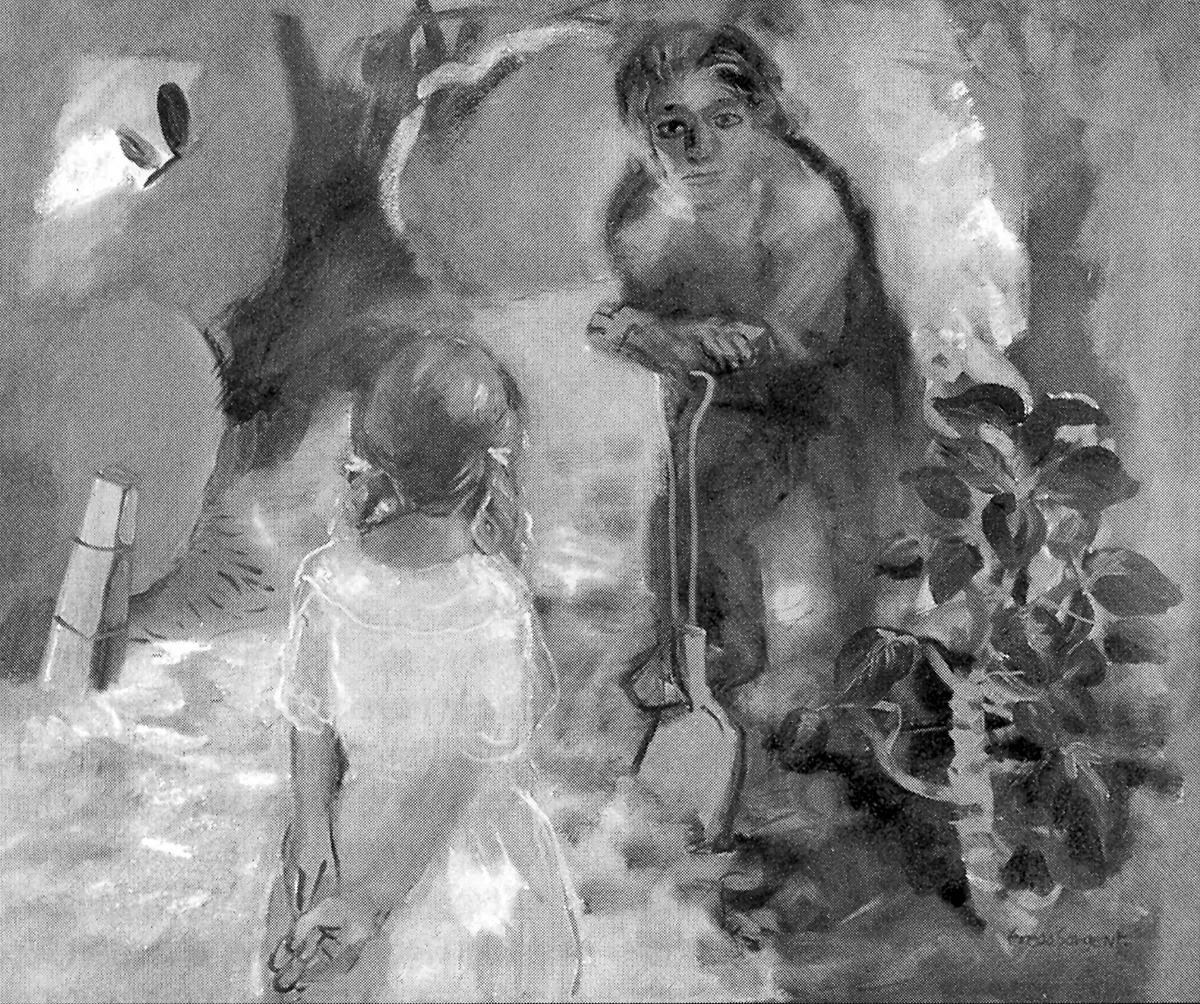
The challenges which Frida Sargent set for herself in the ten drawings and eight paintings comprising the Wuthering Heights series are of another kind. Here the anecdotal element and the literary narrative must not predominate over the plastic element, and both should be used to reinforce the image so that it does not become merely illustrative. The challenge was successfully met in the case of the drawings, thanks to the sensibility of the charcoal linework evoking the silhouettes of the figures with a forcefulness that was often highlighted by broad areas of shadow suggesting nocturnal settings and star-spangled skies. Some of these drawings remind us of works of German expressionism, in particular, Kathe Kollwitz. The lyricism of others is reminiscent of some of the faces of Marc Chagall. In this way, these stories and the literary narrative are transformed into a moving plastic event in which the line and gesture become the essential protagonists.
Something similar occurs with the paintings in this series that recreate images alluding to different moments in the novel which Sargent believes contains all the sense of impulse, force, and fantasy we associate with adolescence.
As in other memorable exhibitions by Frida Sargent, the spectator leaves the room with the sensation of having been in contact with the image and its finish with a fine sensibility which laboriously and silently, day after day, wisely tackles the difficult challenges posed by painting.
MARTA RODRÍGUEZ