
Guillermo Calzadilla, who together with his partner Jennifer Allora represented Puerto Rico in the São Paolo Biennial, has become one of the truly interesting artists in the complex (and even cutthroat) Latin American visual arts scene.
Calzadilla's work as a student in the School of Plastic Arts of Puerto Rico revealed self-conviction, honesty, and an innate belief that good art is constant search and poetry. After graduating, his drawings, paintings, mixed media, constructions, and installations dealt, at one level, with matter and images as postmodern poetry within the present-day understanding of communication, intertextuality, multicultural interpretation, and, above all, personal change and the possibility of action. Yet Calzadilla is also extremely interested in the relationship between masks, identity, action, and spirituality at the end of the 20th century.
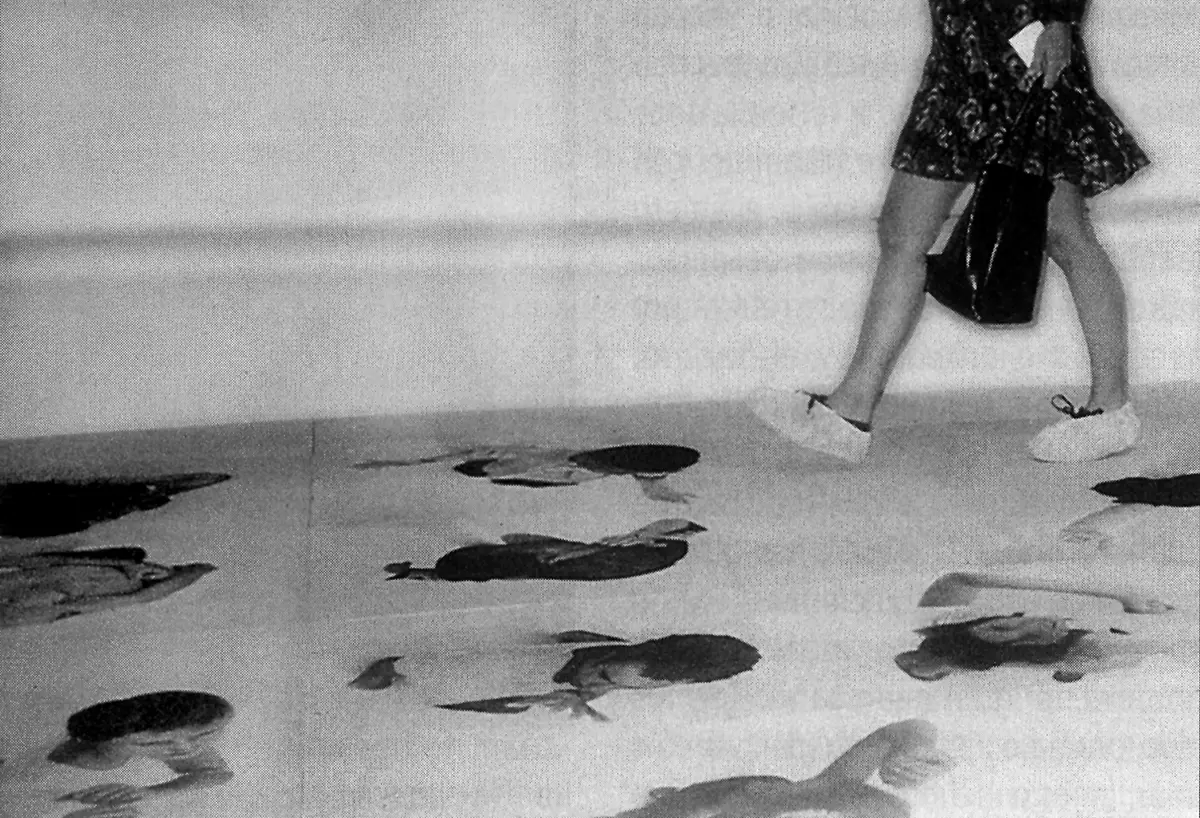
His work has often shown an extraordinary plastic inventiveness that challenges the formal assumptions traditional to Western art and the Caribbean carnival. Kafka, Borges, Cabrera Infante, and Damien Hirst are his protagonists.
His mirrors, his binoculars, his organic visual poems made of meticulously painted small green leaves, or his controversial but truly daring "photo-realistic" Dance Floor, all contain contagious levels of energy and fantastic degrees of lyricism.
Although Puerto Rico is home to Calzadilla, he and Allora now live in New York City. Both artists are in great demand. They have participated in numerous prestigious international events, and their work has been very well received.
Since the pair began working together some years ago, they have effectively integrated a group of different visual discourses. Like a pair of gifted choreographers, their final pieces are both an aesthetic challenge and an original metaphor for human existence.
Although it is now impossible to decipher who is responsible for what in Allora and Calzadilla's work (they even draw together—both draw the same leaf or portrait simultaneously), I have always been able to detect Calzadilla's lust for transgression, and his deeply rooted belief that he must take us to some unknown but marvelously enlightened abyss.
I believe that so far the pair's biggest contribution to art has been to seek an intelligent and effective balance between contemporary aesthetic/plastic/technological experimentation or progress (which becomes outdated so quickly nowadays) and the values that have consequently marked humanity through the ages.
MANUEL ÁLVAREZ LEZAMA