
Héctor García’s photographs from the 1940s to 1980s evocatively capture the unexpected in Mexican life. His images follow the tradition of his teacher, Mexico's most famous 20th-century photographer Manuel Álvarez Bravo, by focusing upon the extraordinary details and the play of light and line evident in the frame of a boy walking between two cars or a woman sculpting a clay vessel. García's images, however, are conceived through the eyes of a social critic, and since the 1960’s he has been recognized for his unusually perceptive work as a photojournalist. Born in Mexico City, García supported himself during childhood as a street vendor, and his photographs sensitively portray this experience and perspective.
Niño en el Vientre de Concreto (1952), is one of García's most powerful images, combining a spare, modernist composition with wrenching social commentary. The image proffers the view from above a small rectangular space cut into a concrete sidewalk, where a small street boy lies on his back, curled into a ball. His knees bend to his head, his feet are braced against the frame marking his tiny haven, and his face is hidden behind his grimy hands. This photograph is, on one level, a striking, almost abstract image of a rectangle within a rectangle expressed in measured tones of gray and black. On another level, it is a profoundly disturbing expression of this child's struggle to survive, revealed by his torn, soiled pant legs, blackened feet, and matted hair.
García's emphasis on formal as well as thematic concerns is also revealed in Paso a la Luz (The Way to Light, 1963), an image of quiet, almost ethereal beauty, reminiscent of an Alvarez Bravo photograph. The García image portrays a little girl bathed in sunlight, dashing away from the camera through a rustic, cross-shaped doorway into a rocky courtyard. Her body casts a shadow that cuts diagonally across the dirt floor of the otherwise, blackened room, she leaves behind. Across the yard from her stands an expanse of a well-worn adobe wall, punctuated by a large pair of wooden doors. García captured a magical moment in this frame, a kind of metaphorical statement expressed by her flight from darkness into light.
Although many of García's photographs appear to deliberately emphasize the striking visual contrasts wrought by light and shadow, or the spare composition defined by a single, mesmerizing detail, he also created numerous documentary images. These photographs record his world, casting the plight of most Mexicans in an utterly human light.
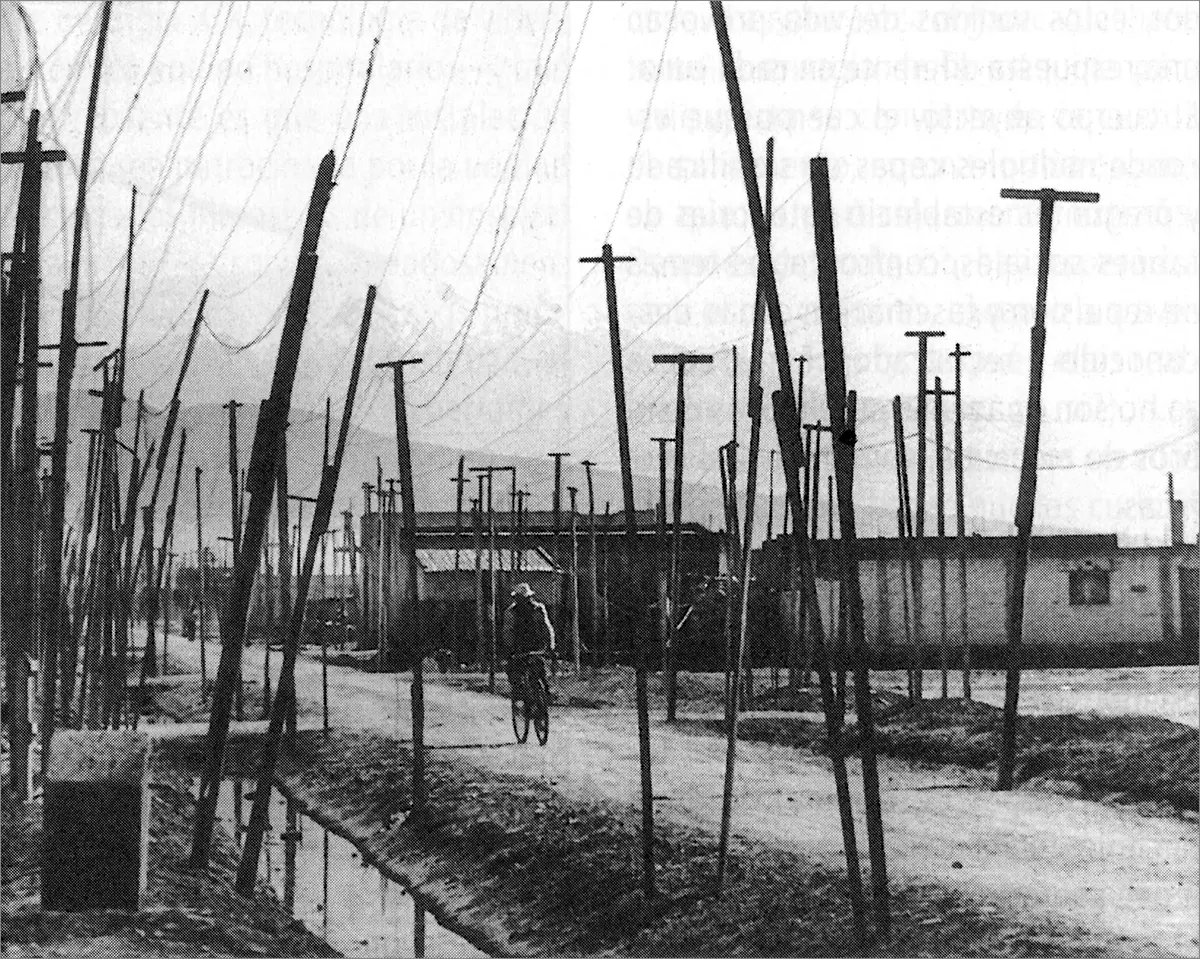
In Ciudad Nezahualcóyotl (1959), García portrays one of the more difficult areas of Mexico City as both poor and proud, a desolate stretch of a dirt road lined with a cacophony of jutting telephone poles and drooping wires. The pale, hazy silhouette of the volcanic mountains fills the skyline and a lone figure on a bike traverses the road that diagonally dissects the cluster of squat, cinderblock houses. García's photograph conveys the humble community as an almost surreal vision. It seems to be effused with a kind of mystical energy generated by the totemesque telephone poles, marking the arid expanse like the towering wooden crosses covering hilltops in the southern Mexican state of Chiapas.
In Jaque (1958), García shot a classic, monumental stone statue of a historical figure on horseback in Mexico City, engulfed by men and boys, perched atop the figure and horse, clutching the animal's tail, and clustered at the base. Each person struggles to glimpse the public spectacle, probably a parade, on the street below. The shared past of these Mexicans is reflected by the imposing, soviet style monument to the Revolution that lurks behind them in the smog-filled distance. Although they appear at ease, one cannot help but consider the force of change youths such as these can produce, namely, the Mexican Revolution, when the situation demands it.
The human face of Mexican life García so powerfully evokes, is exemplified in his masterful, Hombre Ecológico (Ecological Man) of 1965. A youth's profile from head to waist is presented to the camera, as he pauses after laboring in the Veracruz countryside. Upon his head, he wears a straw hat beneath which droplets of rain mixed with sweat edge down his cheek and neck. Stretching over his shoulders like wings, spreads an enormous tropical leaf, its stem serving as the spine down the middle of the youth's back. This is an extraordinary portrait of a young man and his world, that imparts both the youth's resourcefulness and his humble circumstances.
Herein lies García's talent. His photographs resonate because they at once, chronicle the realities of life and capture the unforeseen details that color one's world.
MARY SCHNEIDER ENRIQUEZ