The Venezuelan artist Julio Pacheco Rivas was born in Caracas in 1953 and was, as he likes to call himself, "a child painter." In 1967 he had his first solo show in Caracas's disappeared Isla Gallery. Back then, he created a sort of informal abstract painting which did not foreshadow in any way his future style and his personality of a mature artist, even when he demonstrated, in a fashion that was surprising for such a precocious artist, his imagination and mastery of plastic resources.
It is, however, since 1972 that he begins what he considers, not a Nazarene period, but rather the development of a young painter who is defining himself with a very marked personality. Indeed, from that date to the present, his radical independence in relation to the Venezuelan plastic scene (as well as the French plastic scene, since he lived in France for ten years) is prominent. If we exclude a brief and unfortunate brush with kinetics during his student years (at the Experimental Art Workshop in 1969), Julio Pacheco has been passed up by the conceptual art of the '70s, pop painting, the drawing boom, the so-called "new painting" (neo-informalist, neo-expressionist), and conceptual art once again (now in the '90s). And, unfazed, he has continued in his labor with a steadfast "self-nourishment" that stems from his own work. This individualism, impermeable to trends and fashions, is erected as a dominant feature of his personality which gives a very particular vigor to his work. Besides being individualist, Julio Pacheco's work, as a unit, presents a dynamic and generative coherence, for every stage harmoniously leads to the next without breaks and without repetitions, with an increase in plastic complexity and significant and symbolic implications.
First stage: 1972-1973
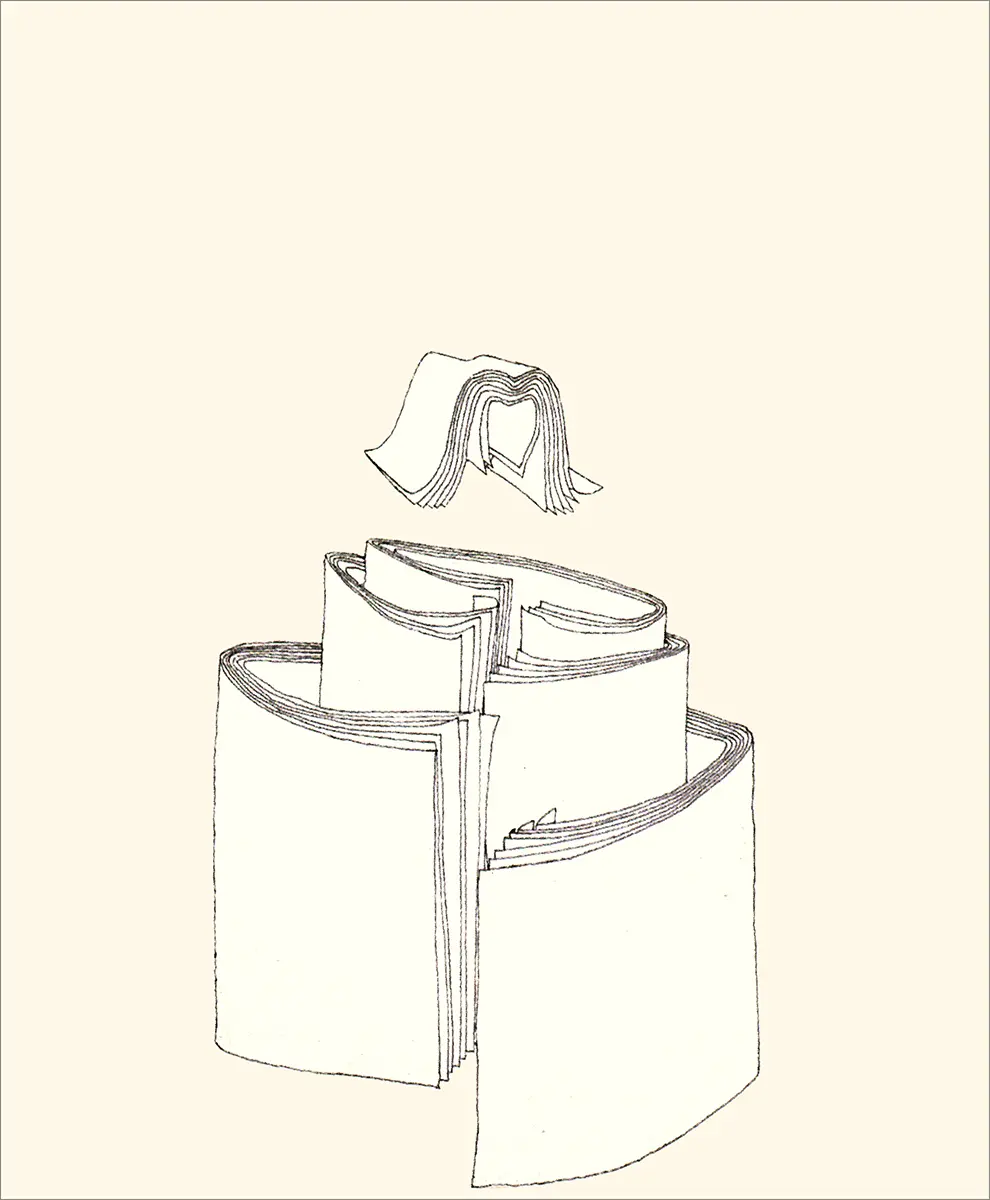
These are drawings that represent sheets or strips of paper. Some have a somewhat obsessive character due to the repetition of lines with few variations. With a very fine outline, the artist marks the boundaries of surfaces that turn, bend, and twist. At first, only the black lines fix the limits of the shapes: both the content and the form are the very support, paper support. Pacheco plays with the ambiguity between reality (that of the paper upon which he draws papers) and fiction (that of the represented paper). These drawings oscillate between extreme realism and abstraction, for the forms that shape them evoke nothing beyond themselves. Up until 1973 and 1974, with La holandesa (The Dutch girl) and La infanta Margarita (Princess Margarita), he dabbled not in figuration, but rather in a somewhat humorous evocation of figures of art history. The papers in his ruffles and creases evoke a coif, a hairdo, a vertugadin. They are neither characters nor do they issue from living models, and yet they have an undeniable power of evocation, something phantasmal; again, halfway between representation and abstraction. Such figures will reach their maximum expression in his 1976 painting titled El regreso triunfal de la Infanta (The triumphant return of the princess), which finds inspiration in Velazquez's Las Meninas. In it, the appearance of the menina (maid of honor) acquires a more sophisticated level of interpretation and, in the background, as in Velazquez's work, a form appears that echoes the silhouette of Jose Nieto.
Second stage: 1973-1976
The strips of paper which began to evolve in vacuo are now placed in one space, or they share the space with a geometric volume that stands in as a base or support. In this space, these volumes, initially simple, become more and more complex and flow into true architectural constructions. The papers now come to inhabit or populate the spaces, where they seem to mitigate the absence of figures, of human beings. Analogously, Pacheco introduces color, and the drawing becomes painting (acrylic on canvas). Beginning with this stage, the artist's universe is profiled, emphasizing from now on the imaginary architectures. Tempus et Solitudo (1975) is a good example of this decisive stage. And the aforementioned El regreso triunfal de la Infanta symbolizes his greatest achievement and his end: the courtly ambiance created by the combination of threshold rooms and stairways ad infinitum has substituted Velazquez's spatial play and sets the bases for the development of Pacheco's work. After this maid of honor, all of the papers disappear; all of Julio Pacheco's canvases become solitary and deserted.
Third stage: 1976
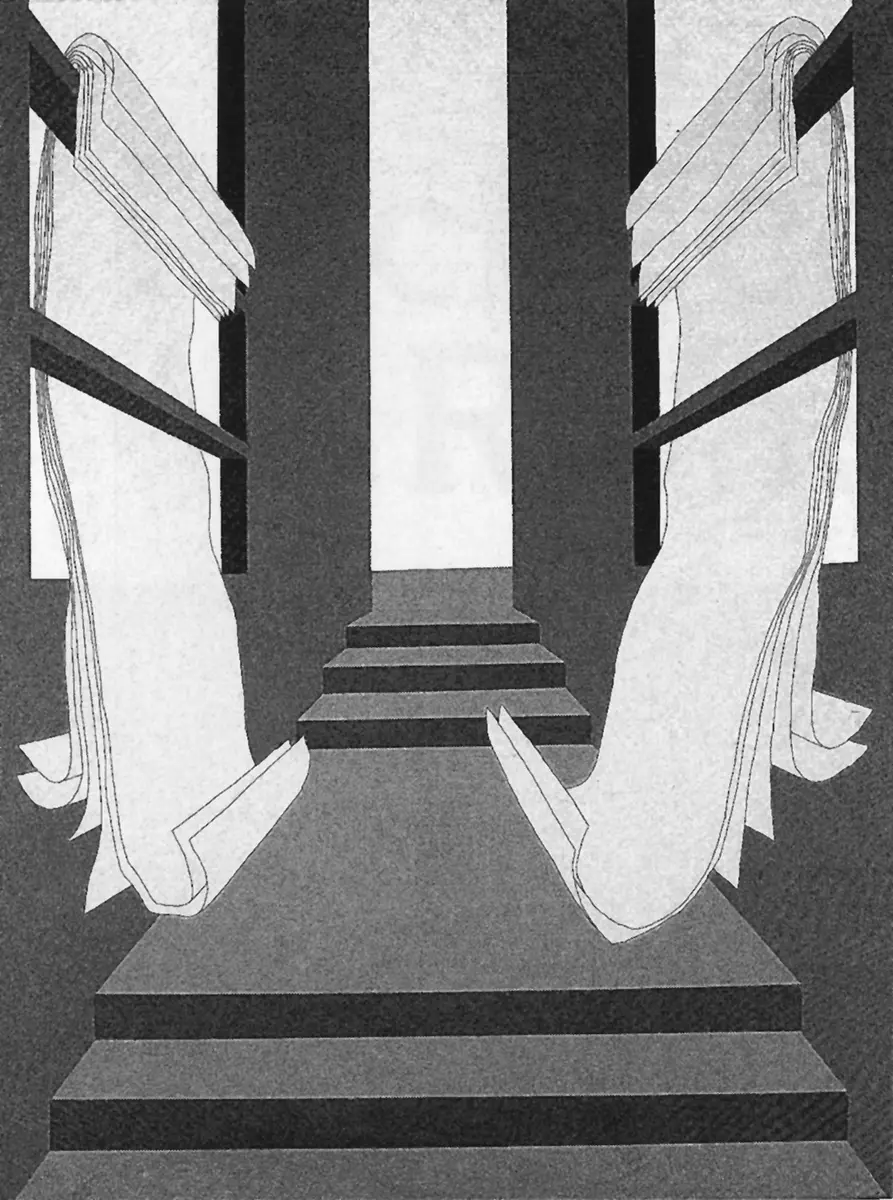
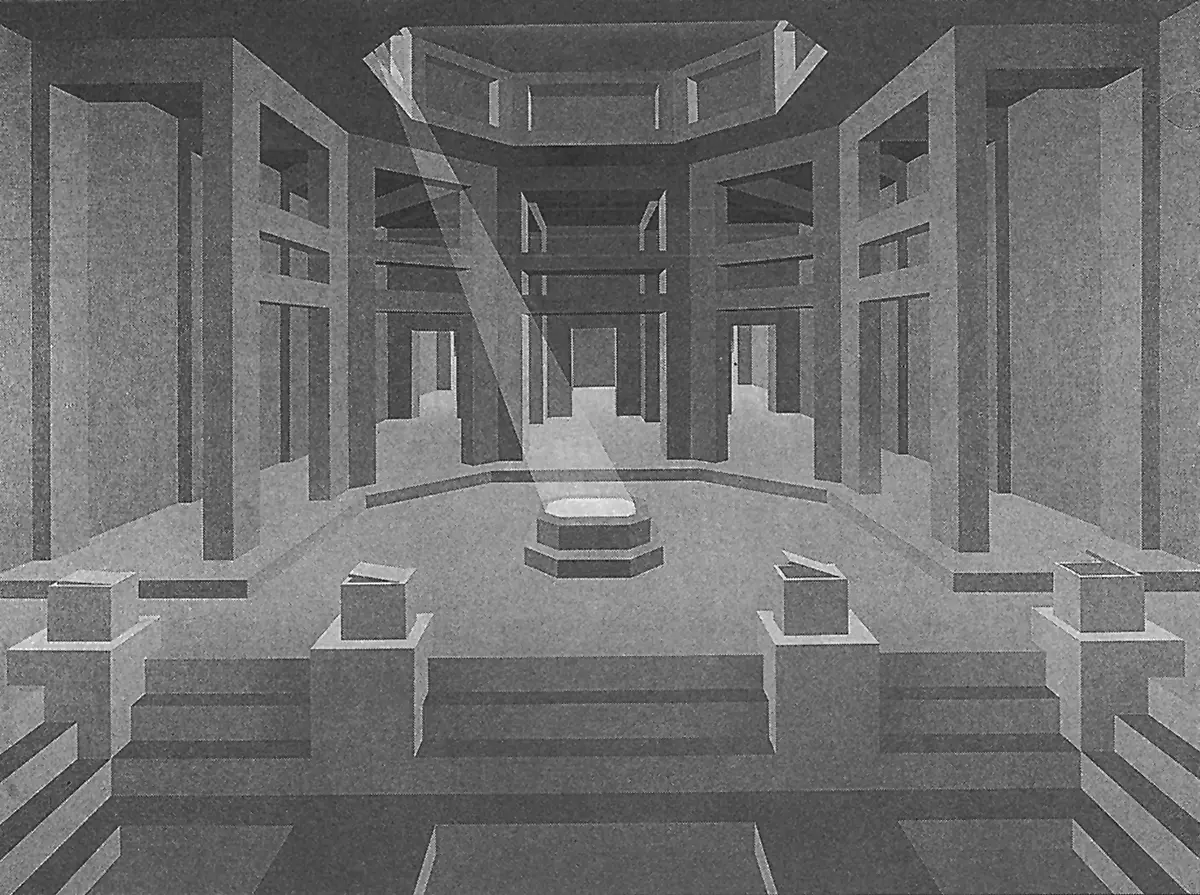
The construction of internal spaces with verisimilar elements is consolidated: columns, steps, thresholds (never doors), platforms, stairways, and beams. But his illogical ordering and combination transform the resulting palaces into impossible, useless buildings—a little like Piranesi's Careen, though less oppressive and threatening, perhaps due to the use of diverse colors. El palacio de Kublait Khan (The palace of Kublai Khan) and Roberto sueña con su propia muerte (Roberto dreams of his own death) illustrate that moment of Julio Pacheco's work in which spatial complexity seems to be an end in itself, a labyrinthine game.
Fourth stage: 1973-1983
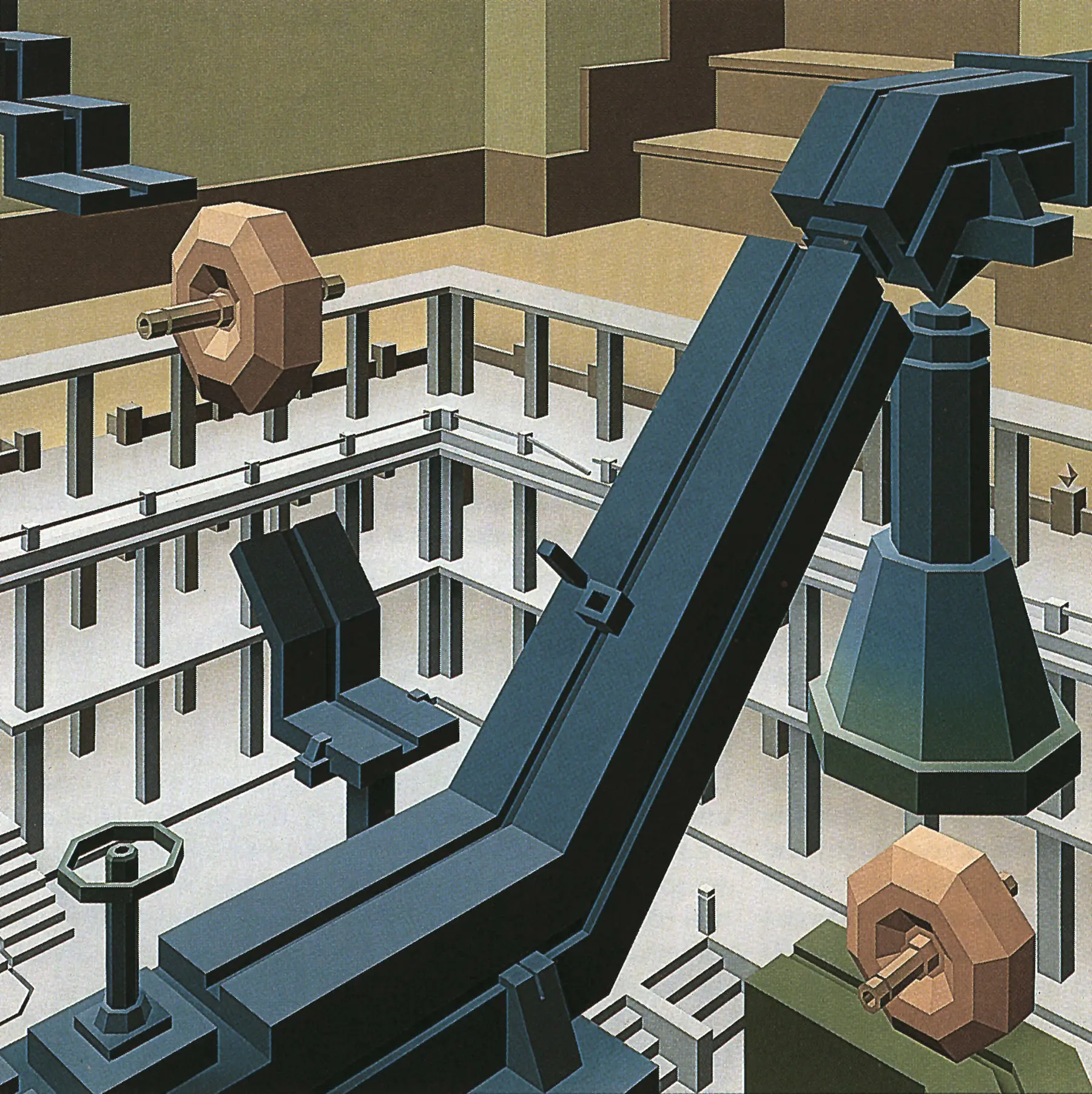
Objects are now placed within these same architectures. Some are identifiable, like the chairs; however, they are impossible chairs, for they have only three legs. Other elements resemble minimalist sculptures on their pedestals. On the other hand, there are certain objects with no counterparts: they may also be sculptures with abstract geometry in accordance with structures that protect them; they may also be machines, robots, or scientific objects. At the same time, the architectures are enhanced in their complexity, their profundity, and their multiplication of levels and enclosures. On the canvas titled Recinto para el héroe que aún no ha nacido (Enclosure for the hero yet to be born, 1977), Pacheco handles the irony of underscoring absence, and vacuity: he sends a countenance of light over an empty pedestal. And, at the same time, he offers us, perhaps, a key to the meaning of those objects present in other pictures.
Fifth stage: 1983-1995
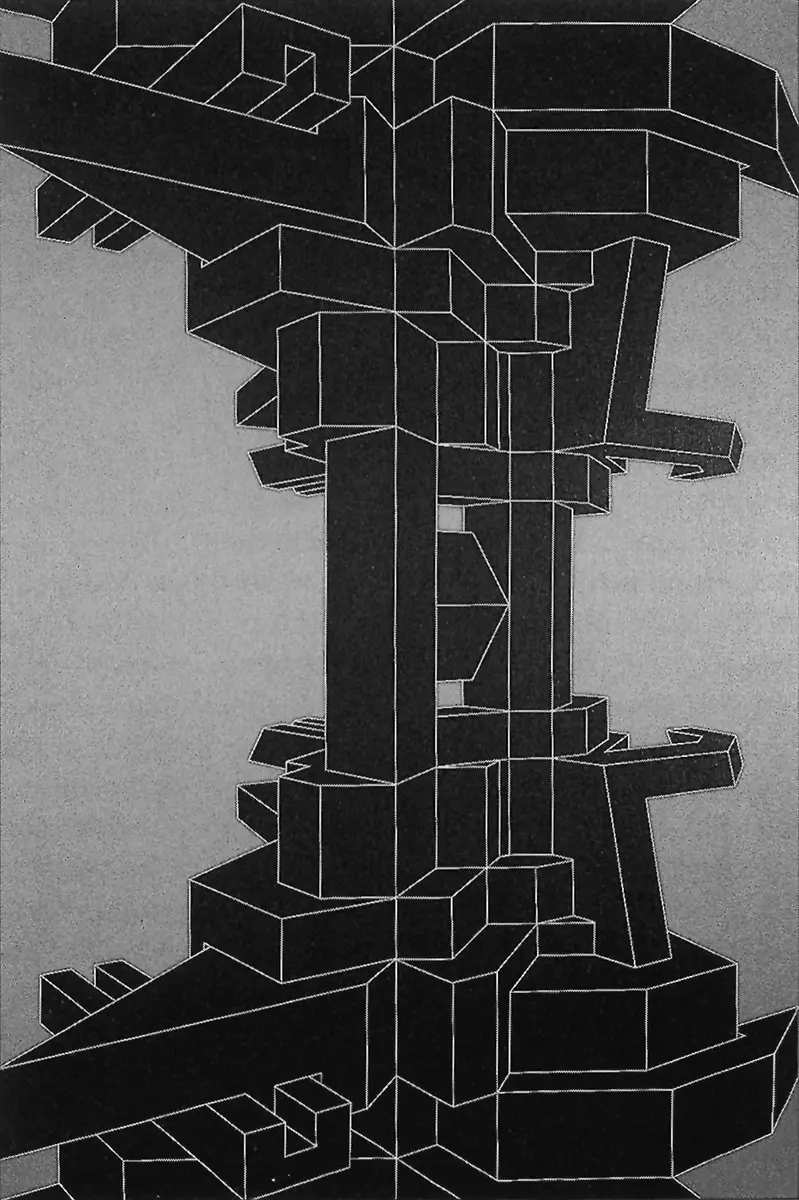
From 1983 on, an obvious change takes place in Julio Pacheco's painting: his scope is external, and because it becomes more and more complex, it comes to form urban groups. However, these forms maintain a strong similarity to the previous forms, although they display a greater development and majesty. Again we find platforms that have now become esplanades, colonnades that have now become propylaea, and sculptures that have now become monuments. In these exteriors, just like in the palaces, there are no indications of human presence, nor are there natural elements. The backgrounds seem like an endless stage design, and the bluish or grayish tones can barely evoke the sky. Nonetheless, in a piece like Mientras Euclides hace la siesta (While Euclid takes a nap, 1983), the clear color on the left side of the background, and the dark tone on the right side, could perhaps be interpreted as a view at once diurnal and nocturnal, thus introducing a bit of Naturalism. It recalls those paintings of Magritte, with the nighttime landscape and the daytime sky (L'Empire des lumiėres), or vice versa (Le Salon de Dieu). Of course, we must relate this ambiguity to the title of the work: since it is an event that, to a certain degree, questions the rationality of the geometric rigor of this piece, it occurs precisely when Euclid lets down his guard. This same stage encompasses some large canvases that depict (in white outlines and black volumes) simetrables, objects with a complex geometrical structure that present two identical and symmetrical parts as if one side were the object and the other side its reflection in a mirror.
This creative period reaches its peak in 1989 with the pictorial and sculptural installation Una ciudad (A city), presented in the Museum of Fine Arts and selected to represent Venezuela in the 1990 Venice Biennale. In Una ciudad, another innovative element appears: the three-dimensional realization on painted wood of some objects present in the paintings as if, impelled by the fictitious space of the canvases, the volumes had gone out in search of real space. It is an imaginary world that takes shape, that is "objectualized." And it takes shape not only in volume, but also in space, as it encompasses the viewer and turns him/her into the only inhabitant in this city, and into a user of its environment. At the same time, the ambiguity between the painted architecture and the constructed object (which could also be a model for that same architecture) is maintained.
Sixth stage: 1995-today
Pacheco Rivas's most recent works are the product of a new evolution that reveals something intimate regarding the monumentality of the preceding pieces. We now return to interiors, but they are no longer protagonists and have taken on a more modest role: to be, above all, receptacles of mysterious, disquieting, and somewhat perverse objects-furniture-machines, that maintain strange spatial relationships with their surroundings, distorting all proportions.
Definitions for a style
We have already seen that Julio Pacheco Rivas's work functions like an organic whole, closed in on itself, but never stagnant. The division of his work into stages allows us to focus on the gradual transformations and to observe how one is derived from the other. But it is also important to establish lines of continuity that assure the genesis and growth of a style, a perennial illation. The lines of continuity are as follows:
The fictitious space of painting
All of the pieces have a structure based on the Renaissance perspective: a mathematical perspective grounded in principles and conventions through which we interpret the universe. This visual system, which has ruled western art for five centuries, has been radically questioned since Impressionism and the classical avant-gardes. It could even be affirmed that the visual revolution of our century is rooted in rupture, distortion, and the abandonment of the classical perspective. Julio Pacheco returns without reservations or concessions to this system and reaffirms its validity and its atemporality. He becomes a faithful disciple of Paolo Uccello and Luca Paccioli. For Pacheco, perspective seems like a whirlwind that envelopes and produces a sort of drunken effect (this is what disproves the supposedly "rational" character of the system). In fact, already in the Renaissance —and the contemporary artist demonstrates this anew— the objective group of mathematical laws that allow us to comprehend and reproduce the reality of the world, may also be at the service of non-reality and may possess a terribly deceitful power of conferring a real aspect on the unreal. Thanks to perspective, there is an internal rationality in Julio Pacheco's canvases that envelopes the problems of verisimilar representation, though it is used to stage what is not verisimilar; at least, what is non-existent beyond the mind and painting of the artist (and now, beyond our recollection incorporated by this painting, by this imaginary world). And this leads us to reflect upon the painting in general and its power to place the visible at the service of the invisible, to edify illusion through the data of reality.
Geometry.
There is a geometric organization of space, sustained in the convections of perspective: lines and vanishing points, horizon, and foreshortenings. This geometric organization allows a profound staging of any type of form. However, in Pacheco, these forms are, without exception, also geometric: there are no irregular, bland, organic forms, only orthogonal, angular forms (and volumes) that may be described as Euclidean: cubes, spheres, cones, cylinders, etc., and their infinite combinations. Since we already know that geometry does not exist in nature, we are confronted by a deeply anti-natural world (and not merely because it does not represent trees and rocks), a world shaped by images of the mind.
Colors
We do not find primary or saturated colors. The artist uses a very refined scale of neutral and balanced tones that tend toward the cold or warm colors, without ever reaching them: toward the cold colors, from turquoises to violets; toward the warm colors, from ochres to guavas. Within one single form, the tonal variations are progressive and very subtle. There are no light and shadow effects; the forms stand out neatly, and sharply, before the background. Contrary to Renaissance painters, Julio Pacheco deliberately does not resort to an atmospheric perspective that introduces modulations of light and which fuses the objects with the surroundings, thus softening the geometric rigor. In this way, he reinforces the unreality of his compositions, for they have no air. The colors are voluntarily anti-natural and unfastened from those monuments and architecture.
Temporality.
Since Julio Pacheco's works contain no anecdotal referent, their temporality remains subjected to the environment that they suggest. In this sense, the constructions do not resort to any identifiable period or style, although they can evoke some through vague analogies. And since the compositions are presented in a perfect state, they also lack reminiscences of the past. Rather, they appear as future cities, but in the future, left behind for the use of archeologists.
Julio Pacheco Rivas's painting is the fiction of fiction. But since everything in it is imaginary, it (like an object) comes to be the only reality.
FEDERICA PALOMERO
Painting and sculpture manager at the Museo de Bellas Artes in Caracas. Art Historian.