
Rootedness is a distinct feature in all of Maribel Pórtela’s art. Her ceramics are a fusion of earth and fire, life and death, and both pre-Hispanic and western myths. For a woman with a strong link to Earth —yet raised in a culture that celebrates death as another rite of passage—, ceramic and sculpture, past and present, go hand in hand. In her installation Voyage to the Underworld, the False Doors to Death, presented recently at the George Gardiner Museum of Ceramic Art in Toronto, the crossover between two worlds stands out as her first artistic trademark. But she has set other paths for us to see. The 300 human figures in this work—none of them bigger than a fist—compel the viewer to face death as a transition rather than the end of this precious life.
As if that alone weren't a great achievement, she also manifested the generosity of her talent in an unusual manner. Following an old Mexican tradition, in which offerings to the dead are given away to those who come to pay their respects, Pórtela followed suit. " This is an offering to the dead but also to the living," she pointed out. And so on the show's closing night, more than 200 people came and walked home with a souvenir of the installation.
Pórtela (born in Mexico City, in 1960) has emerged as a leading contemporary ceramicist because of her playful sense of the medium, the unusual format she favors (installation), and the crossover she makes between individual and popular imagination. In her view, ceramics are instilled in our consciousness even before we are born. "People lived surrounded by ceramic utensils and were buried with them. And it is only recently when plastic and other synthetic materials have taken over, that we appreciate the value of the handmade object, earthenware, the sculpture made of ceramic."
Pórtela's sculpture illuminates aspects of a long-standing tradition that were not visible before. The fact that birth of sculpture as a modern concept, for instance, was achieved through the use of clay by artists like Auguste Rodin who created prototypes in clay and later translated them into bronze. It was the tactile quality of the material that took sculpture from carving into modeling, making ceramics the medium preferred by sculptors at the turn of century.
In their immediacy, amusing character, and symbolism, the small pieces that comprise her installations have more in common with the pre-Hispanic style of ceramic sculpture. Very often she reinterprets the characteristic Mayan heads with bulky earpieces or creates figurines with shaved heads and square shoulders, typical of the western cultures of Mexico. Her formal choices provide the raw material for Pórtela's inspiration. The act of translating those shapes into a narrative that does not always coincide with western values offers a moral to contemporary society: embracing death is part of a universal cycle.
The False Doors to Death opened on November 1, 1998, coinciding with the Day of the Dead, a popular celebration that has survived the conquest of Mexico by fusing with Christian values. Using clay from the Zacatecas region of Mexico, known for its malleability and resistance, Pórtela created the figures one by one. Each was carefully worked, showing even the smallest details like facial features, fingers, and genitalia. After firing them at 1000 degrees, she smoked the figures arbitrarily with pine kindling to accentuate the dirt color of the clay.
"I wanted to create an allegory for the many ways people feel about death, their fear of their own death, and their desire for the ideal way of dying. The false doors refer to the denial of death as posed by our society, which seems to me is hypocritically interested in preserving life when actually it breeds suffering and pain by making war, polluting, exerting political oppression, etc," the artist explained during her presentation on opening day.
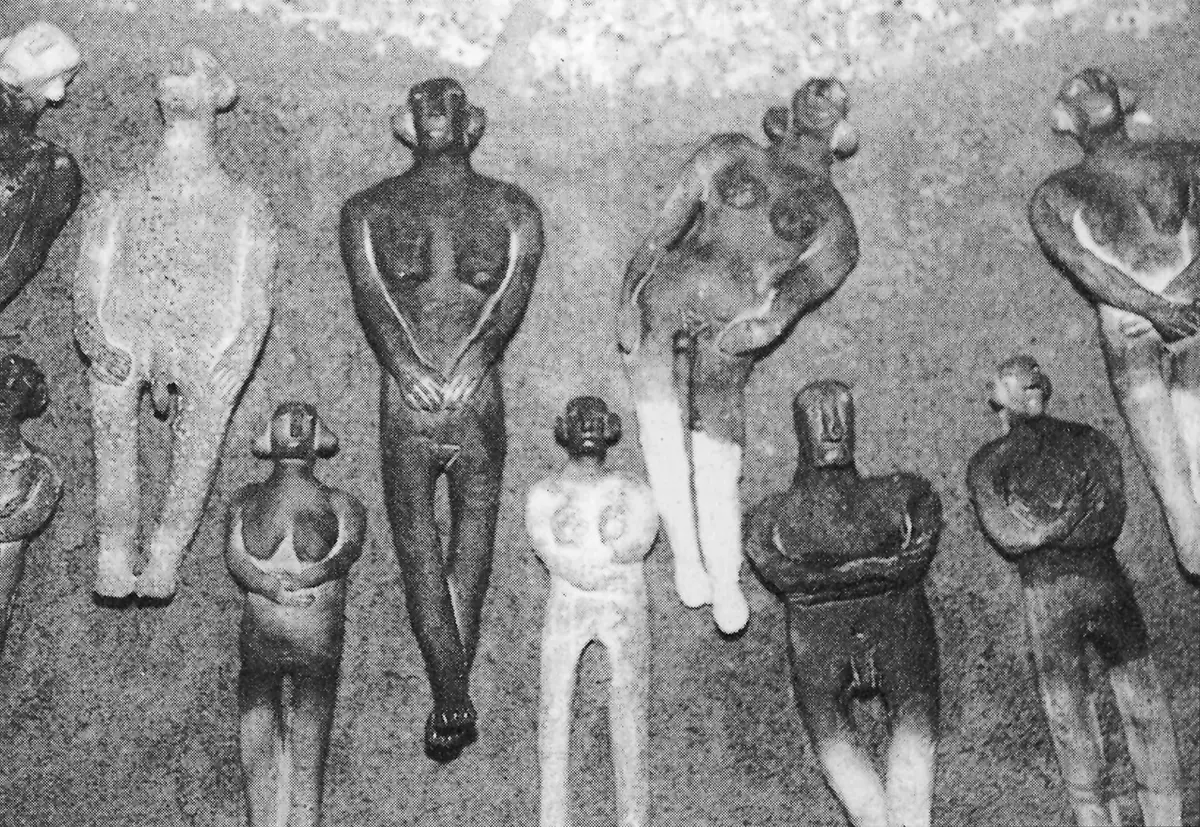
Indeed the piece took one to the several stages of death. A sand path in the shape of a serpent, a symbol of time in ancient civilizations, led the way to the larger body of the installation arranged as a semi-circle. Over the path, there were dozens of hollow feet, with wings on their ankles, which emblematically took the dead on the journey to the underworld. The first door at the end of the path was guarded by three figures with androgynous features awaiting the newly arrived. From this door, several columns of dead advanced to the center. Some walk on their feet or their knees, some drag across the necropolis.
One of the roads displayed several barges, each one bearing a figure resting inside. "These are the dead who were lazy in their life and therefore couldn't walk on their own feet." On the far right there is a path littered with half torsos, limbs, and heads with tongues sticking out, "belonging to people who died in plane or car accidents, their bodies inevitably dismembered," explained Pórtela.
At the center of the installation lay a mound of sand covered with skulls and femur bones. This was the final destination, the place where all the dead meet in eternity. According to pre-Hispanic tradition, the dead will gather together on earth once a year on All Saints' Day to visit their living relatives and to share the earthly delights they once knew. Their eternal return is facilitated by the invocations made by the living during their short time in the world.
Looking at Voyage to the Underworld, and leaving the museum with some fragments of it, one felt the lightness of our living conditions— the realization that life is not the only stage of being, and that death has a more active role in shaping the universe. Death has more importance in our existence than we like to admit. Its role is to shape our rituals and culture in more accepting ways than we can imagine.
JOSÉ SPRINGER