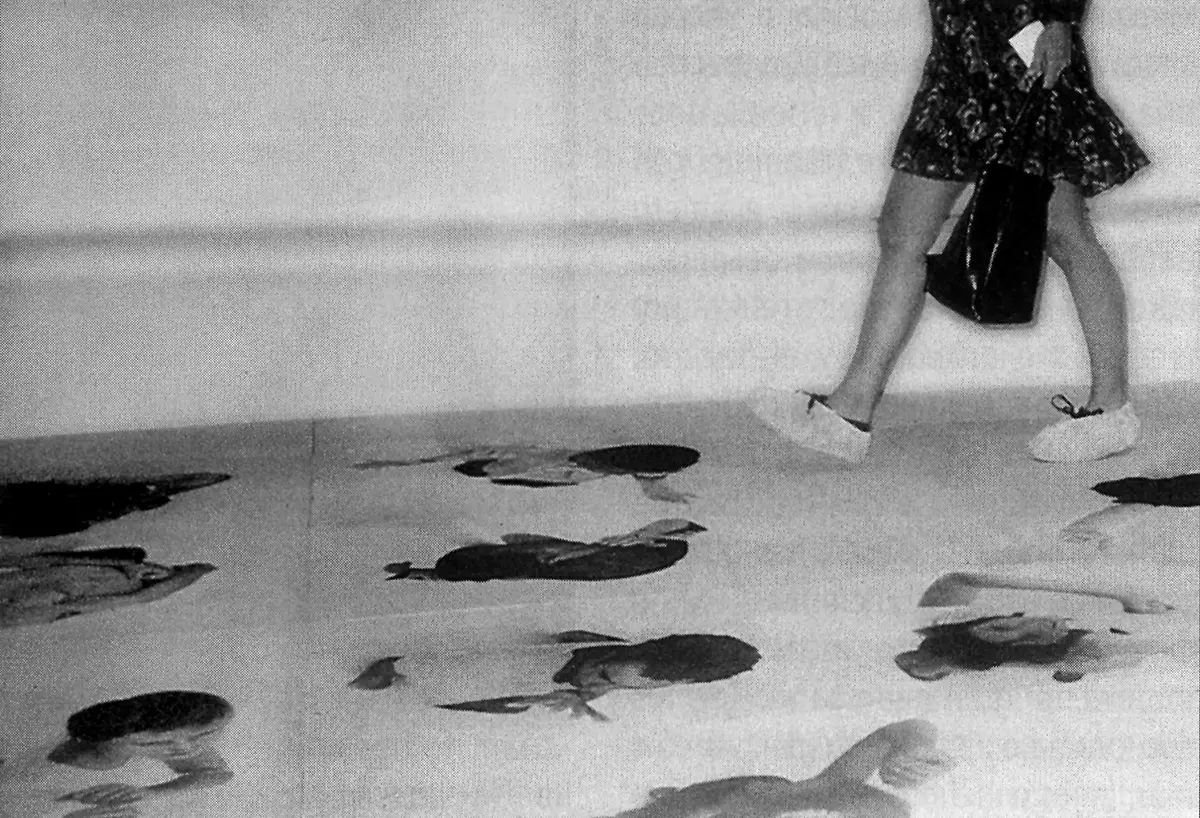
The exhibition of the work of Argentine artist Marie Orensanz recently presented at the Evelyne Guichard Gallery, —following one at the Museum of Fine Art of Buenos Aires last year and preceding her show at the Ruth Benzacar Gallery in 1999— was interesting in many respects. First of all, there was the choice of venue. This consisted of two different buildings, separate but near each other, which obliged the visitor to cross a neutral area in order to go from one exhibition to another. This obligatory passage outside might have caused a break in proposals meant to convey a single story. But it was instead like a breath of fresh light, an anonymous ritual, buttressing the visual and sensitive continuity of two places that proposed, according to an aesthetic and poetic dialectic, two conceptions of color and volume. The work is sufficiently constructed in terms of thought and gesture to be able to resist this no man's land and bear the weight of this anonymity. In the larger building of this former factory, with windows ornamented to the closed precinct style, The Leaves of Life, the black work, gathered together the most recent production of the artist (sculptures in canvas and mixed media). In the adjoining building, there was the white work titled The Veins of the Earth, which used paper and marble.
The evolution of Marie Orensantz's work might seem surprising. From white to black, from marble to canvas, from the linear to the organic, from weight to a sense of lightness, and from matter to air. The distance covered since the time of her manifesto titled Fragmentismo (1978) encompasses nevertheless a conceptual and formal logic that forms the center of her work and generates its transformation at the deepest level of the creative process. In the artist's desire to reduce the object in an attempt to grasp more fully its qualities of incompleteness, to exorcize its sense of infinity, the fragment of marble taken from the quarry at Carrara, chosen for its transitory existence, is replaced by the fragmentation of the work. Yet there remains in this final proposition «the integration of a part within the whole and which endorses every kind of liberty. Constancy in change and continuity in difference- these are the main features of Orensanz's work that were evident in this exhibition.
The interplay of opposites, carefully orchestrated by the exhibition in the two places, proposed a new reading to the alternation of white and black, marble and canvas, a feature that was further emphasized by the explosion and fragmentation of the forms. The white room was thus one of meditation and silence, a somewhat monastic space in which the folded papers and marbles constructed a constantly unfinished order, ungraspable stability in the polysemous chain of knowledge and sensibility. The black room, on the other hand, was essentially dynamic, a room of gesture, traces, flight, and cries of action and the alchemy of mutation. A guiding thread in the works led the spectator's mental and physical gaze from down below (the earth) upwards (towards life), following the continuity/discontinuity of these morphogenic symbols. The incursions of the writing on the marble have dissolved, the fragment of matter has exploded and become again a kind of new word, a witness shelled and dispersed on a smooth and immaculate wall. These differences are in the end only the result of an interplay of appearances because the veins of the earth and the leaves of life merge together and respond to one another in a single proposal which Orensanz explores at the heart of her creative interrogations.
Paradoxically, it is in drawing, painting (on marble and cotton), assembling miscellaneous materials, and now modeling a canvas (which is mysteriously impregnated with a mixture that, when it dries, gives it a definitive rigidity) that the artist shapes her relationship with space and the world. More than ever before, Orensanz has established a carnal relationship by blending this paste with which she makes forms called leaves and covers them with black paint. However, with these identified and metaphorical images (i.e., Leaves of Life), we find ourselves both in the body (evocation of the female sex, the hand) and in nature. Since the time she began to allow her abstract totems to emerge "in the bud," Orensanz has moved towards a geometry in movement that underwrites her vital approach. The three stages (veins/earth, roots/woman, leaves/life) are but expressions of an inner journey that combines reflection on the form and its meaning with a reflection on life in the act of being lived.
One must also mention in relation to this exhibition the increasingly important role played by museography, something that participates significantly in the meaning of her work. The artist herself believes that the presentation of the work is an essential part of the exhibition and she insists on hanging her shows herself. The relationship between the place and the works on display is thus an inseparable element of any analysis of the pieces. The effect of light is also a major component, particularly in the black room where it was filtered through Venetian blinds, a modern Alhambra where the black (opaque) work takes on a sort of religious aura. The black leaves and the splashes of light make up a checkerboard full of fleeting contrasts. In the white room, a window looked out onto nature, with the visitor's gaze moving from inside to outside and back again(a to-and-fro movement between real nature and imagined nature. This is where the recurrent feature of Orensanz's work arises in our memory: our experience of this "path" and where it might lead.
CHRISTINE FRÉROT