
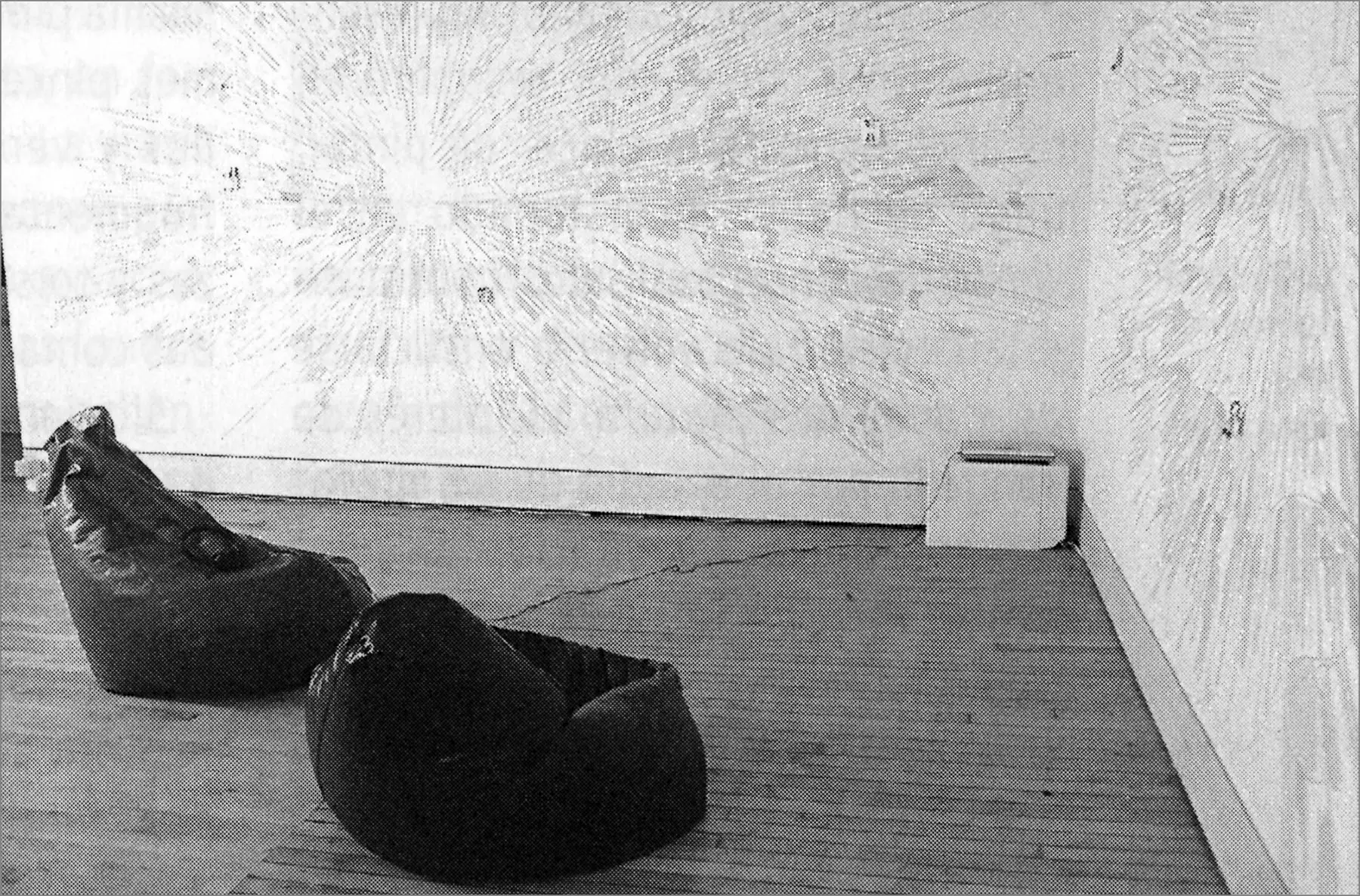
Drawing upon a vast array of artists and materials, Ruido presents a strong group of emerging artists who are capable of mixing fun with concept and noise with visuals. Despite the title's suggestion, not all the works in this exhibition were randomly loud, but as the title implies, they all have something to say in a strong way. Among the more ambitious installations was Black Hole (Takes) Blue Hole (Gives) by Vargas-Suárez Universal. This collaborative team created a special environment in the corner of one gallery. On the two walls were linear abstract drawings implying a kind of space or the mapping of sound waves. This was augmented by a special ambient mix that the viewer was encouraged to listen to while seated in a bean bag chair. The notion of synesthesia, or the correspondence between sights and sounds, gets an intriguing update with this piece.
Another strong installation was by Juana Valdés titled Take a Second of Me. This involved a video projection of the artist in the bath projected upon a wall of vertical fields of brown-tinted colors. This minimalist "screen" represents a cross-section of skin pigmentation, and the dark coloring of Valdés' own skin contrasts effectively with the startling white of the soap and bathroom titles. It is a witty reference to classic modernist form, the tiles of the bathroom offers a complex grid to play off the vertical planes painted on the wall.
Probably one of the better-known artists in the exhibitions is the Puerto Rican Arnaldo Morales, whose industrial sculptures serve as both a reminder of the power of the machine and an amusing subversion of that power. The implied threat that these interactive pieces pose, combined with the raw sounds and electrical effects they emit, suggest bizarre artifacts from some post-apocalyptic future or an updating of the tradition of drumming on oil cans and plastic buckets. Although in another gallery, Anaida Hernandez's cloth relief constructions with zippers and bells offer a more quiet counterpoint to Morales' machines. These are some of the most unassuming works here yet they hold their own in this show.
The street aesthetic once exploited to the point of impoverishment in the 1980s, is obviously not dead. Funk Taxi 1533 —another young artist collective—, created a bold ruinous installation in which smashed and bifurcated taxis were outfitted with televisions and stereo equipment. Through the combination of video art, sculptural installation, and the reclamation of discarded urban detritus, Funk Taxi 1533 has managed to merge some of the more pressing concerns of the art world at present. However, there is something in the ruined car bodies and choppy video images that adds a nostalgic quality to such a current piece.
Nadine Robinson's Boom Paintings add a new dimension to an older art form. These paintings incorporate speakers into their visual surfaces. Behind the scenes, the work is wired to a record player, so that the paintings will play music for the "viewer." In some ways, this relates to Robert Rauschenberg's combines that used radios, or Vito Acconci's musical sculptures, but there is much wit in the musical selections that Robinson provides, and the deliberate use of vinyl records in this digital age once again evokes a sense of another time.
When asked about how she developed the concept for this show, curator Jasmine Ramírez said that she simply looked at what was being produced right now. If that is the case, then in New York at least there is a compelling range of international artists finding innovative expression by using sound and urbanity as their muses.
JOHN ANGELINE