
The exhibition presented at the Maison de l'Amérique Latine between January 14th and February 26th was quite new since it showed for the first time a logical alternation of drawings (inks, gouaches, and lead pencil works) and sculptures (bronzes and marbles) by the Peruvian sculptor Alberto Guzmán.
The artist, who was born in Peru in 1927, belongs to a generation of figures who, along with the Cuban Agustín Cárdenas and the Uruguayan Leopoldo Novoa, have been rather like outsiders in the field of Latin American art. While he let himself be influenced from his arrival in Paris by such almost inevitable presences as the post-cubists, the surrealists, or the kinetic artists, he never identified himself with any school or current, preferring to remain outside the formal orthodoxy advocated by the champions of those movements. This freedom is what makes Guzmán unusual, but it does not do him justice since in the art world where affiliation or belonging is often the unavoidable token of recognition or appropriateness to modernity. Guzmán's only allegiance is that which he pays to his profound desire for matter and space.
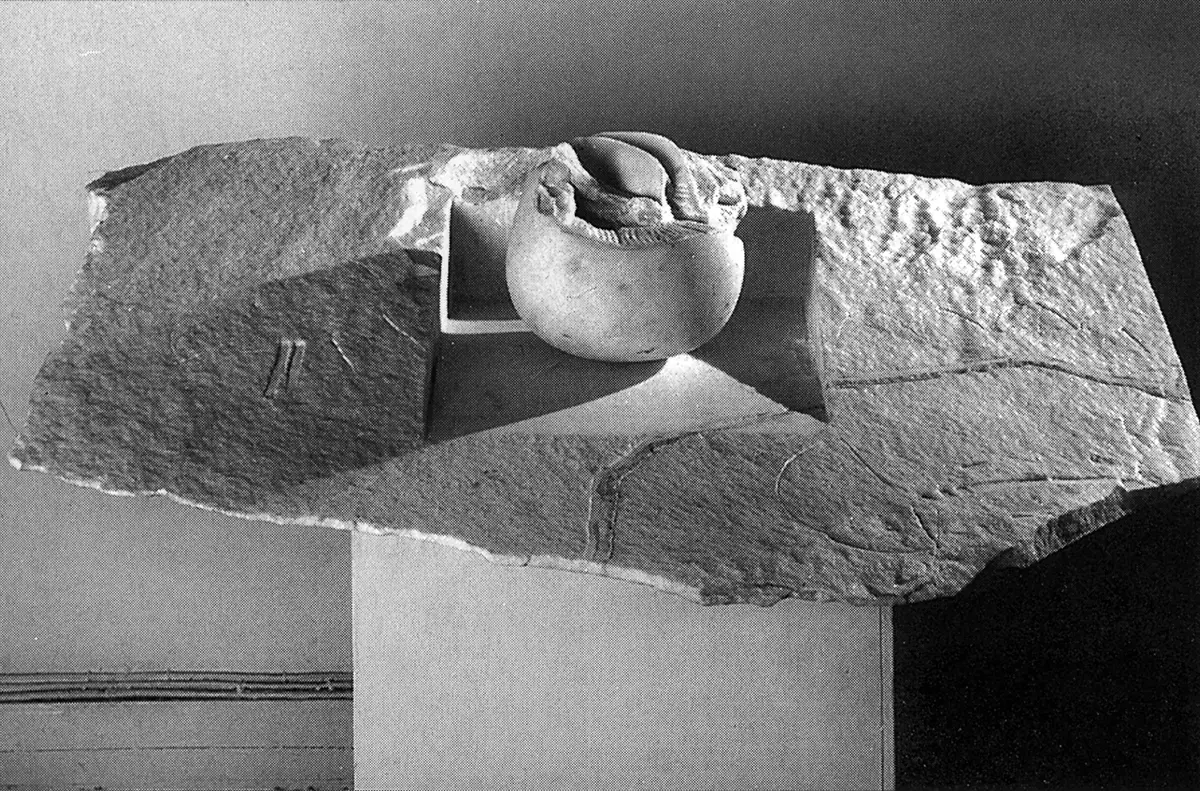
The presentation of the works conjured up the idea of duality since it involved placing together sculptures and drawings (which also have volumes) and highlighting the oppositions created by the black and white marbles, polished and rough surfaces, the graphic and aesthetic correspondences between cardboard, bronze, and marble, as well as the role of the plinths and bases in formal and plastic counterpoints. In his work which is both diversified and coherent, the originality of Guzmán, who is above all a sculptor, lies in his capacity to emerge from the three dimensions and to remain there while changing materials. Whether in his works on the cardboard where, like on a kind of "skin", he makes incisions, tracings, cuts, digs, and lifts the surface, or in his flaky bronzes, or Places —bronzes with a distinctive patina from 1998— his works evoke the same idea of landscape and seem to be imaginary or mental cartographies that evoke the "geomancy of the site" to which Pierre Restany refers.
Since there was not enough space in the gallery to present very large pieces, the organizers gave an intimate touch to the show by selecting small sculptures which nevertheless revealed the most characteristic features of the sculptor's work. As if the three dimensions were not enough for the work and the relationship with space had to be corroborated with perforations and openings, Guzmán, working like an ordinary artisan, constantly opened and pierced the mass. This dialectical process from the full to the void and from the rough to the smooth involved a tactile appropriation of matter and its place. However, the outlines of openings (slits and holes) relativize the density of the material and the corporeal nature of its physical presence. The loss of (or search for) matter is also reflected in his "sculpted cardboard works", where the scratches, digs, and other marks recall the gestures of Fontana and the Brazilian artist Arthur Luis Piza. In four pieces from 1998, Ocher Wall (statuary marble and ocher patina), Rupestrian (ocher on white marble), Ocher angular stele, and Palladio (white and ocher marble), Guzmán uses a graffiti-like of graphism which once again recalls his pictorial work, this time in the spirit of rupestrian painters. This might reflect on the sculptor's part of a possible search for primitivism, a desire to be closer to the essence of things.
The incursion into the erotic sphere is less evident, although, in certain works such as Inclined Place (white marble, 1989) and Place of three transparencies, the form plunged into the "flesh" of the mass like an "axe" has something carnal and even sexual about it in its absorption, violation or wounding of the surface.
Guzmán develops an entire range of symbolism, a formal Ariadne's thread that guides his incursions towards a "landscape" which is both physical and mental. It is linked to the memory of Andean architecture, its different levels, the innumerable steps of Macchu Picchu as in Froth of the Darkness (white marble, 1995, on black marble plinth) and Onyx and Spiral Place (green bronze and onyx stone, 1995). The spiral sign or the concentric circles which frequently appear are part of a symbolic and decorative language in which the artist traces his glyphs in the way that prehistoric man marked out his territory in recognition of a cult or some sacred practice (for example the enigmatic markings in the Nazca plains, between the earth and the sky).
Guzmán's work can be seen as part of this magical invocation to nature: some of his sculptures like Place of three transparencies (white marble, 1994) can be read as ritual altars which pay tribute to his own culture. A large piece of marble entitled Yelmo greeted the visitor on the first floor; it has the strangeness of a totemic Cyclops, but the humanity given to it by this falsely unbalanced air makes it into the effigy of art where the active role of the emotion is not to be overlooked.
CHRISTINE FRÉROT