
Born in Mexico in 1938, Alfredo Castañeda, architect, devoted poet, and reader, was a child of the Spanish Civil War (1936-1939). This was a war that resulted in a large migration from the peninsula to Mexico, and the personal situations and objectives of which were very different from those that characterized the conquest of the Americas in the fifteenth century. The list of twentieth-century immigrants includes great thinkers and artists from various disciplines. The Spanish wave was so strong that it even managed to introduce a Galician accent into the speech of people born and educated in Mexico. Alfredo Castañeda is a Spanish painter whose work undoubtedly reflects elements of this impact on Mexican culture at the time. Those who escaped from the war to Mexico were able to dream of a new continent: the rituals of the Catholic faith were intensified and expressed differently; the education of the children in the shared schools tightened the links beyond the distance of the ocean: poets, musicians, and painters engaged in a long embrace. Today, with Castañeda living in Spain, a slow balance in the migrations is emerging, from the land of the conquered to the land of the conquerors. This and other kinds of associations would make a long list beyond the scope of this review, but they provide food for thought. In the same way, there is a leitmotif running through the painting of this artist: the sense of deterioration and ruin, of things falling apart, and a capacity to transfer decomposition into a dream. The ability to transform pain into beauty, death into resurrection, and pain into renewal are some of the elements present in the sketch of the delicate smile we find in Our Dream (1999). Often with his eyes closed, other times with his gaze focused on us, on the beyond, or on the inner self, the painter deploys his technical, compositional, and creative skills nurtured by the influence of the great Velázquez. The subject of the composition is important since it integrates sets of crossed oppositions in the picture, from the center to the edges and upwards and downwards from an almost non-existent horizon.
#im
The composition is not a means of depicting the image, but is closely linked to the author's expression and the symbolic directions which he gives us in symmetrical and asymmetrical works in which —-like a shaman—, Castañeda places his figures at a very specific point before developing the ceremony. Devoted as he is to the history of art, and in particular the art of the high Renaissance and the harmony of the Flemish artists, Castañeda creates a space of contrasts and affinities in which an air of serenity is accompanied by the gallant elegance of a contemporary baroque style.
No one passes through Mexico or Spain without becoming "contaminated" by something of the baroque spirit. It is as if in each work by Castañeda, a little spirit has entered the work while it is still damp and filled it with ironic, mysterious, and paradoxical details, which give it a sense of dynamism without compromising the purity with which the work conceived and painted.
In Our Dying (1999), an oil and pencil work on paper, the artist does not integrate traditional Mexican or European concepts into his vision of death. There is a sense of flowing in this picture, which imbues the context of all his work. Not specifically through Herodotus, but through various philosophies which the artist has explored in his constant reading. The artist's initials —A.C— also remind us of the abbreviation used in Spanish for "before Christ" (A.D.). This important theme is noted here in passing and will be developed later: meanwhile, readers can already make their own associations.
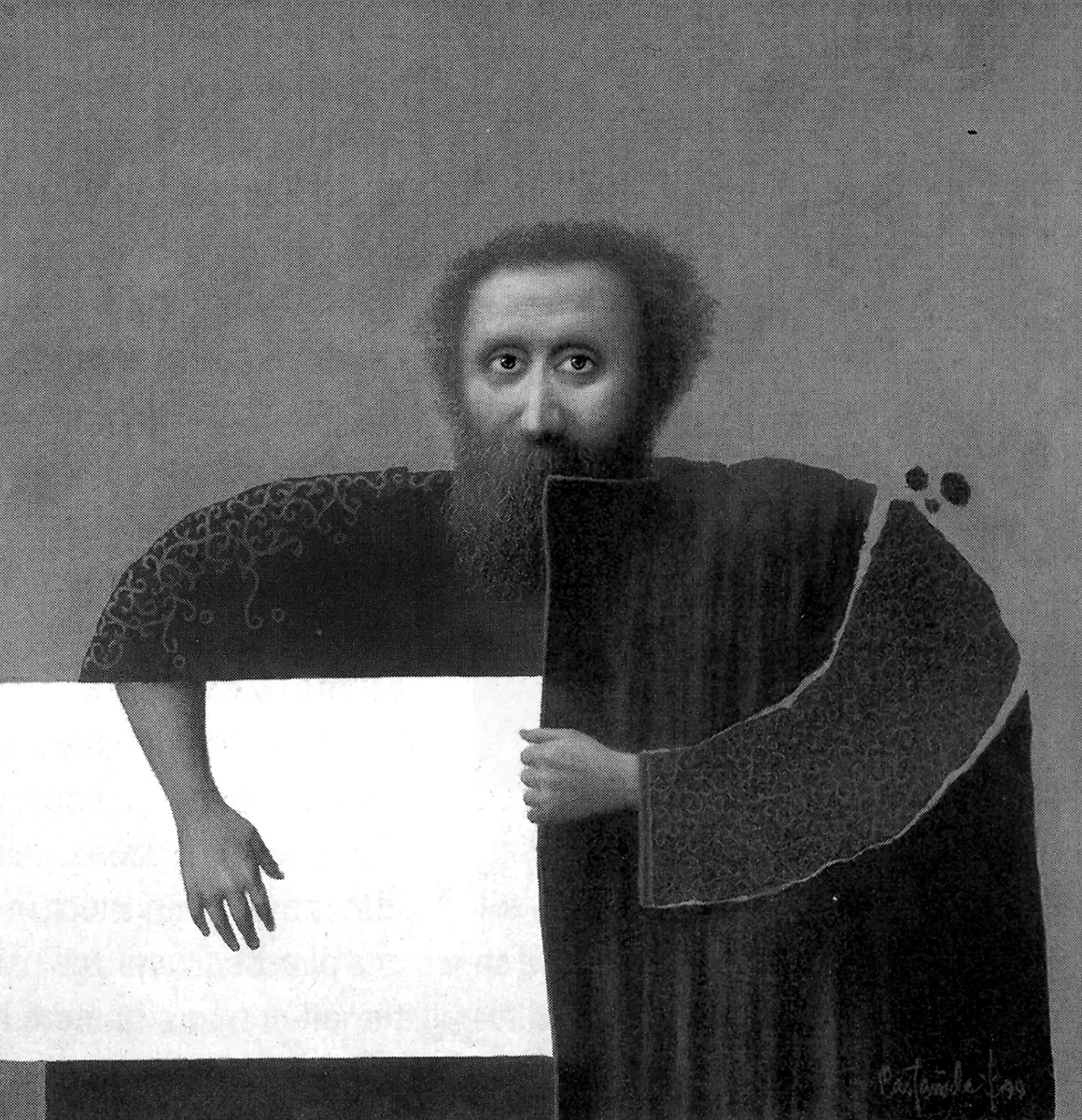
In treating his various subjects, such as death and justice, the artist does not focus on them in any tragic way. He suspends the situation in a moment of elegant tension, the outcome is held back, and the option is frozen concerning what might happen to change the harmony. Even in self-portraits, there is a sense of drawing close and freezing the moment. Castañeda draws identifiable figures almost like self-portraits, although they are not. The use of patterns or modular designs was also a feature of this exhibition, where the artist's familiarity with the Mozarabic tradition was a further feature of his wide knowledge.
The exhibition in New York was made up of forty works, which could be divided into five sub-sections: medium format paintings, four small pieces based on objects —three book covers and a "glass" work—, as well as small works on paper, with greater emphasis on technique and imagery. The elements became diluted and the softness was almost a chasm into which the visitor plunged despite the glass and the picture frame. Emblematic of the artist's work, the cover of the catalog showed a large format work reminiscent of a predella or al tar-step. The Mystical Lamb evokes the sacrifice of Isaac and vice-versa, in confirmation of religious and philosophical faith, with reference to Flemish art and baroque elements.
As in the visual interplay of a labyrinth, one situation leads to another and takes us back to a previous one, to a past situation, or to a comparable present one. The artist himself said: "This recent exhibition will be called Our I and My We because I believe that we are multiple beings and have collective identities." In this way, Mary Anne Martin, the artist, his wife, Alejandra Yturbe, and Mariana Perez- Amor celebrated the thirtieth anniversary of the first time that Alfredo Castañeda exhibited his work at the Mexican Art Gallery (GAM) in Mexico City along with Ines Amor, whom we remember with affection.
GRACIELA KARTOFEL