Although persons displaced from their place of origin come in all colors and from all continents, the executives of the television networks have decided that Kosovar refugees —fortunately for them— are more mediagenic than the others. CNN shows them every day, especially since the NATO bombings of Yugoslavia. Of course, they are after all mostly white with blue eyes, unlike the Tutsis and Hutus of Africa or the Kurds of Iraq. In any event, the situation of forced expatriation is one of the most desperate problems of the closing years of the twentieth century. Similarly, ethnic conflicts are not the only ones that result in the migration of populations. As seen in the cities of Latin America, for example, the market economy expels more people from their land than do regional armed conflicts.
From Far Away, the exhibition Carlos Gallardo recently presented at the Art Museum of the Americas Gallery in the OAS building in Washington, D.C., seemed to explore, on the basis of his own experience, the themes of estrangement, identity, and memory. In addition to expressing the intentions of the artist, the pieces evoke the social and political aspects of these questions.
Gallardo earns his living primarily as a scenographer in well-known theaters and as a costume designer for companies throughout the world. Accustomed therefore as he is to develop his work in the grandiose setting of the stage, with immense spaces and countless resources, it is his plastic work that allows him to strike a more intimate chord.
Gallardo is now far from Buenos Aires, where he was born in 1944. It is not a minor detail that the artist, one fine day in the middle of the 1980s, decided to abandon his successful career as a graphic designer, and leave Argentina." I had to do what I wanted. If I had stayed, I would have ended up growing fat and doing what others wanted" he told ArtNexus. Since his departure, he has devoted himself to painting. He now lives in Montreal, Canada.
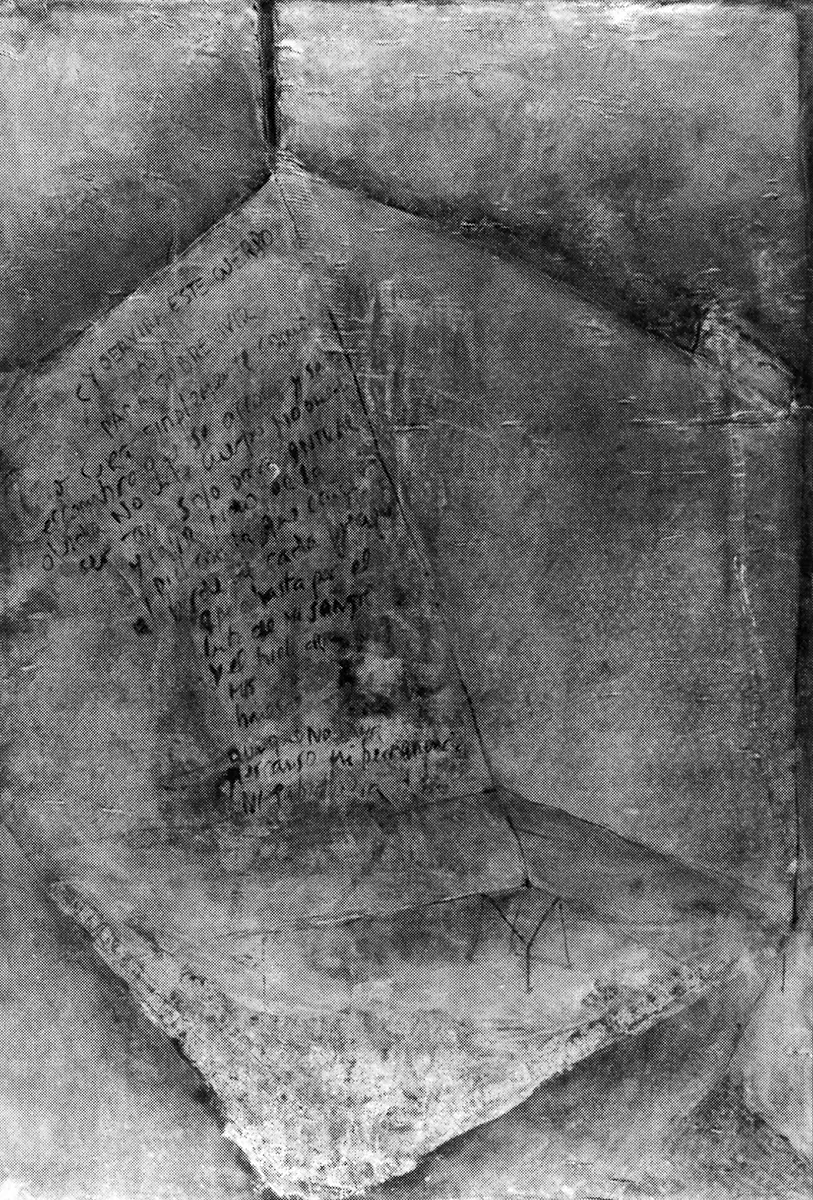
The fifteen works in this exhibition, all done in the nineties, have common features in terms of their conception and temperament that allow a mutual dialogue to be established. They are powerful and subtle objects and images that are apparently rooted in the paths of his own soul, in an internal debate that constantly engages him. For many years now Gallardo has been using memories, pages of his own correspondence —yes, the writing is written on delicate almost transparent sheets of paper that used to be a great source of reading before the invention and spread of electronic mail—, and diaries to construct a space of reflection and of dreaming.
All the works seem to capture instants, parts of a biography. But the elements used —personal letters, postcards, envelopes addressed to the artist, bits of photographs— are merely a pretext, a vehicle for exploring a territory where the private dimension gives way to the universal. Gallardo is interested in encouraging the spectator to use his gaze and to project his own story, fantasy, or so-called reality. Do the grey, bluish, sepia, and dull white colors he uses to refer to the leaden years of Argentina under dictatorship, to the color of the moon, the passing of time, to lost childhood, to nostalgia, or the fatigue of traveling?
The clues suggested by his work however only serve to fire more ideas and thoughts at us. Wrong Times (205 x 188 x 10cm., 1994) is one of the works in the show that clearly exemplified this spirit. The artist sealed up fifteen years of his history with heavy screws. Thus the labor and the days detailed in his diaries became imprisoned forever between the acrylic and lead enclosing them.
In the diptych titled Contextual 1 (160 x 224 cm.), Gallardo constructed a puzzle with bits of letters received or sent. The angles, formed in the cuts and coincidences of the paper and reinforced with acrylic paint, appear as refuges, places of protection for the feelings emerging from the texts and which the spectator can imagine, but not see. The lines woven at the intersections of Consumirem exixtirem est (188 x 131 cm., 1993), one of the few paintings in the show, rise up like cornices along which unseen consumers roam, they exist only to the extent that they actively participate in the trade proposed by the market. A close reading reveals that the signs and words which can be deduced are not marks of the past, but a present where the material imposes itself on the spiritual. The artist lists the price tags of clothes and objects and gives the name of credit cards and brands of watches and automobiles.
Childhood appears as an idealized threshold in the polyptychs of Other Skies (1995). Embraced, loved, contained, disguised, or blurred, the children of these works seem like promises of the future, but also as witnesses to the past. Absence is an inevitable presence in this image of childhood to which there is no return. The impossibility of a safe return home, to the homeland, is an everyday experience of all persons exiled for economic or political reasons.
In the series titled Evidences (1996), based on eight lead boxes each measuring 35 x 35 x 8 cm., the interplay of contradictions continues. The eye of the beholder tries to retain in the works what the materials deny. The pieces contain writing which is barely visible in tarnished, stained, and half-destroyed fragments of letters, envelopes, serviettes, and photographs, imprisoned with acrylic and steel cables.
In the two works titled Ephemeral (each 23 x 105 cm., 1996), the artist uses steel, acrylic, photocopies, letters, pencil, lead, plastic, and filing cabinet handles. Here, too, we can see the importance that Gallardo attaches to materials and techniques in the construction of his work. This raises the elementary questions of any human being about what, who, how, when, where, and why —questions whose answers— if they exist-are presumably to be found in files that cannot be opened. In this sense, the artist presents another contradiction in terms. What is being proposed? A profound journey to the essence of things or an inventory of the most ephemeral aspect of contemporary life?
The transparencies of the materials are used as a means of veiling; writing, as a means of search; and the boxes, as a means of keeping. Is the search over and the illusion lost? Is there any way out? Gallardo continues to explore these questions and remains hopeful.
VICTORIA VERLICHAK