
Carlos Rivera Villafañe has established himself as a provocative and consequential visual chronicler/poet/ philosopher of the different kinds of violence that reign in Puerto Rican society and all over the world at the end of the 20th century.
Deeply hurt by the pain caused by what has become an accepted social curse, Rivera Villafañe's compositions —which always surprise us with the disturbing protagonists of guns, devils, and wounds— expose the complex circles of violence that mirror and ultimately define our society.
From very early on in his artistic career, Rivera Villafañe revealed a truly original approach to the presence of violence, every type of violence in our so-called civilized societies. In the 1980s the artist began to translate, by means of effective and original iconography and a convincing visual syntax, the everyday violence that surrounds us and marks our daily lives.
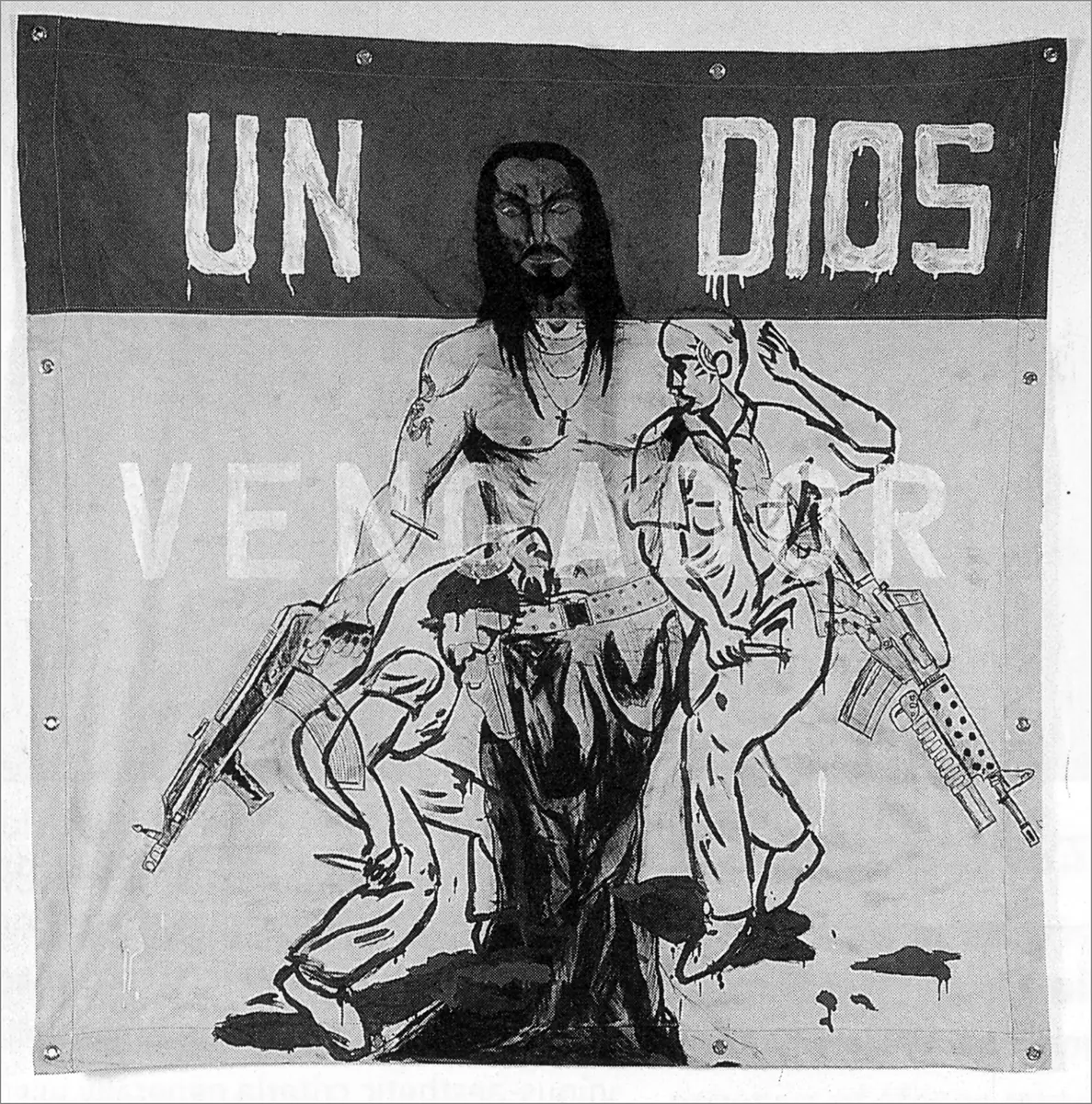
Rivera Villafañe's dramatic graphic work—his irreverent and at times painful paintings, his unorthodox and daring three-dimensional pieces, sculptures, constructions, table games, and interactive installations—reveal not only an intelligent and sophisticated aesthetic eve, a solid education, and outstanding creative talents, but also the artist's natural and bold stance against violence and his honest and poetic approach toward justice, happiness and the dignity of men and women.
Borrowing freely from the visual discourses and schemes developed after World War II — especially in the 60s, '70s, and the 80's— and understanding the essence of both Christ and Nietzsche, Villafañe has been able to construct his paintings and three-dimensional pieces as passionate antipoems about how far away we are from true Communion.
His recent paintings, sculptures, constructions, and installations are heartfelt invitations to enter the domains of violence so that we can see ourselves as part of that violence. His spaces and his games are dramatic examples of the Paradises we have lost and the Hells we have created.
Rivera Villafañe's present interactive installations —especially Efecto Terminal I, II, and III— are effective existentialist experiences that persuade us to analyze ourselves as potential protagonists in the maps of violence that limit our lives.
Although Rivera Villafañe —who has been chosen to represent Puerto Rico at the Segunda Bienal de Lima— uses violence as a painful but effective metaphor for our 20th century, the real aesthetic and socio-politic objective of this iconoclast/anti-poet/peacemaker is to force us to see ourselves as potential archangels for whom harmony, happiness, and love are the real roads to the Splendid Cities Arthur Rimbaud dreamed about.
MANUEL ÁLVAREZ LEZAMA