In recent years most Latin American artists have tried to distance themselves from the path which Gerardo Suter has continued to follow without vacillation. Ignoring the collective move away from any reflection of the pre-Columbian past in contemporary Latin American art, Suter has directly sought his inspiration in such sources, and in the ambiguous language of romantic-poetic signs and models tacitly created in recent decades by the combined efforts of both aestheticians and tourism promoters. Whatever the original intention of this creation of atemporal and mythical imagery, the images encourage us to discuss the way in which we define history and the way we visualize the historical. In Suter's work, history is defined as a half-scientific and half-artistic practice because of the theatrical effect with which it is usually endowed.
Furthermore, Suter has managed to construct a contemporary language by using elements from the art of Latin America that have been severely criticized in the modern period —dramatism, giganticism, historical nostalgia, and excessive aestheticism, but which he takes to their final consequences of active confrontation with the spectator. Above all else, as we look at the works, Suter confronts us with the problem of beauty: we are attracted by his images and the ease of his seduction makes us feel guilty at finding pleasure in something so easily enjoyable. And yet, we cannot make an immediate judgment on these images: they encourage us to ask questions about such subjects as the visual updating of historical and literary myths, the dramatism of archaeology, the theater of history, and the temporality of images.
The historical repertoire Suter uses to construct his settings —they are more scenographic sets than photographs— is, as Olivier Debroise notes in the exhibition catalog, perhaps not as important as the context in which the artist presents his elements. In this way, Suter joins the tradition of such artists as Dieter Appelt and Ana Mendieta, who do not propose illustrations but reflections on the sacred, and for whom photography is merely an instrument that forms part of a process.
The fact that Suter is not a photographer in the strict sense of the term —despite the historical continuity between his work and that of such photographers as Weston and Alvarez Bravo— is confirmed by his video installations which mimic the instantaneous nature of photography (which curiously recalls the idea of instantaneousness which for a time dominated new Hispanic painting). In his more recent works, Suter has not so much emphasized the recreation of myths and mysteries as the phantasmagorical nature of the imagery, the memento mori element of photography, as defined by Susan Sontag. In his photography, Suter tries to create an impression of movement and in his videos, to depict the idea of the static (in other words, to reproduce the intermediate point between life and death which so obsessed Victorian figures like Edgar Allan Poe). It is precisely these experiments with photography and loop video that constitute the most disturbing parts of Suter's work.
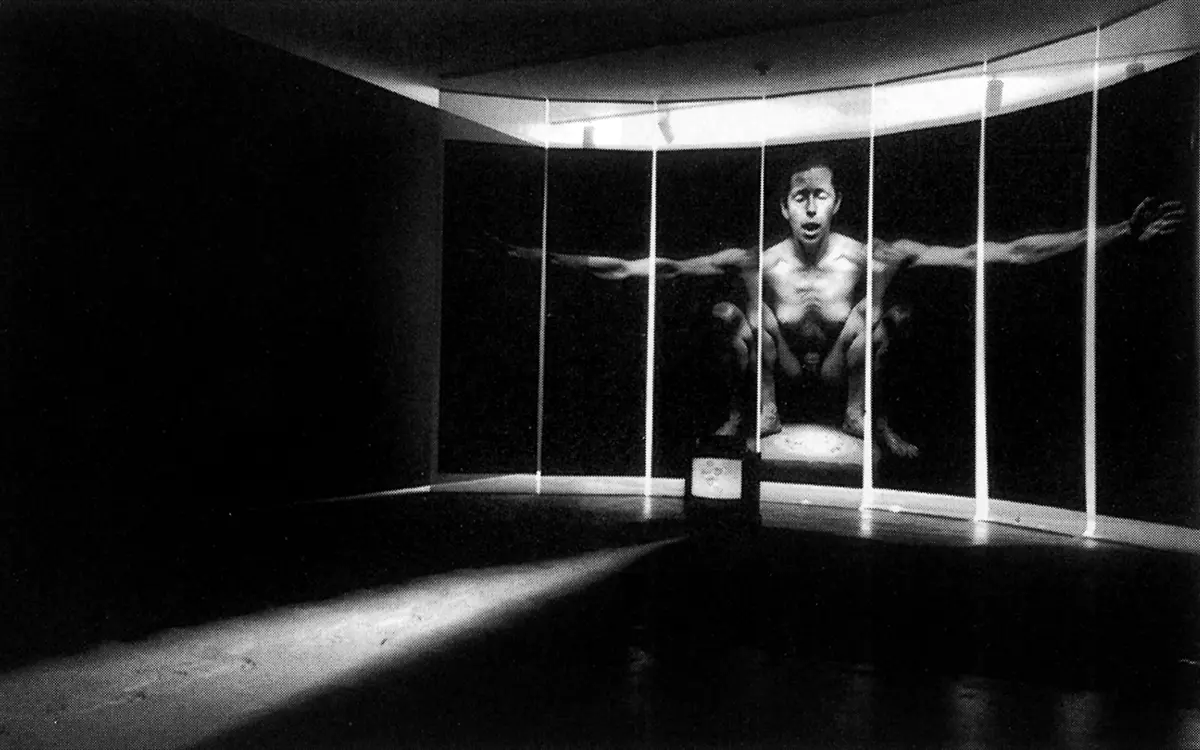
In this first retrospective of Suter's work in New York, which will go on to San Francisco, Pennsylvania, Austin, and Escondido, California, we can see that the artist has, throughout his career, tried to understand the relationship between image and temporality, whether as mythical history (as in his early work) or as a philosophical idea (in his more recent production). This is evident in one of his early series titled The photographic archive of Dr. Retus. This series of photographs that simulate impressions from the 1920s has to do with the way in which photography, and not so much its object, plays the main role in the mythification process. The invention of the figure Retus (the letters of Suter, written in reverse order) and the explanation accompanying the original presentation of this series (that these photographs were taken by this fictitious archaeologist in the 1920s) recall the historical processes of mythification of Meso-American archaeology which, like orientalism, had a major impact on the conception and understanding of the Meso-American past. From the images of Catherwood to Eisenstein's Long Live Mexico, the photography from the 1920s to the 1940s, and down to the melodramatic scenography of the Templo Mayor museums and the Museum of Archaeology of Mexico City, the indigenous past is traditionally seen through the lens of drama. Suter uses this history of historiography to look at the Meso-American past in a Borgesian manner: the past as the continuous evolution of our human memory, which erases, invents, and recreates freely, very much in its own way, and almost always against our will. On the other hand, in more recent works such as Binnacle, a mythical being (video projection) emerges from the darkness to perform a ritual act and then disappears. Its appearance, which has something phantasmal and mythical about it, occurs within an ambiguous space that is meta-historical, meta-spatial, and indefinable, like the space of memories.
Americas Society organized the Labyrinth of Memory exhibition. The show was presented at the Sculpture Center and the Americas Society. Throckmorton's was a parallel but independent exhibition organized by Throckmorton Fine Art.
PABLO HELGUERA