
Julio Zachrisson is one of the best-known Panamanian artists outside the country. His long artistic career, based mainly in Spain where he has lived since 1961, reached a high point recently when he was awarded the prestigious —and well-deserved— Aragón Goya Prize for his printmaking. Despite studies in Mexico, Italy, and Spain, as well as several prizes and exhibitions in Europe, the United States, and Latin America, Zachrisson has never stopped being a Panamanian.
His extrovert personality, accent, and his vernacular vocabulary reflect his origins, as do the themes he uses in his artistic work. He is an intense figure, who has traveled a lot, but who has never lost contact with his roots.
His fame was achieved in printmaking. The etchings, dry-points, and lithographs which he has created since the 1960s are a faithful reflection of his extraordinary technical ability and his febrile imagination. These surrealistic works, full of characters and stories, focus on subjects related to the literature, mythology, legend, and urban folklore of Panama. The careful drawing and detailed world of these prints filled with grotesque figures recall the links which exist between Zachrisson and the artistic tradition of Spain, such Latin American artists as José Luis Cuevas, and the social and political reality of Panama. The figures to whom Zachrisson has given life with his restless linework on the printing plate are vital, volumetric and sexual, both real and imaginary.
Zachrisson has also produced a body of work in paintings on canvas, which were last seen in Panama during his exhibition titled Pictorial Work 1984-1993 at the Museum of Contemporary Art six years ago. Initially, it was surprising to see the differences between the prints and the paintings. The oil works emphasized two-dimensional design and color rather than volume, with flat and intense colors, well-defined edges, and almost invisible brush strokes which left little evidence of the artist's intervention on the canvas. However, Zachrisson's humor and his relationship with Panama were still evident in these works. Visually, they recalled the molas woven by the Kuna Indians of San Bias, in which the bright colors seem to be superimposed on one another, creating borders that, like aureolas, repeat the initial form. In the same way, the deformed figures and the titles revealed the artist's sarcasm and customary themes. They included Eve, with her large snake; the hysterical figure of the woman in Terrified; the Kuna Witch surrounded by worms and candles; and the awkwardly seated woman in Mal sentada. The men represented in these works smoked, ate, composed, and played music. Nature was represented by the parrot (which in Panama is called Cazanga in the provinces) and the leaves of the Bixa, which in Zachrisson's case are used to wrap a woman, rather than something to eat, as in the dish of rice, vegetables, and meat wrapped in banana leaves, known as tamal.
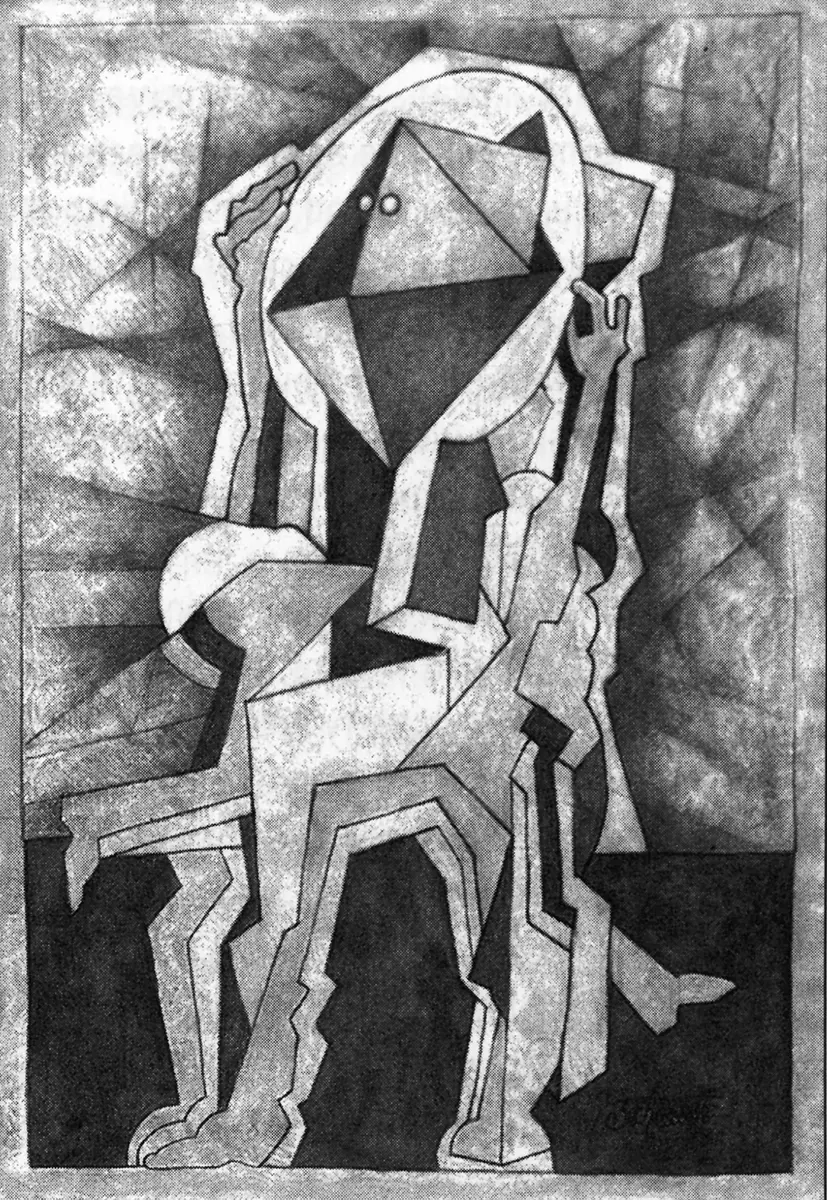
It is within the context of his career that the recent works that Julio Zachrisson presented at the Habitante Gallery in Panama City at the beginning of the year should be placed. The show consisted of a series of works in mixed media on paper, where once again Zachrisson surprised us. These were not large canvases, but colored drawings/paintings in small formats, almost of a personal kind. Although each work has a central element as in the previous paintings, everything is now more subtle. The formats are more intimate, the drawing more delicate and the colors more discreet. Once again we can see the artist's drawing skills in his linework and the use of chiaroscuro reminiscent of his prints.
In turn, the drawn backgrounds have acquired greater personality and participate more in the drama of the work; the figures no longer refer to specific stories but have become symbolic and timeless. In this series, Zachrisson seems to be paying tribute to the cubist tradition, playing with geometry and the prismatization of space, as well as with visual interpretation seen from various simultaneous angles. Several works also create a sensation of movement recalling the characteristic dynamism of futurism. One work in particular, composed of yellow and grey forms, includes a figure with a pyramid-shaped face, many legs, and angular forms which seem almost a parody of the synthetic geometry of Braque combined with the contained dance of Severini. This tribute to the art at the beginning of the century, and to geometry in particular, is interesting in the work of an artist who until now has explored human sensuality and organic forms within a surrealism of his own invention.
At first glance, the works in this show seemed rather dark and simple, almost anti-monumental within the context of this master's work. The populous and intriguing environments of his graphic work are absent, as are the bright tones of his oils. We cannot even see the white of the paper as Zachrisson uses a range of tonalities for his background. The works are now dominated by straight lines and colors such as ochre, grey, coppery red, and burnt yellow. Also absent are the titles that on previous occasions served to enhance the irony of Zachrisson's message. But perhaps they are not necessary since for anyone who looks carefully at the pictures face to face, the figures speak for themselves.
The Figures of this most recent show are not anecdotal but emblematic. In most of the compositions one or two figures appear in the center of the image, sometimes interwoven or with other beings or shadows behind. We slowly begin to recognize them. These schematic figures are riding horses, playing imaginary instruments, offering us forbidden fruits, and even joking with us. Their limbs are everywhere, with their hands playing a central and amusing role. They appear linked together or opened up, in an expression of surprise, sometimes holding up the heads of the figures, writhing with worry, searching for something, and lustful in cases where the erotic message of the hand play is obvious. Julio Zachrisson may have become more subtle, but he has lost nothing of his charm.
MÓNICA E. KUPFER