The African mentality is born out of a respect for spiritual power, wherever it originates, thus accounting for the openness of African religion to simultaneous practice with other traditions, syncretism, or parallelism. African culture was, and is, a constitutive ingredient in Cuba, many other Caribbean areas, and Brazil. The presence of the African mentality in the work of Manuel Mendive is a reflection of its flexibility, transformation, and perseverance over a long period of time. In Cuba, the synthesis of African religion and Catholicism was a survival tactic of the slaves who were brought to America under the harshest of conditions. Their strategies included the appropriation of elements of the new religion into their African sensibility. They also included the creation of new modes of visual expression, which were added to the already fertile array of ritual images, costumes, and objects brought by memory from Africa.
For today's world, Mendive continues to appropriate, transform and adapt the visual language of Africa as a strategy for conveying its rich mythology to a new audience that is less informed about its aesthetics. He brings a sensibility to each and every work that is as genuine as it is fantastic. Manuel Mendive Hoyo was born in Havana in 1944 to a family of Yoruba practitioners. Initiated as a Santero and Palero in the Santería and Palo Monte religions, his devotion to the spirits, called orishas, is the source of his imagery, and his understanding of African and other non-Western cultures informs his artistry. His work, in painting, sculpture objects, and interdisciplinary performances, involves a process of internalization of Afro-Cuban myths and constant exploration of their meaning as they relate to his life and that of the world around him.
With African and Santería mythologies and their colorful casts of characters as his inspiration, he creates his own Afro-Cuban mythology and a lush environment for their fantastic existence.
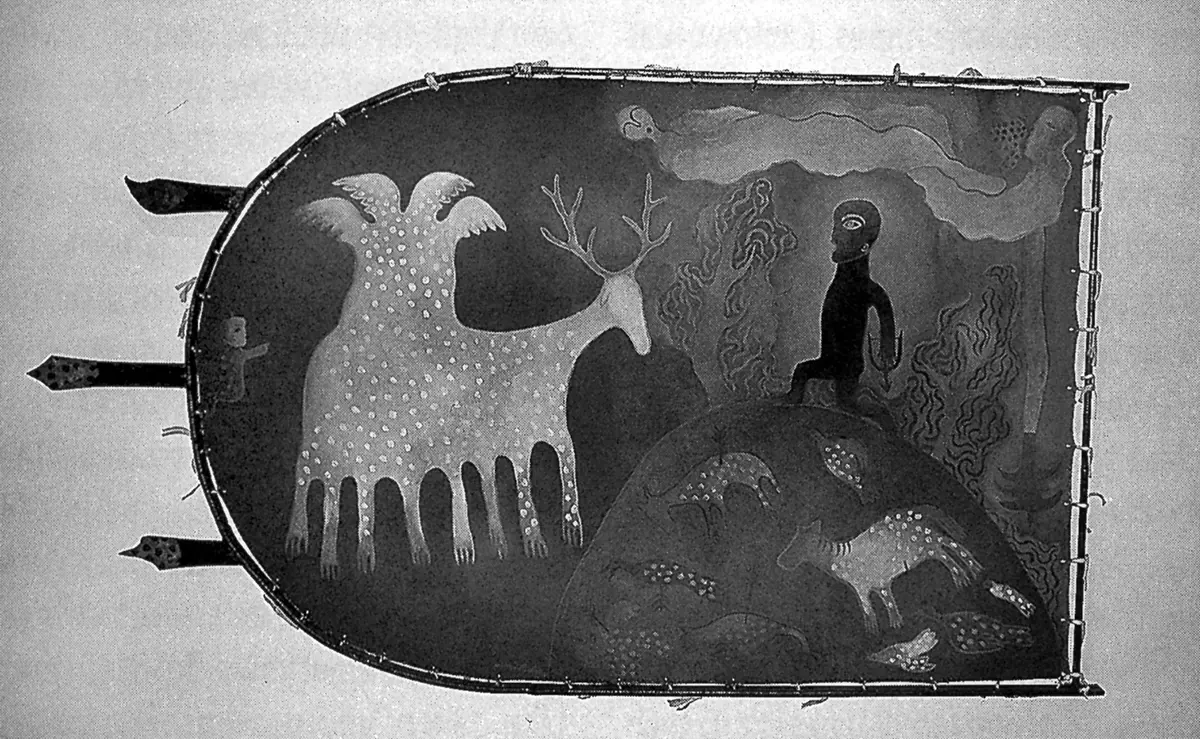
This syncretic environment acquires a particularly ritualistic and non-Western appearance with the addition of beads, stitches, patches of cloth, and cowry shells to surfaces often created from unprimed, unframed canvas, sometimes stretched with iron banding into unusual shapes. Each work is as much an offering as the objects that complete the story within its border and function as the embodiments of spiritual power, ashé. In Los Hijos de Yemaya, Cuando se Mueren se Van a Vivir al Mar (The Children of Yemaya, When They Die They Go To Live In The Sea) from 1998, the children of the goddess of love, maternity, and the seas, await their destiny with their mother below. Made of hammered metal, armless, and covered with the dots that are so familiar in his art, their earthly abode, shaped like a house, is made of metal also and pays tribute to the great metallurgy traditions of Benin. The dots indicate a spiritual presence and the transformative powers associated with the gods and their earthly helpers (shamans, possessed, initiates) and mimic the patterns of body painting, scarification, beadwork, and African cloth, as well as the pelt markings of the great felines. The hammered metal shapes recall milagros, small Catholic objects given in thanksgiving for a miracle to a special saint. Thus, the two traditions unite. The world of Yemaya is beautifully painted on a sail-shaped canvas in translucent blues of the sea, replete with swaying sea creatures and the anomalous armless shapes that represent spirits in Mendive's art.
The same translucent blues now appear often in Mendive's work. Earlier works were denser and packed with highly decorative creatures and images. In the works in this exhibition, his spirits are presented in a free and boundless space far more appropriate for their fascinating activities and the peaceful mood that reflects the artist's own personal countenance. Reflejos (Reflections) from 1998, brings the spirits of the land and water together in soft aqua tonalities that seem to provoke their transformation from flora to fish and fauna in the never-ending cycles of the world of the living and the dead.
Other paintings in the exhibition explore the magical and complex world of the orishas. Rooted in the Yoruba religious vision and Mendive's own personal experience of God, they portray the values of the Afro-Cuban believers, especially the ashé that is present in the human line of continuity with the past and imparts spiritual strength.
This exhibition also featured a few of Mendive's sculptures, richly textured with the addition of cowry shells and patinated surfaces that resemble the remarkable bronzes of Africa. Two monumental painted wooden chairs pay homage to the thrones of African royalty, but with the artist's personal interpretation as male and female entities that reveal a sense of humor dwells in the magical land of the orishas, where peace and happiness will prevail, if humanity would only pay attention.
CAROL DAMIAN