
Throughout her career which began at the end of the 1970s, María Teresa Pardo has explored various possibilities in the medium of sculpture. Each period in her work reflects her interest in texture and the relationship objects establish with the space they occupy. This was the case during her residence in Barcelona in 1989 when she studied at the School of Fine Arts at the University and undertook a project titled Journey, consisting of two installations that anticipated some of the characteristics of her current work, titled Memory, presented last April in Room No.1 of the National University Museum of Art in Bogota. These common elements include the use of sound (on this occasion the sounds made by whales), the darkened atmosphere of the exhibition room, and the presence of little boats, which could also be seeded, made from plaster.
In both works, there are a number of motivations of a romantic kind, the result of a feeling for nature that María Teresa Pardo shares with those early nineteenth-century figures who suffered the effects of the radical separation which culture and Western forms of life made between nature and man. But unlike those figures, who conceived of nature as an absolute and eternal force, a supreme, infinite and omnipotent entity, María Pardo is fully aware of nature's fragility and the threat of its imminent destruction. Her current work is imbued with romanticism in various degrees, and in this sense can be seen as a celebration of nature. But it also constitutes a possible memory of something that belongs to the past, since nature may well cease to exist in the future, its presence identifiable only in the marks it has left behind.
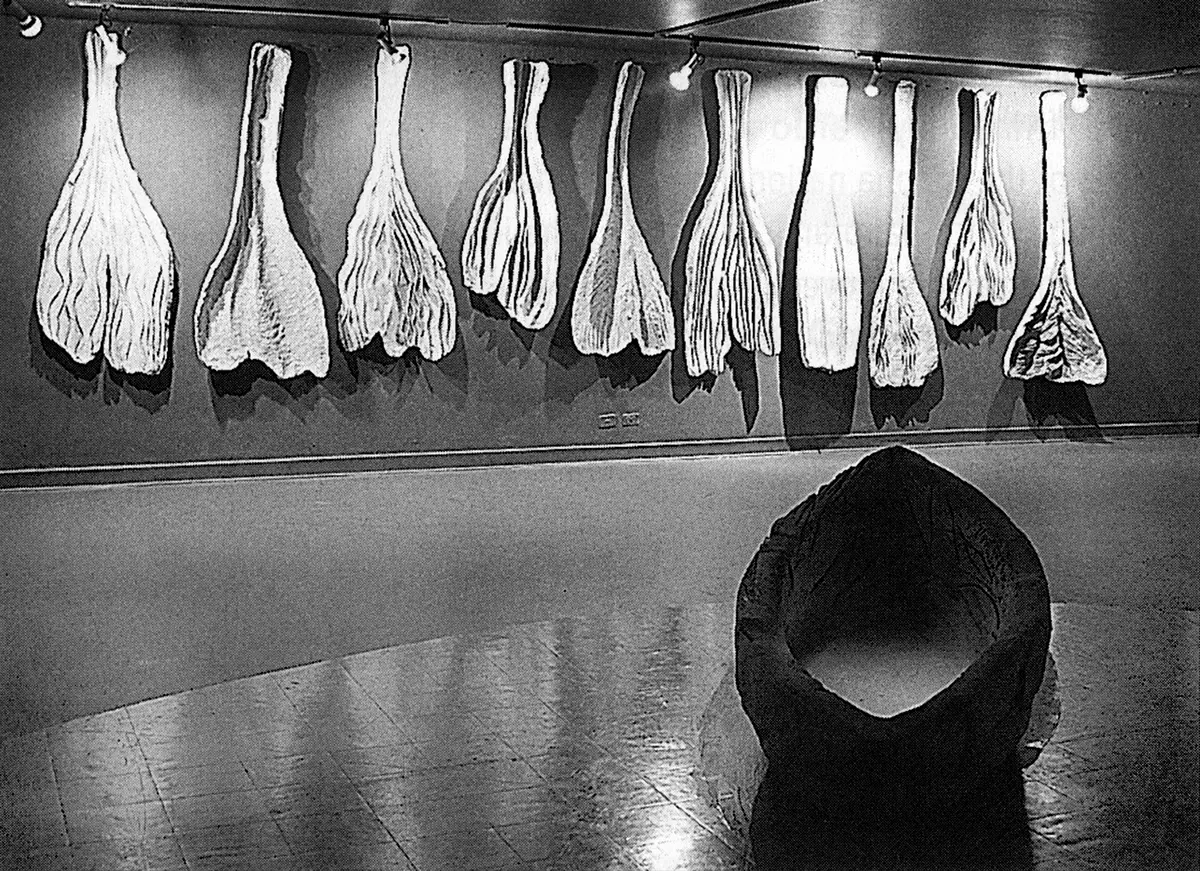
The installation was presented in a rectangular space; the walls and part of the floor were painted a dark matte grey, which helped emphasize the atmosphere of penumbra achieved through the lighting directed on the ten pieces that rested against the wall at the back of the room. Each piece was of the same height as the wall and was constructed in reinforced mortar technique-a slow and laborious process. The form and texture of the eminently organic-looking pieces were achieved during the modeling of the clay. Given the size of each piece, this process requires the use of spatulas and considerable manual effort involving the weight and movement of the body. The works, therefore, reflect the gestures of the artist and all the experience she has acquired throughout her career in the handling of her materials and forms. The works have the natural color of their materials, although pink and sometimes lightly greenish tones appear, and were set out according to a specific rhythm that played on the length (sometimes concave and sometimes more convex) and volume of each piece.
In a slightly diagonal line, a short way from the works, the artist placed a boat on the floor made from what seemed to be the same kind of material, but much lighter. Its main function was to house within it the images. of a video divided into two 15-minute segments. The first showed aquatic images filmed by Pardo on the beaches of the Tayrona national park, beginning with a panoramic view of the sea. The camera moved gradually in to film the birth and death of a wave on the sand-a sequence repeated over and over again and interrupted with the images taken with a fixed camera of the movement of the fresh and crystalline water of a river revealing the life flowing through and living in it. After these images, the video returned to the wave coming in and receding. At the end of the fifteen minutes, the image fades away while the sound of the sea, which has been constant throughout, falls and becomes a distant background music to the song of a huitoto native imploring the land to recover its vigor after the harvest. The only visual image remaining in the video shows a flood of violet light on the boat; after another fifteen minutes, the scene returns to the initial image.
The visitor to the room heard the distant sound of water from far off, inviting him to enter. Once inside the room, he was submerged in an atmosphere in which the sound ceased to be a rumbling and became an overwhelming presence of water filling the room. Depending on the position of the spectator, different experiences were possible. From the corner of the boat, the water could be seen flowing constantly over it, while from the wall at the back, the enormous shells seemed to come together in their undulations with the to-and-fro movement of the waves, the oscillating movement of time, with the surface texture and form revealing the constant passing of the water as a source of life and transformation. Many visitors remained for a long time looking at only the video, which itself offered a complete experience. Those who went over to the wall were able to experience at first hand the impressiveness of the materials used, and the density and weight of each piece, which could be read as kinds of fossils or shells preserving the marks and vestiges of a life which no longer existed, presences whose forms and surfaces bore the imprint of time-one of the principal themes of the installation (memory as the recollection of material vestiges). Pardo's installation gave expression to one of the dictionary's definitions of memory: the faculty of the mind to retain and remember the past.
MARTA RODRÍGUEZ