
The sculptural vocation of María Teresa Torras was reconfirmed by the fullness of the installation titled Code X recently presented at the Sofia Imber Museum of Contemporary Art of Caracas. The volumetric nature of each element was given special emphasis and made a substantial contribution to the comprehensive and organic whole in which the individual elements and overall synergy co-existed in an astonishing manner. For me, this was the first and most immediate quality of this work, where the artist does not see the installation as a practice different from that of sculpture. It is a combination on a monumental scale of the monumental elements brought together.
María Teresa Torras uses this aesthetic to give her pieces, and the work as a whole, an abstract dimension, and a symbolic nature. There are no anecdotes or allusions here, no torturous concepts or esoteric speculations. There are instead sensibilities and intuitions combined with the qualities of discipline and craft to create impressive plastic resonances and the existence of very plural perceptive effects. To all this, we must of course add the vigorous formal temperament that has always characterized her works, as well as the emblematic dimension that is a constant feature of her proposals.
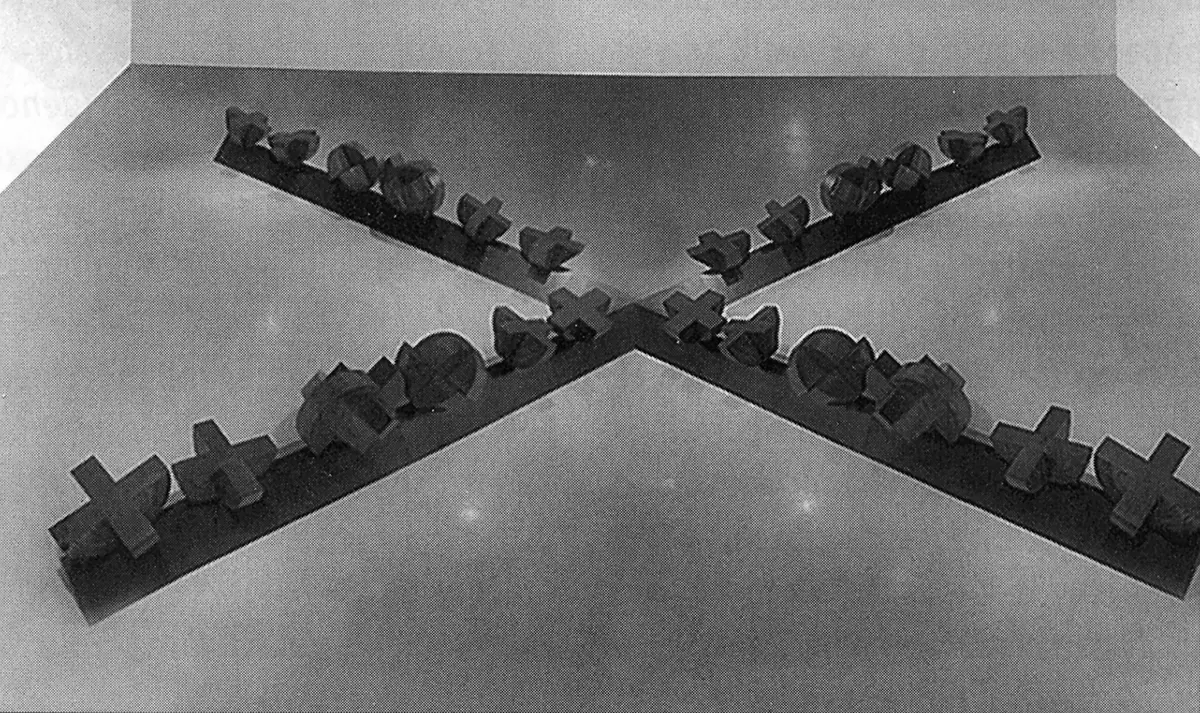
At the descriptive level, mention must be made of the various kinds of plastic interplay suggested by the work. The installation has the virtue of moving simultaneously at two extremes which —over and above their apparently irreconcilable nature— come together into a single resolution. As a means of emphasizing this ambivalent encounter, Torras formally marked out an enormous "X", measuring 144 square meters, that had a certain minimalist intention about it. However, on the arms of this geometrical and rectilinear element, she placed thirty-two modules (8 double and 16 single) which were combined in various ways. Each module could be seen in terms of its separation from its original cylindrical forms. Thus the perception of the modules resulted in curious combinations and multiple profiles, where the flat and curvilinear elements were combined to produce simultaneous effects of quietness and movement. These proposals were based on a curious constructive sensibility. There was thus an interesting contrast between the schematic nature of the base X and the structured modules for which it served as a support. Each code, therefore, eliminated its differences from the other, the result being an organic coherence in the composition as a whole.
The ambivalent dimension of the installation was also evident in other significant respects. The stable and restful quietness of the X-axis was accompanied by the dynamic sensation generated by the intertwined and fragmented cylinders which seemed to roll on the axis provided by the base. The effects of stability and dynamism thus combined and stimulated the curiosity of the spectator. There was also a symmetrical element, represented in the equally balanced cross, which was complemented by the asymmetrical elements of the distribution and the particular nature of each module. Within the framework of this multiple interplays of sensations and perceptions, the cold and aseptic appearance of the X ended up becoming a kind of monorail on which the elements could move around. This combination of suggestions gave the resolution a ludic aspect that was further strengthened by the intersection of circles and X-forms that ceased to be contradictory and became fused in each model. This encounter of opposites thus became the synthesis of a paradox: each element is what it is as a consequence of being two things at once, two things which furthermore seem to be the origin or destination of each piece. This ambivalent interplay can also be expressed in another way: an X is not round but can become so through the cleverness of design.
But beyond the ludic dimension of the project, there was a symbolic element that characterized the installation as a whole. This quality was clearly identified and explained by María Luz Cárdenas when she said that the work of Torras is based on the "intersection and integration of space and time. However, an X is made up of four moments, and the number four has a strong symbolic association, since it recalls the ordering of the cosmos at the mystical level and integrates the active and passive principles. The original elements of creation were four in number (earth, water, air, and fire); the points of the number also number four (east, west, north, and south); the moon has four phases (full, waxing, new, and waning); there are four seasons in the year (spring, summer, autumn, and winter), four times of the day (dawn, midday, nightfall, evening); there are the four ages of life (childhood, youth, maturity, and old age); and according to Jung, the psyche has four functions (perception, intuition, feeling and reflection)."
We might say that the concepts of simulation and dissimulation, as well as those of play and symbol, acquire the status of legitimacy since the presentation of contrasting elements side by side, without discarding the opposition between them, is the supreme affirmation of the symbolic. For this reason, a symbol always generates and results in a high level of tension. Torras is not interested in the origin or the consequence of these effects; what interests her is that the starting point and the final resolution should be deliberately fused into a single aesthetic effect. Indeed, all the elements of her work are condensed into what we might call a ludic and lucid geometry, where the signs are transformed into the symbols of a supreme paradox: to say a lot, without claiming to say anything at all, or to encourage silence by saying many things.
VÍCTOR GUÉDEZ