
In the Buenos Aires artistic scene, it is already a well-known fact that even has its own mythology: the originality of the artists who presented their work in the Rojas Cultural Center at the beginning of the decade became all the rage.
In 1989, in a corridor that led to the auditorium of the Rojas Cultural Center —an institution that depends on the University of Buenos Aires— the artist Jorge Gumier Maier began to organize exhibitions of artists he had met during their shows in discotheques and bars.
During the eight years he worked in the Rojas Center, Gumier Maier transformed the corridor into a gallery and its artists into a venue for contemporary Argentinean art. The general curatorship was both capricious and sufficiently impressive to achieve legitimacy in the gallery circuit, unity in terms of critical discourse, and followers everywhere. Simplifying things a little, we can describe the process as a tendency that exalted kitsch and domestic-oriented aesthetics, and the affirmation of art as a deviation from meaning, as a place for the beauty of little things.
However, the Rojas line was not so dogmatic, although the shows also included artists who had distinguished themselves in the sixties for their political militancy, such as Pablo Suárez or Roberto Jacoby and some other artists who work in a more decorative and precious fashion like Marcelo Pombo and Benito Laren.
Though it did finally manage to conquer some legitimate spaces, including some at the commercial level, the art of the Rojas Center was in the beginning labeled pejoratively as "light" art. "Light" here for the critics meant devoid of any political passion or demonstrating a lack of commitment to the problems of the time. Gumier Maier dealt with his opponents by asking himself with elegant irony, "Why this insistence on reducing artistic things to a sensitive, intelligent, and alert activity? Does that not confuse it all with a consulting agency for the study and understanding of the contemporary world?"
At the end of 1997, at the high point of his career as a curator, and had just presented a retrospective show of Rojas art titled The Tao of Art, Jorge Gumier Maier resigned from his post. His successor was Alfredo Londalbere, also an artist, who is currently coordinating the programs of the gallery.
The show that Román Vitali (1969) presented at the Rojas Center in April is the second of this artist from Rosario at the gallery. The first was curated by Gumier Maier himself. This new show corresponds to the second stage of the gallery, but it had the quality of representing one of the most brilliant aspects of a tendency or style that seems to be on the point of exhaustion, or at least dispersal.
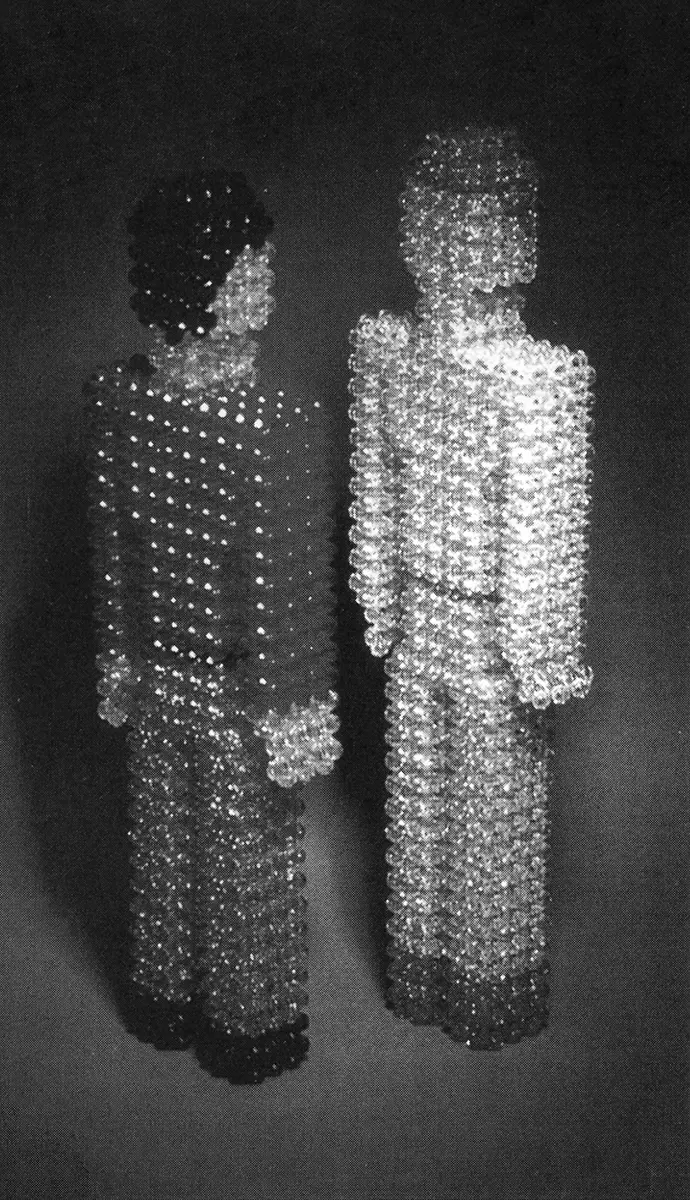
For a number of years, Vitali has been working almost exclusively with two materials: plastic beads and lights. The beads are little plastic balls of translucent colors which, sewn together, are used to make jewelry. Vitali transformed this material into a delicate and obsessive technique: threading the beads like a craftsman until he achieves the formation of a textured and brilliant mesh that materializes ideas and above all emotions.
Among figurative works, he presented a small and delicate house that irradiated light and from which emerged, like hairs or flashes, threads of brilliant optical fiber. There was an enormous vase on a table, with bulky red flowers, almost deco style —clearly one of the laws of the material is that in general, the sewing results in a certain geometry in the design— a line of cypresses swayed by the figured arrival of a gust of wind which left all the tops twisted; a large celestial tear, and a red drop, the size of a head, in staggered design.
Each of these figures seems imbued with its own intensity. The small house immediately makes us think of a catastrophe, the vase assumes and exalts its decorative character, and the line of trees is, despite its delirious artificiality, tremendously melancholic and evocative.
One of the new elements in the show was the inclusion of a series of works that depicted figures in a critical state. The Problem shows a woman with her head on fire, in which the flames invade her skin and extend over her face, like red stains on the wall. The Promise presents a woman with her hands in prayer, standing on a little pedestal facing a circular mirror. Her hair is made of strips of small yellow beads which fall like a veil six times longer than the body of the woman. There is also a figure of a man whose body is covered with heavenly down from which very long transparent threads emerge like electrodes or some strange piece of medical equipment.
In each of these works the drama is the result of excess, and the subject seems to be diminished by the excessive proportions of the drama. However, everything has a quiet tone which is more sad than catastrophic, with the delicate form of a jeweled object. It is here that the ambiguity of the operation lies: even in the most abstract works, such as the fluorescent tubes smothered in colored beads, the strategy is to seek expression through adornment, that is, through an idea of party-style beauty that loses its ingenuity as Vitali gradually endows it with the form of tragedy.
INÉS KATZENSTEIN