
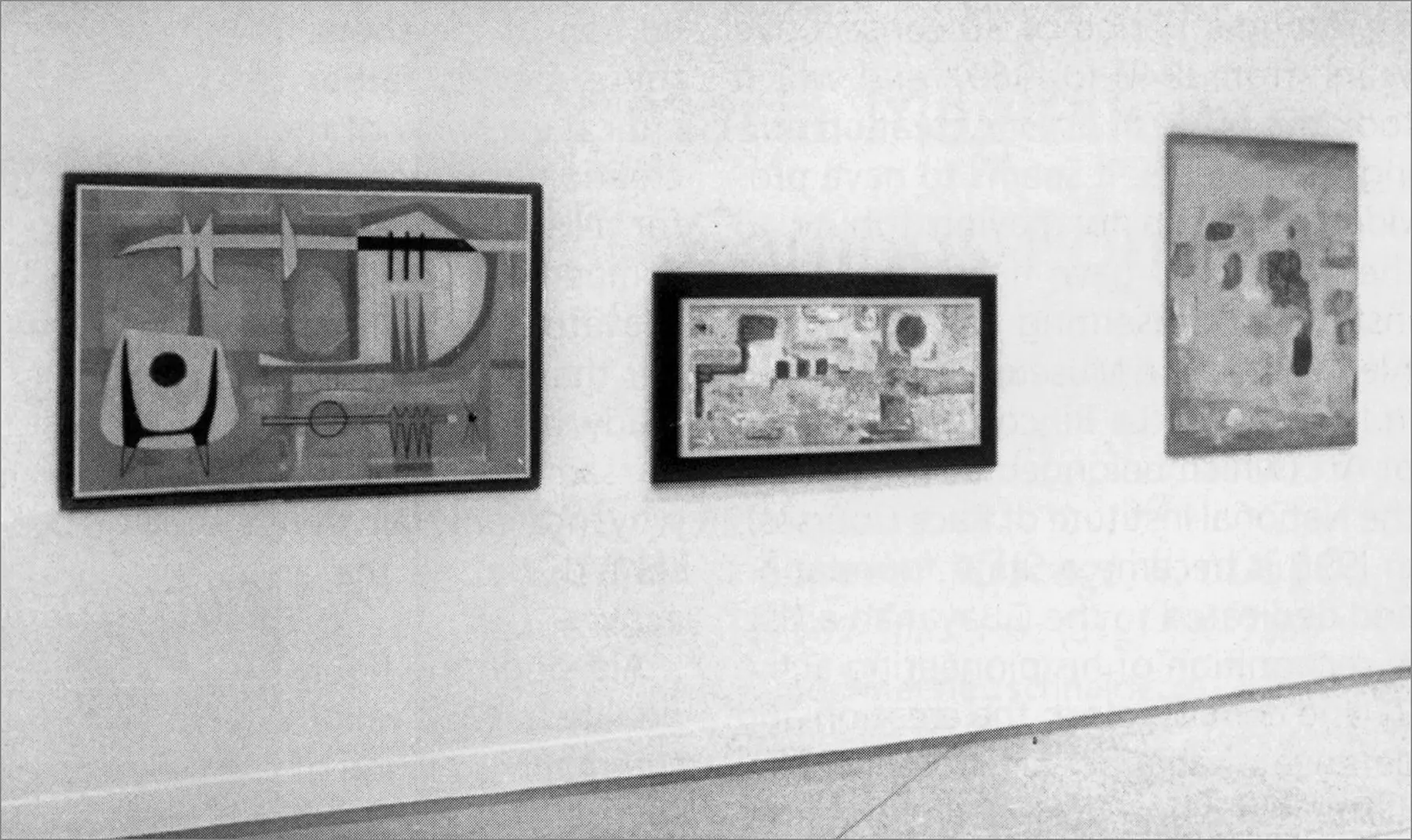
Between 18 October 1998 and 14 February 1999, the Alejandro Otero Museum presented an exhibition entitled Art in Freedom. The 1958 Salon. According to its organizers, the show, which was a version of the XIXth Official Salon presented at the Museum of Fine Arts of Caracas in 1958, was an attempt to commemorate "the restoration of political democracy in the country and the granting of the National Prize for Painting to Alejandro Otero" on that occasion. The curator of the show, José Antonio Navarrete, merely indicated the simultaneous nature of the fact, but the title was rather tendencious, and some press reviews referred to the idea that before democracy artists did not enjoy freedom. Although artists certainly protested at the time against the composition of the membership of the Prize jury, which was increased in number and able to understand the new art, it cannot be assumed without qualification that the prize awarded to Otero was the result of the restoration of democracy when in fact the discussion on the subject was focused, not only at the time but for many years before, on specifically artistic problems.
Abstract art (which was produced furthermore by the same artists who participated in the Salon) had already been recognized in the country since at least 1955 when on the initiative of Carlos Raúl Villanueva, it was included on the walls of the University City. It would seem that progressive dictatorial regimes not only do not reject art that is exclusively focused on the plastic investigation but are actually sympathetic to it.
Although this is not the place to discuss the problem of the late recognition of abstract art in the Salon, it is worth noting briefly that between approximately 1949 and 1956 the management body of the Museum had carried to the extreme in all its activities (including the Salon) the conservative attitude which had characterized it from the beginning. So that it was only as a result of the interference of and pressure brought to bear by some young artists, such as Otero himself and other colleagues from the time, as well as the architect Villanueva (who in 1951 joined the Conservation and Promotion Board of the Museum), whose vision of art was very different from that of other members of the Board, that the Museum presented in 1955 a few exhibitions which were unusual for the period, such as those of work by Alexander Calder and Wifredo Lam.
In 1958, with the replacement of Carlos Otero by the young painter as director of the Museum, the incipient constructivists hoped for a new attitude towards their production by the institution. Apart from the difficulties which may have been caused to the members of the jury by the previous attitude of these artists (who had reviled and boycotted the Salon for a number of years), what is certain is that the problem seems to have come from a kind of negative view of youth by the institutions themselves, a view which highlights the fear of change which was very deep-rooted during those years in the power circles of Venezuela. The Student Section of the Salon enabled students to show their work alongside that of older artists, but the very existence of such a separate section was itself indicative of their marginalization. Although the intention of the scholarships granted by the Ministry of Education from 1945 (it was on one of these scholarships that Otero visited Paris at an early date), as well as of the National Prize for the Plastic Arts, set up in 1947 for new artists, which stipulated that the artist had to remain in Europe for at least three months, was undoubted to allow young artists to come into contact with the European artistic scene, the fact that such artists remained distant from the national artistic context for a prolonged period of time seems to have been considered as something disturbing by the institutions. In fact, the prizes awarded in the Official Salons during the period, when a large number of young artists were outside the country, reflect the sharpening of the retrograde trend in these events.
However, if the idea was to free the country of dissident voices, it must be concluded that in the end, this was counter-productive since in Europe the artists opened up their eyes to the new possibilities of artistic expression and were able to experience there a real kind of dissidence, with manifestos and the like. The Museum of Fine Arts and the art Salons were the main targets of their insults. But it was not all protest. One of the objectives of the magazine they published at the time (Los Disidentes, 1950) was to reflect on painting and defend abstract art. In particular, the ideas of Alejandro Otero on abstraction would directly reach the public through the debate unleashed in 1957 between Otero and the writer Miguel Otero Silva and published in the newspaper El Nacional.
It is important to note that after the arrival of Barrios as director and then under the administration of Miguel Arroyo, things changed in a very favorable manner at the Museum.
One of the functions of a museum is to study the process of artistic creation in the light of its collections. Amongst other things, this exhibition was an attempt to study the emergence of abstract art in Venezuela in the context of a periodic event (the Annual Official Salon of Venezuelan Art), which was presented in the country during a period of 30 consecutive years (from 1940 to 1969), and which took the pulse of artistic creation during those years. It seems to have provided a reason for paying tribute to the artist who gave his name to the institution presenting the show, the Alejandro Otero Museum. Inaugurated in 1983 as the La Rinconada Museum of Art (which belonged at the time to the National Institute of Race Courses), in 1990 it became a State foundation and was dedicated to the Guayanan artist, in recognition of his pioneering activity and central role in the creation and defense of abstract art in Venezuela.
The exhibition itself seemed a little limited - occupying just one room. Apart from the fact that the intention was not to reproduce the Salon itself, the curator explained this limitation by the difficulty of obtaining the works forty years after the event. Beautifully and harmoniously installed, according to the original montage at the Museum of Fine Arts, along the lines of the new museography established by Barrios, the works appeared to be organized by tendencies, beginning with the figurative works and ending with the abstract pieces. At all events, the selection gave an adequate vision of what the Salon was, as well as the intention of the new presentation, focused above all on studying how new proposals emerged and became consolidated in a traditional context, and the recognition, in terms of prizes, of abstract art for the first time in the country, very late after other developoments in Latin America. The curator emphasized the heterogeneity and eclecticism of the acceptance of works in these National Salons, something which was quite clear in the 1958 event, as well as in this summary edition of the show. This meant that these events, rather than offering a critical overview of the state of plastic creation in the country, were "a place for all national art, (that is to say), a compendium of works in competition" (Navarrete, 1998). If we also remember that so-called "naive" art had already been recognized, including in the same Museum, we can understand why not only all trends were represented, but all the artists who were active.
Although the figurative/abstract art debate has lost validity nowadays, this summary re-edition of the Salon which focused on the problem reveals the tremendous importance it had at the time. In the same way, we can see that the works of a good number of our abstract-constructivist artists, those which would continue to defend their proposals to the final consequences, did provide an impulse, a resplendence and a freshness which were absent from the figurative artists. Works that we might consider embryonic had a brilliance that perhaps all nascent art has (or everything that is newly born). But as regards abstract art, perhaps it would not be too unreasonable to note that it has a notorious tendency to age quickly, as in the case of the pioneers of abstract art in Europe and their followers. The strength, emotion, originality, and purity of the first manifestations of constructivist abstraction (in the works of Mondrian, Tatlin, Pevsner, and Gabo, as well as Malevich, including such pure and spare works as White on White, circa 1919) could not be equaled, not to say superseded, in many of the variations on abstraction proposed by artists after the Second World War. It was not in vain that many of the groups of Latin American artists felt that they had to give a personal twist to constructivism, as in the case of Torres Garcia, who combined pure constructivist elements with humanistic ones. The brio and splendor of the works of the incipient constructivist artists in Venezuela perhaps lie in the wonderment felt at these new creative possibilities, which seemed so marvelous, and in the passion with which they began to explore them. While Pascual Navarro, Elsa Gramcko, Oswaldo Vigas, and others still used traditional oil on canvas, many others were experimenting with new industrial materials: spray technique on wood or masonite (Omar Carreño, Daniel González, Alejandro Otero), casein on wood (Gerd Leufert, Mateo Manaure), acrylic, plexiglass and wood (Jesus Soto). The sculptors, including Pedro Briceño and Víctor Valera, who won the National Prize for Sculpture at the Salon, contented themselves with working with sheets of iron, a material which they would continue to use down to the present, while Gego's sculpture, a kind of loop in aluminum strips, announced the spatial developments of an undeniably fluid and dynamic kind which would lead her to weave nets in real space.
Although these artists would in the future take their own decisions and risks, one of the things which seem to be a special characteristic of a good deal of abstract-constructivist work in Venezuela is its tendency, from the beginning, towards dynamism. There is no static vision of abstraction in their work. This aspect in a sense reveals a difference with many of the abstract artists who, in Paris, were supposedly those who inspired this new trend. Our artists viewed space not as an area in which forms and space interpenetrate, but as a place where forms engage in a play according to certain rhythms: they contract or expand (Carlos Cruz- Diez), appear in groups which seem capable of displacement (Mercedes Pardo), become inclined and appear between other forms (Alejandro Otero). In his Kinetic Structure of Geometrical Elements (1955), Jesus Soto highlights the importance of space in his kinetic investigation: initially a real space, since it brings into play, on two separate planes, the linear forms of a sheet of plexiglass and those of background plane.
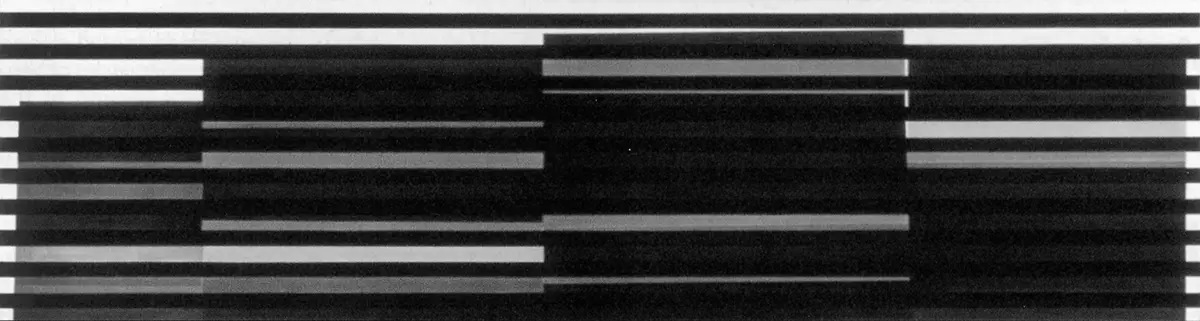
The prize awarded to Coloritmo 36, which was made by Otero in 1958, although late, shows that recognition could no longer be withheld at the official level in Venezuelan culture of the new conceptions of art now that the century had passed its halfway mark. This series, which was begun three years before, reveals a sense of abstraction based on a vision of reality that is no longer related to the agrarian world and its measurements of the land, according to the theories of René Huyghe (1972, Vol.ll, p.20l), but to the ideas generated by the modern scientific and technological world. Alejandro Otero developed this dynamic and spatial concept which he had already foreshadowed in his Coffee-pots and in which rhythm and energy play a fundamental role.
BIBLIOGRAHY
1. Arte en libertad. Salon 1958 (study guide No. 16), Alejandro Otero Museum, Caracas, 1998.
2. Huygue, René, El arte y el mundo modem, Madrid, Planeta, 1972
3. Navarrete, Jose Antonio, "Cuatro notas leves", in Arte en Iibertad, op.cit. (in press).
IRIS PERUGA
Licenciate in Visual Arts, Central University of Venezuela. Councelor and research scholar at the Museo de Bellas Artes, Caracas.